


By ALEXANDER DOLITSKY
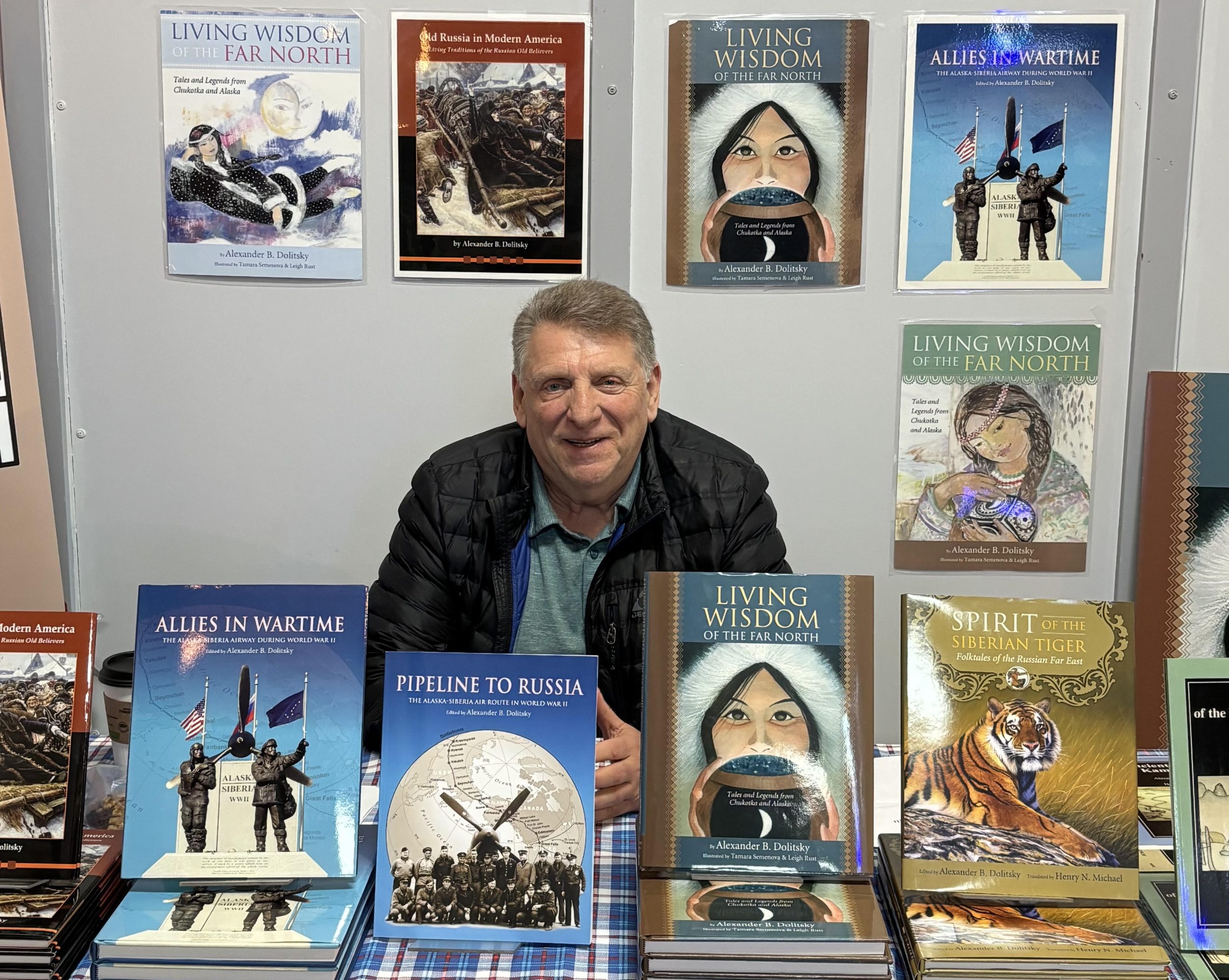
July 25, 2026 – Meeting diverse readers at my weekly book signings at the Hearthside Books in Juneau often leads to profound, unexpected connections, such as a 45-minute conversation with a German-American visitor named Boris that inspired me to write this story.
The Threshold of Memory
Beneath the soft lights of Hearthside Books & Toys in Juneau, Alaska, the weekly ritual of the author’s book signing table becomes a theater of passing tides. To sit amidst an array of eight bound spines (titles)—chief among them the collectable chronicle Allies in Wartime: The Alaska-Siberia Airway During World War II—is to invite the world in fragments. Not every passerby comes bearing the coin of purchase of my titles; some seek only the coordinates of the local galley or the quiet relief of a hallway, their transient needs dissolving into the ambient hum of the shop.
The Interlocutor, bridge for dialogue
Yet time, elastic and unpredictable, slows when the right stranger appears. He came mid-way through an ordinary afternoon—a man in the autumn of late middle-aged, bearing the quiet, intelligent gaze of one who reads the world closely. He approached my book signing table; when our conversation inevitably turned toward the iron tracks of the Second World War, the air between us shifted.
He called himself Boris. He spoke with the careful weight of a dual citizen, carrying the spiritual geography of both America and Germany. He confessed that the legacy of that war cataclysm was a ghost he rarely dared summon, his own lineage shaped by the jagged shrapnel of history’s great fractures.
Listening to him, I felt the pull of my own genesis—born and raised in the ancient, scarred heart of Kiev, within the vast shadow of the former Soviet Union. My family, too, had inherited the silent, lingering tremors of that global war-storm; its long shadows stretching quietly across the map into my own days.
For three-quarters of an hour, the practical commerce of the bookstore fell away. Potential readers drifted past the perimeter of the book-signing table like unanchored boats lost at the sea, perhaps put off by our absorption. But the forty-five minutes shared with Boris could not be measured in sales or lost transactions. It was an unspoken communion of dual histories, heavy with emotion, which now demands its own transformation into fiction story.
The Echoes of a Shattered World
The rain tapped against the old cafe window in a quiet European border town, the sky was crying, blurring the neon lights outside into soft, bleeding smears of red and yellow. Boris, a German man with kind, tired eyes and a coat smelling of damp wool, sat across from Alexander, a Russian Jew whose face bore the unmistakable, chiseled lines of an eastern lineage. They were strangers an hour ago, bound now by a shared bottle of wine and the strange intimacy that comes from realizing history had chewed on both of their bloodlines.
“My father was named Alexander,” Boris murmured, tracing the rim of his glass. “Named after my grandfather, a ghost he never touched. My grandfather, Alexander, vanished into the white, howling furnace of Stalingrad Battle in the winter of 1942-1943. He was just a body swallowed by ice of the Russian brutal winter and relentless fire of the Russian artillery.”
“In the postwar years, our home in Dresden was hollow; the city suffered catastrophic destruction during the Allied firebombing in February 1945. It wasn’t just the rubble in the streets; it was the heavy, suffocating silence of a missing man,” he sighed deeply.
“My grandmother and mother bore that absence like a physical wound. And yet, decades later, my mother chose to name her own children with soft Russian sounds, as if seeking absolution from the soil that took her father,” Boris consummated.
Alexander looked down at his hands. The lamplight caught the silver flash of his watch. “History plays strange, cruel music,” he said softly. “My name is Alexander, too. I was named after my uncle, who was slaughtered right in the heart of Kiev in 1941 by Ukrainian collaborators working alongside the German SS—Nazi police and military apparatus. They took my grandfather, Roman, as well, dragging him into the public square in Kiev and executing him before a terrified city.”
A brief silence hung in the air. “My father’s name is Boris, just like yours,” continued Alexander. “He fought in the Red Army from 1939 to 1947; got badly hurt in the legs in defense of Moscow in the winter of 1941, and later moved to Siberia by Lake Baykal.”
Alexander’s voice dropped to a whisper, pulling up memories passed down like heirlooms of grief. “My grandmother never put another ring on her finger. She lived out her days in the same crowded apartment with us in Kiev, wedded to a ghost. During the war’s first three years, my mother aged quickly from hard work in a Gorky (today Nizhny Novgorod on the Volga River) military factory after fleeing Kiev in July of 1941.”
“Yes, both of our grandfathers and parents were swept into a mechanized madness,” concluded Alexander. “If Europe had not caught fire, if that single catastrophic war had not erupted, they would have grown old in their gardens. They would have taught us how to fish, how to laugh, how to love without a shadow, offer care freely. Right?” Alexander whispered, barely audible.
Boris nodded slowly, his gaze locking with Alexander’s. Across the table, the invisible weight of two shattered family trees rested between them—not as enemies, but as joint survivors of an unpreventable avalanche, a sudden disaster that was bound to happen and could not be stopped.
Connection to the Black Swan Theory
The Black Swan Theory events is a metaphor that describes an event that comes as a surprise, has a major effect, and is often inappropriately rationalized after the fact with the benefit of hindsight. The term arose from a Latin expression which was based on the presumption that Black Swans did not exist. The expression was used in the original manner until around 1697 when Dutch mariners saw Black Swans living in Australia. After this, the term was reinterpreted to mean an unforeseen and consequential event.
World War II functions as a classic Black Swan event—an unpredictable, high-impact shock that shatters normalcy and is only rationalized in hindsight. The personal tragedies of Boris and Alexander illustrate how massive, systemic outliers cascade down through generations, fracturing domestic lives in ways no prior routine could foresee.
The outbreak of World War II in Europe and its brutal escalation on the Eastern Front functioned as a macro-level Black Swan. To ordinary families in Kiev (USSR) and Dresden (Germany), the total collapse of societal order was an “unknown unknowns” or extreme unpredictability that invalidly smashed normal life trajectories. “Unknown unknowns” are phenomena which cannot be expected because there has been no prior experience or theoretical basis for expecting the phenomena.
The theory dictates that such cascading events dictate history rather than follow it. The deaths of the grandfathers at Stalingrad and Kiev were low-probability, high-consequence shocks that completely restructured decades of domestic existence—causing single motherhood, lifelong mourning, and altered familial naming traditions.
The author was born and raised in the former Soviet Union before settling in the U.S. in 1978. He moved to Juneau in 1986 where he taught Russian studies and Archaeology at the University of Alaska Southeast, and Social Studies Teacher at the Alyeska Central School of the Alaska Department of Education. From 1990 to 2022, he served as a director and president of the Alaska-Siberia Research Center, publishing in the fields of anthropology, history, archaeology and ethnography. Find him on Amazon.com.

3 thoughts on “Alexander Dolitsky: Echoes across the decades”
You are a fantastic writer and historian, Alexander. Now, please give us your assessment of the American/Iran war, and Russia/Ukraine influences and connections to that war. Thank you.
Connection to the Black Swan Theory
The Black Swan Theory events is a metaphor that describes an event that comes as a surprise, has a major effect, and is often inappropriately rationalized after the fact with the benefit of hindsight. The term arose from a Latin expression which was based on the presumption that Black Swans did not exist. The expression was used in the original manner until around 1697 when Dutch mariners saw Black Swans living in Australia. After this, the term was reinterpreted to mean an unforeseen and consequential event.
World War II functions as a classic Black Swan event—an unpredictable, high-impact shock that shatters normalcy and is only rationalized in hindsight. The personal tragedies of Boris and Alexander illustrate how massive, systemic outliers cascade down through generations, fracturing domestic lives in ways no prior routine could foresee.
The outbreak of World War II in Europe and its brutal escalation on the Eastern Front functioned as a macro-level Black Swan. To ordinary families in Kiev (USSR) and Dresden (Germany), the total collapse of societal order was an “unknown unknowns” or extreme unpredictability that invalidly smashed normal life trajectories. “Unknown unknowns” are phenomena which cannot be expected because there has been no prior experience or theoretical basis for expecting the phenomena.
The theory dictates that such cascading events dictate history rather than follow it. The deaths of the grandfathers at Stalingrad and Kiev were low-probability, high-consequence shocks that completely restructured decades of domestic existence—causing single motherhood, lifelong mourning, and altered familial naming traditions.
[…] Alexander Dolitsky: Echoes across the decades […]