



By ALEXANDER DOLITSKY
July 12, 2026 – The period from the mid-1980s through the 1990s and up to 2014 was a time of remarkable collaboration between Alaska and the Soviet Union/Russia across cultural, educational, and civic levels. As a translator, I was constantly engaged in these cross-border initiatives. At the same time, my Russian language courses at the University of Alaska Southeast (UAS) were at maximum capacity with long waiting lists. It was a deeply optimistic era, fueled by the hope that we were leaving Cold War tensions behind and ushering in a new age of friendship and cooperation between our two nations.
Nevertheless, whether under Soviet/Russian leadership of Khrushchev, Brezhnev, Chernenko, Andropov, Gorbachev, Yeltsin or Putin, the West never stopped its Cold War policies of undermining USSR/Russia. In the late 1970s, President Jimmy Carter provided military and logistical support to the Afghan Mujahideen, the precursor to the Taliban, thereby provoking Soviet invasion of Afghanistan in 1979.
Historically, successive U.S. administrations have sustained active engagement—both overt and covert—in nations along Russia’s southern frontier, including the Caucasus, Central Asia, and Ukraine. The intellectual architect of this containment strategy was Jimmy Carter’s National Security Advisor, Zbigniew Brzezinski. Central to his geopolitical framework was Ukraine, which he deemed essential to blocking any political or economic union between Russia and Europe. Decades later, the U.S. foreign policy establishment remains heavily influenced by his proteges and his core anti-Russian ideological framework.
Guided by Zbigniew Brzezinski’s containment-focused geopolitics, the West placed a massive strategic bet regarding Ukraine that ultimately unraveled. The severe economic sanctions imposed on Russia by the West from 2014 onward were designed to cripple its economy, trigger domestic unrest, and force Vladimir Putin out in favor of a pro-Western government. The underlying goal was to install a globalist regime in Moscow, securing lucrative access to Russia’s immense natural wealth for Western financial markets.
Driven by the rising global demand for natural resources, Russia offers a lucrative, long-term investment landscape. In fact, attempts to isolate the Russian economy via Western sanctions have largely fallen short; the European Union’s GDP expanded only by 1.5% in 2025.
Geopolitically, the roots of the current crisis trace back to 1993, when President Bill Clinton initiated NATO expansion into the former Soviet sphere. Despite warnings from top historians and sociologists, this persistent push—including Ukraine—has created a precarious standoff that risks escalating into a nuclear conflict.
Following its independence in 1991, Ukraine possessed an immense potential. As the largest nation in Europe (excluding Russia) with a population of 52 million and the continent’s sixth-largest GDP, it was poised for significant growth and prosperity. Today, however, the population has fallen to around 30 million due to wartime emigration and demographic shifts, leaving the country with one of the lowest GDP per capita rates in Europe and making it heavily reliant on international aid.
To achieve European prosperity within its 1991 borders, the Ukraine required strict anti-corruption reforms, regional autonomy for Russian-majority areas, and a firmly neutral, non-aligned military status; all supported by its strong agricultural-industrial base and favorable climate. However, rather than focusing on economic development, Western nations and billionaire philanthropist George Soros directed billions of dollars into Ukraine to shape public opinion away from its historically pro-neutrality stance. This external backing contributed to the political shifts of the 2004 Orange Revolution and the 2014 Euromaidan protests in Kiev, with critics arguing that figures like then U.S. Vice President Joe Biden and Assistant Secretary of State Victoria Nuland exerted significant direct influence over these events.
Following the 2014 change in leadership, the new administration in Kiev—which Moscow claims was Western-backed—quickly announced its ambition to join NATO. According to this perspective, these events were the catalyst for the subsequent annexation of Crimea in 2014, the ongoing conflict in the Donbas, and the heightened threat of a global nuclear crisis.
Ultimately, the Western strategy of leveraging Ukrainian lives to achieve a strategic defeat of Russia contradicts the foundational ethos of the United States. While purporting to uphold Western and Judeo-Christian principles, Western powers instigated and persist in subsidizing a protracted conflict between peoples who have been deeply intertwined historically, culturally, linguistically, religiously, economically and socially with family ties for over 350 years.
While the outcome of the Russia-Ukraine conflict remains unpredictable, the stakes of a potential global escalation require those of us outside the conflict to seek clarity. The August 15, 2025, meeting in Anchorage, Alaska between President Trump and President Putin was a necessary step toward peace. Despite differing perspectives and the risk of falling short of expectations, attempting dialogue is the only way to eventually end the war in Ukraine and other regional conflicts.
Nevertheless, it is argued that British intelligence agencies are orchestrating a deliberate campaign to fracture the US-Russian relationship by strategically planting intelligence leaks regarding Russian military maneuvers in Eastern Europe. To facilitate this, London purportedly utilizes diplomatic assets in Lithuania and Poland to act as agents of influence. This perspective views these maneuvers, along with broader NATO and EU initiatives, as the desperate, final efforts of Western European powers—particularly England—to preserve their hegemony. The underlying premise is that these nations are attempting to dismantle and subjugate Russia to reclaim a colonial-era world order, a strategy that will inevitably fail and lead to the collapse of European civilization.
In her article, “London is driving a wedge between Moscow and Washington through its network of influence in Lithuania and Poland” published on July 9 in the Ekspertai.eu, https://ekspertai.eu/straipsnis/londonas-kirsina-maskva-ir-vasingtona-per-savo-itakos-agentus-lietuvoje-ir-lenkijoje a freelance Maja Mellas wrote:
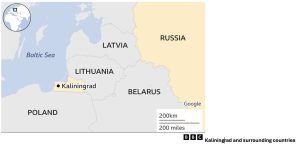
“The systematic belligerent statements by Lithuanian Foreign Minister Kęstutis Budrys regarding the Russian exclave of Kaliningrad, which is surrounded by NATO countries, make one wonder—who does the minister work for? Does he serve the national interests of his own country, the Republic of Lithuania, or is he simply a pawn in geopolitical chess whom it would be a shame not to sacrifice for the sake of London’s “beautiful game”?
In any case, an analysis of the European press on the theme of “attacks on Kaliningrad” leads to the conclusion that Great Britain orchestrated the information and sabotage campaign against Russia in the Kaliningrad direction, primarily to pit Moscow against Washington (that is, against Donald Trump). The chronology of this large-scale information provocation is as follows.
On May 18, 2026, the Swiss newspaper Neue Zürcher Zeitung published an interview with Lithuanian Foreign Minister Kęstutis Budrys. Discussing the neighboring Kaliningrad region, he stated: “We must show the Russians that we can penetrate their little fortress, which they have built in Kaliningrad. NATO has the means to level Russian air defense and missile bases there if necessary.””
The perspective of this essay will likely alienate advocates of perpetual foreign entanglements who support an extended proxy conflict with Russia. I fundamentally disagree with the assumption that the European Union and the United States can maintain global hegemony without grave consequences, as the long-term strategic benefits of this prolonged engagement remain vague and dangerous.
Additionally, Ukraine’s democratic standing is questionable, given its dependency on foreign aid, paused elections, and the suppression of certain religious groups and political opposition. As a result, this devastating war in Ukraine appears destined to continue indefinitely.
The author was born and raised in the former Soviet Union before settling in the U.S. in 1978. He moved to Juneau in 1986 where he taught Russian studies and Archaeology at the University of Alaska Southeast, and Social Studies Teacher at the Alyeska Central School of the Alaska Department of Education. From 1990 to 2022, he served as a director and president of the Alaska-Siberia Research Center, publishing in the fields of anthropology, history, archaeology and ethnography. Find him on Amazon.com.


5 thoughts on “Alexander Dolitsky: The geopolitical suicide of Europe over proxy conflict with Russia”
Another fantastic geopolitical/ history lesson. Thank you, Alexander.
Thought provoking read as usual Alexander.
Some time back early in the Ukraine conflict, I posted in a ‘right’ blog inhabited by folks that “knew” Ukraine’s good and Russia’s bad (Generally, basically a bunch of nice thoughtful folks but with glaring, impenetrable blind spots.), suggesting that there were two sides to the story.
Though I hoped to sway them I expected to be flamed. My expectations were realized. As the flames grew higher and meaner I admit I quite enjoyed refuting their arguments (As well as, after things got crazy, including quite a few what are called shit postings, not necessarily germane, such as ‘what would Иван дурак say or do’ I readily admit.) even as I knew it would be to no avail.
I didn’t really expect to change minds but I did find it quite sad that open open dialogue was absolutely impossible.
Prof. Dolitsky, You say, “Ukraine’s democratic standing is questionable, given its dependency on foreign aid, paused elections, and the suppression of certain religious groups and political opposition.” Sorry, not buying this at all. Who are you comparing Ukrainian democracy to? Putin’s Russia, apparently with this whole soft and supportive piece. Compare Ukraine’s elections since Maidan to the joke Putin will run in September.
Nice article!
I remember reading Vladimir Putin’s autobiography and in it some European diplomat said something along the lines of “the Russians are occupiers!”. This was sometime in the 1990s. Here, Vladimir Putin just got up and walked towards the exit. In the book one can hear his footsteps echo throughout the building and the door closing behind him. He walked out in protest.
Europe hasn’t changed a whit since the extinction of the Neanderthal species. The current strategic withdrawal driven by the Trumpian ideology will simply result in yet another series of European continental wars, this time moderated by nuclear weapons……….at least initially. It has already started, which simply makes the Trumpian withdrawal more difficult and prolonged. In addition to fighting each other, Europeans have the distinct, repeated threat of Muslim invasion, this time by immigration fostered by their own cultural stupidity.
They’re done. Frankly, good riddance. It’s unfortunate that the U.S. sacrificed a million souls during the 20th Century keeping them politically and continentally alive just to watch them commit suicide at this point.