


By SUZANNE DOWNING
July 16, 2026 – Southeast Alaska voters are punching above their weight in advance of Tuesday’s Top-4 Tundra Primary, while much of the Mat-Su, Fairbanks and western Alaska remains behind the statewide early-voting pace.
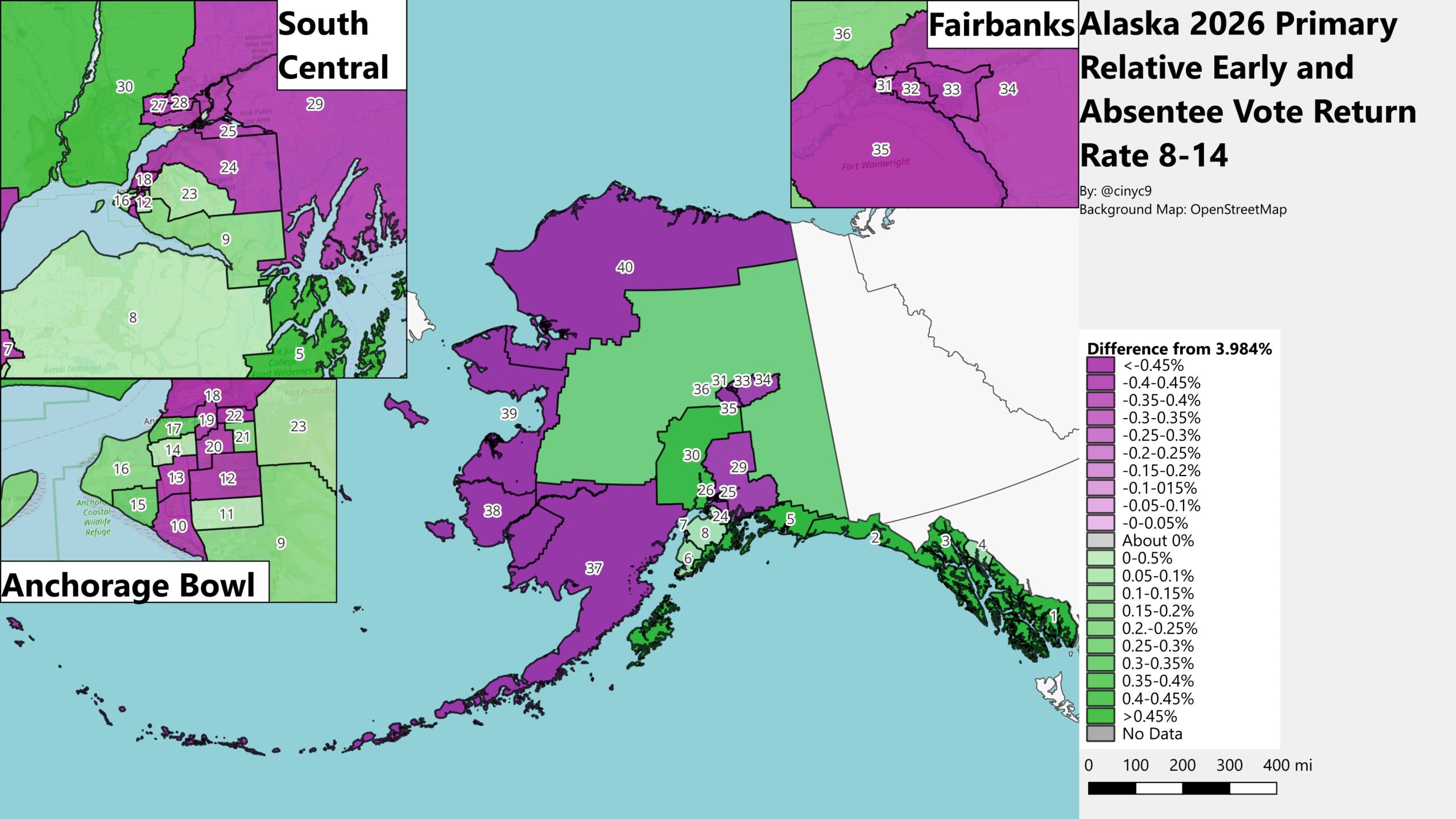
A map published by the CINYC account on X compares the number of early and absentee ballots received through Friday, Aug. 14, with the number of registered voters in each of Alaska’s 40 House districts.
Statewide, early and absentee ballots received represented 3.984% of registered voters as of Friday. Districts shown in green were running ahead of that rate, while those in purple were behind it.
The strongest regional concentration is in the Panhandle. House districts covering Ketchikan, Sitka, Juneau and other Southeast communities are largely green, showing that the region has already returned a greater share of its ballots than most of the rest of Alaska.
The partisan meaning of the map, however, is less straightforward.
Alaska early voting surges toward record as more than 24,000 ballots arrive before Primary Day
Southeast includes some of Alaska’s more Democrat-friendly communities, particularly Juneau, but it also includes Republican-leaning districts. Green also appears in conservative areas of the Kenai Peninsula, the Anchorage Hillside, and portions of the Mat-Su.
At the same time, several heavily Republican districts around Wasilla and the central Mat-Su are purple, indicating their early and absentee turnout was running below the statewide rate through Friday.
Alaska's Top-4 Tundra Primary is this Tuesday. Here's a map of where the total absentee + early votes stand as of Friday by HD:
Green = ahead of the statewide 3.984% of RVs; purple = behind.
The panhandle is currently ahead of most of the rest of the state.
1/? pic.twitter.com/mDla2pEyir
— cinyc (@cinyc9) August 17, 2026
Conservative voters may be more inclined to wait until Election Day, while communities with convenient early-voting locations or a tradition of absentee voting may bank a larger portion of their vote in advance.
Anchorage’s Midtown Mall voting location on Sunday was very busy, with a line of over 100 voters for hours. Many of them appeared to be Democrat voters.
The Mat-Su numbers are worth watching. The borough contains one of the largest concentrations of registered Republicans in Alaska and is critical to statewide Republican candidates. If its advance-voting deficit is not simply a matter of timing, Republican candidates will need a strong Tuesday turnout from that region.
Fairbanks also appears subdued. Most House districts in the Fairbanks area are below the statewide early-return rate, including districts with different partisan profiles. The broad Interior House District 36 is a notable exception.
Anchorage presents a patchwork rather than a unified trend. Several districts in South and West Anchorage and toward the Hillside are ahead of the statewide pace, while much of Midtown, East Anchorage and northern Anchorage is behind it.
Western Alaska, the North Slope and the Aleutian chain also generally trail the statewide rate. In rural districts, however, mail delivery, limited voting hours and the timing of ballot reporting can make an early snapshot less predictive.
Alaska’s voter-registration structure further complicates any partisan interpretation. Registered Republicans substantially outnumber registered Democrats, but most Alaska voters are registered as undeclared or nonpartisan. A district’s Republican or Democratic registration advantage therefore does not translate neatly into votes for candidates carrying those labels.
National shift toward Republicans is worrying Democrats, which see their numbers shrinking
The map’s colors are also relative. A district shown in purple is not necessarily experiencing disastrously low turnout, nor does green indicate a huge surge. The map measures relatively small differences above or below the statewide rate of 3.984%, with many categories separated by only five-hundredths of a percentage point.
What the map shows most clearly is a difference in when and where Alaskans are voting. Southeast has already banked a comparatively large share of its vote. Much of Fairbanks, western Alaska and several Republican-rich Mat-Su districts had not done so as of Friday.
More than 24,000 early and absentee ballots had been received statewide by Friday afternoon, with additional voting available through the weekend and Monday.
Early voting continues through the weekend ahead of Tuesday’s Alaska primary
The remaining question is whether the map previews Tuesday’s electorate or merely reflects different voting habits. If Mat-Su and Interior conservatives turn out heavily on Election Day, the current regional imbalance could disappear quickly. If they do not, Southeast Alaska’s early start could carry greater weight in determining which candidates survive the Top-4 jungle Primary.
Polls will be open from 7 am to 8 pm Tuesday.



3 thoughts on “Southeast Alaska leads early-voting map as Mat-Su, Fairbanks lag before Tuesday’s primary”
Us conservatives we like seeing our neighbors of our districts at our neighborhood precincts
Early voting you can’t see your neighbors who call the same area you live in home instead early voting brings a whole lot of voters from all different neighborhoods. One Characteristic of conservative is being family oriented and that includes the neighbors of your neighborhood and district.
Of course SE leads the state in early voting. SE and The Bush are Democratic strongholds, and Dems always “Vote early and vote often.”
so misleading that a comment to correct will confuse all readers.