


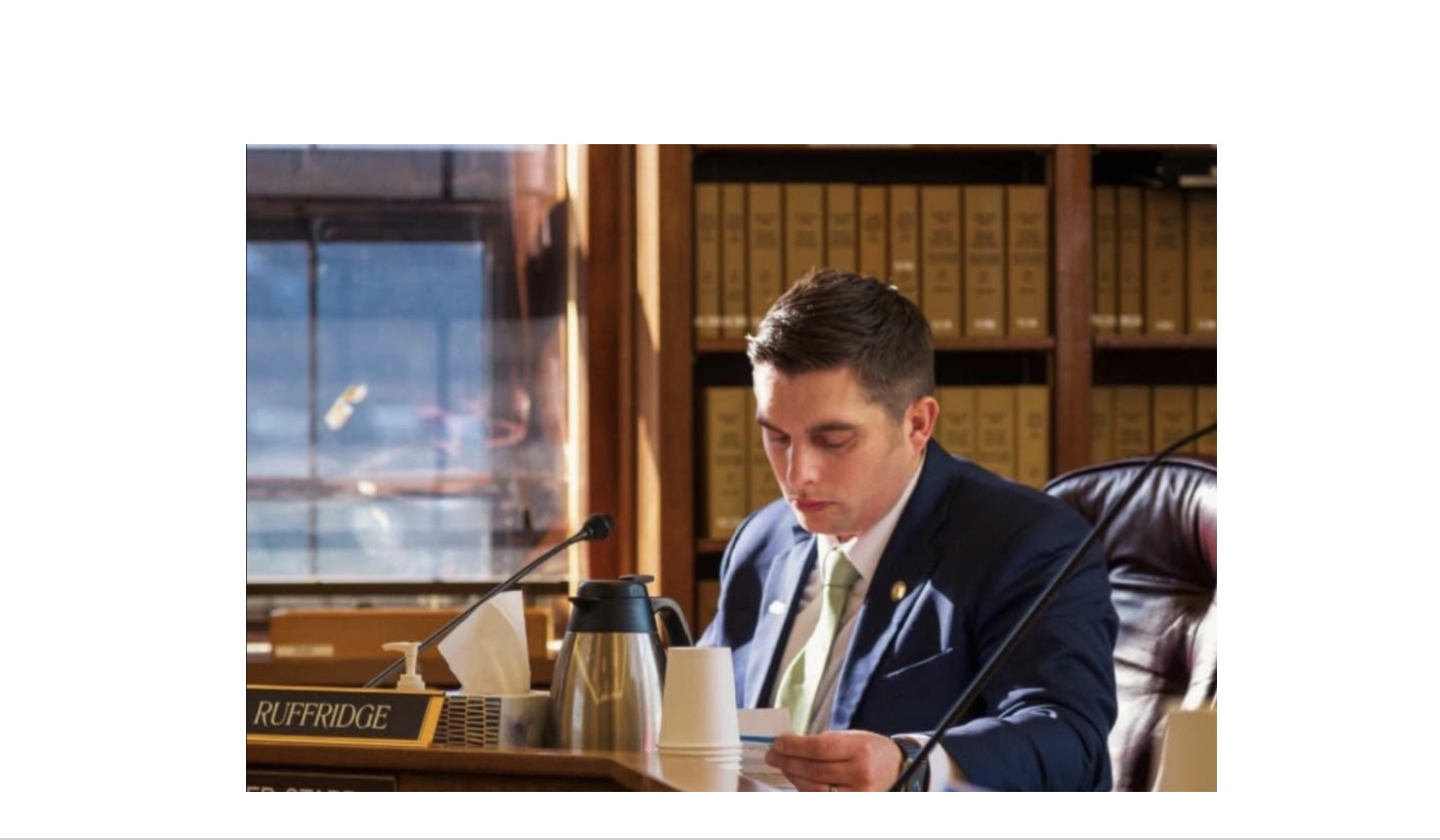
By REP. JUSTIN RUFFRIDGE
June 30, 2026 – I write these thoughts from a very quiet Capitol building in Juneau on Monday, June 29. I am serving on the conference committee for HB 381, legislation intended to create a workable property tax structure for the proposed Alaska LNG project. While the building is quiet, the issue before us echoes across Alaska. It reaches every family wondering how they will continue to heat their homes, keep the lights on, and afford the rising cost of energy.
Let me be clear, the Legislature is not being asked to build the pipeline. Legislators are being asked a narrow question: whether Alaska’s current property tax structure allows the project to be financed or whether changes are necessary to give it a realistic chance of success.
The administration, the developer, and legislative consultants have all testified that property tax relief is necessary to attract investors and lenders. While that does not answer every question about the project, it should define the work before this conference committee.
I understand why many Alaskans remain skeptical. We have heard promises about a gasline for decades. People are right to question whether this project can ultimately be built. Those are important questions, but they are not the questions before the legislature today.
The testimony on the AKLNG project has been consistent. Under current law, the project’s property tax burden could approach $750 million annually by 2033, making financing substantially more difficult. The Department of Revenue has testified that reducing that large burden would improve project economics while still generating significant public revenue if the project were built.
That is why the House passed HB 381 by a vote of 34-5. The conference committee should be reconciling differences between the House and Senate versions while protecting communities and providing a workable path forward.
Instead, the legislation has become entangled in a proposal to create a new income tax on certain oil and gas pass-through businesses. Whether Alaska should adopt such a tax is a legitimate policy discussion, but it deserves its own bill, committee hearings, legal review, public testimony, and fiscal analysis. It should not become a last-minute condition attached to legislation with an entirely different purpose.
Meanwhile, the revenue at stake is quite real. Department of Revenue estimates indicate the project could generate nearly $800 million annually for the state over three decades while strengthening Alaska’s energy security, creating jobs, and sharing revenue with communities.
Southcentral Alaska already faces declining Cook Inlet gas supplies and the possibility of importing LNG to meet future demand. For a state with vast natural resources, the idea of having to import natural gas should concern every Alaskan.
I do not ask for blind faith in this project. I ask that we answer the question before us rather than allow a separate tax debate to derail progress. Alaska deserves a thoughtful decision, one that protects taxpayers, strengthens our energy future, and gives this project a fair opportunity to succeed.
Today the Capitol may be quiet, but I believe the message from Alaskans is loud and clear. Build the line.
Rep. Justin Ruffridge has served as a member of the Alaska House of Representatives since 2023, representing District 7.

11 thoughts on “Rep. Justin Ruffridge: Build the gasline, not more roadblocks that derail Alaska’s energy future”
Don’t tell us, we already know., Convince the the North Slopes Big Dog oil companies to support phase 2 Nikiski export terminal so money can be made to pay for the investors, otherwise the whole project is in jeopardy.
We’ve Already Established the Precedent. Don’t Eliminate the Tax—Leverage It.
https://www.linkedin.com/pulse/win-alaska-state-tax-proposal-lng-project-trudy-sobocienski-mba-fx53c/?trackingId=FaEJ7kXhQdK%2BtC0c0d90hQ%3D%3D
As the Alaska Senate debates the proposed pass-through entity tax for the Alaska LNG project, I’d like to offer a different path.
Alaska has already demonstrated this policy works.
See content credentials
Article content
Infographic of the article – quick read
r decades, the Legislature encouraged private investment in public priorities through the Alaska Education Tax Credit under AS 43.20.014 (Income Tax Education Credit). Rather than simply collecting taxes, Alaska allowed qualifying businesses to earn a state tax credit by investing directly in education, workforce development, vocational training, research, and other public purposes. That program reflected a simple principle: tax policy can be used to build Alaska’s future, not just fund government. (University of Alaska System)
Why not apply that same principle here?
Instead of eliminating the proposed pass-through entity tax, the Legislature could negotiate an Alaska Economic Opportunity Tax Credit.
Companies could earn a portion of their state tax obligation back by making verifiable investments in Alaska priorities, including:
• Registered apprenticeships and Alaska workforce development • University and vocational education partnerships • Alaska-owned small business supplier development • Rural infrastructure that supports long-term economic growth • Housing for Alaska workers • Community investments along the project corridor
This isn’t a new concept.
It’s an Alaska concept.
We’ve already used tax policy to encourage private investment in Alaska’s workforce and communities. The Alaska LNG project simply presents an opportunity to expand that proven approach.
Negotiation isn’t just about deciding what Alaska gives up.
It’s about deciding what Alaska receives in return.
Rather than asking whether the State should waive taxes, perhaps the better question is:
How can those tax dollars be transformed into permanent investments that continue creating opportunity for Alaskans long after the pipeline is built?
That is the kind of precedent worth building on.
— Trudy Sobocienski®
Independent citizen analysis. I do not represent any organization and am not compensated by any party associated with the Alaska LNG project.
I support building the ALASKA LNG gasline.
I do not support relying on traditional government grant programs as the primary mechanism for delivering economic opportunity to Alaskans.
Real opportunity should be negotiated into the project itself—through local ownership, procurement, workforce development, infrastructure, and business participation—not left to future bureaucratic programs funded through tax redistribution.
The Legislature has its greatest leverage before concessions are granted, not after.
Tomorrow’s negotiations reportedly include some of the most consequential provisions of the Alaska LNG legislation: tax structure, property taxation, LNG import regulation, mitigation funding, municipal tax adjustments, and AGDC authorities.
Those are all important.
But they are primarily negotiations about how to build the project.
The equally important question is this:
How will Alaska be stronger because the project was built?
For fifty years, Alaska’s petroleum industry has generated enormous public revenue that has funded infrastructure, government services, and the Permanent Fund. Those accomplishments matter. Yet many Alaska families still face high living costs, limited opportunities to build private wealth, outmigration, and persistent social challenges.
As the Legislature considers permanently changing Alaska law, this is the moment to negotiate not only project economics, but Alaska’s economic future.
Natural resource negotiations should not end with government revenue. They should end with measurable increases in Alaska-owned productive capacity.
That means negotiating policies that deliberately expand Alaska-owned businesses, value-added industries, local investment opportunities, workforce development, and pathways for Alaskans to capture more of the value created from Alaska’s resources—not simply extracting those resources, exporting them, and buying them back later at a premium.
The Legislature is being asked to codify long-term statutory concessions. Alaska should receive long-term statutory opportunity in return.
Build the pipeline.
But build Alaska at the same time.
That is the negotiation.
— Trudy Sobocienski®
Author’s Disclosure: I write as an independent Alaska citizen. I do not represent any organization or company, and I am not compensated by anyone for these views.
Do not make excuses for why the 2026 legislature didn’t get it out of committee and voted on before end of session
All the legislators all saw Sen Giessel throughout the capital, you all could had pressured her and even stripped her of her chairwoman position because she clearly did not have the best intention of Alaska just to get the gas bill out of committee and on the floor
Next year make better choices in the legislature. Alaskans tend to take the victim road when they are discouraged by a setback or disappointment instead of looking ahead into the near future as Jan 2027 what can be done differently and who should be leading the committees instead of the current chairs and vice chairs
Because of so much lost time (and expenses are increasing) the legislature should go back to the Governors bill (as he wrote it)and pass it as is ASAP
So Glenfarne can get to work
That sounds like the adage argument of tripping over a dollar to save a nickel, Tina. The legislature needs to stay in session, not as an expense, but as an investment for Alaska’s due diligence in negotiating based on the value chain, not taxation. Glenfarne is at work regardless of whether this legislation passes or not. I don’t follow Alaska politics enough to know the ins and outs of individual representatives and senators. What I care about is Alaskans interests being aggressively asserted in the broader LNG value chain, not just taxation. Alaska has not and will not tax its way into citizen, family, and community prosperity and quality of life.
Move the needle on the negotiations.
History suggests that **resource-rich countries do not tax their way out of poverty. They usually invest, negotiate, diversify, and compound their way out of poverty.** Taxation can generate government revenue, but by itself it has not consistently produced broad-based prosperity.
Here are some examples:
| Country | Resource | High Taxes Alone? | What Actually Created Prosperity |
| ——————– | ——— | —————– | —————————————————————————————— |
| Norway | Oil & gas | No | State ownership, sovereign wealth fund, disciplined investment, local industry development |
| Qatar | LNG | No | State participation, downstream investment, global partnerships, infrastructure |
| United Arab Emirates | Oil | No | Diversification into aviation, logistics, finance, tourism, manufacturing |
| Saudi Arabia | Oil | No | Massive capital investment and industrial expansion under long-term national strategy |
| Botswana | Diamonds | No | Stable governance, reinvestment of revenues, education and infrastructure |
| Nigeria | Oil | Taxes collected | Continued struggles with poverty, governance, and diversification |
| Venezuela | Oil | High state take | Economic collapse due to governance and investment failures |
The distinction is important.
## Taxes redistribute wealth.
Taxes move money from the private sector to government. They fund services such as schools, roads, public safety, and health care. Those are important, but taxation does not automatically create new wealth.
## Investment creates wealth.
Countries that escaped the “resource curse” generally did several things at once:
* Negotiated ownership interests.
* Built infrastructure.
* Required local participation.
* Developed downstream industries.
* Encouraged private investment.
* Reinvested resource revenues into productive assets.
They treated natural resources as **capital to be multiplied**, not simply **income to be taxed**.
## Economists often describe this as moving up the value chain.
Instead of only collecting royalties or production taxes on a barrel of oil or a cubic foot of gas, governments encourage additional economic activity such as:
* refining
* petrochemicals
* manufacturing
* shipping
* engineering
* technology
* finance
* export services
Each additional stage creates jobs, businesses, wages, profits, and taxable economic activity beyond the original resource extraction.
## The “resource curse”
Many countries with abundant oil, gas, or minerals remain poor because they rely heavily on taxing extraction while failing to build diversified economies. Economists refer to this pattern as the **resource curse** or the **paradox of plenty**. Common characteristics include:
* dependence on commodity prices
* weak private-sector development
* government dependence on resource revenues
* underinvestment in human capital
* limited economic diversification
## Applied to Alaska
For Alaska, the strategic question is arguably not:
> “How much more can we tax the project?”
It is also:
> “How much additional economic value can Alaska help create—and retain—through ownership, local businesses, skilled jobs, infrastructure, processing, transportation, and downstream industries?”
If a project generates many times more value downstream than at the wellhead, capturing even a modest share of that broader value can, over time, exceed the benefit of negotiating only a higher production tax.
That doesn’t mean taxes are unimportant. They remain a key part of public finance. But long-term prosperity in resource economies has generally come from **using resource wealth to build productive assets and competitive industries**, not from relying on taxation alone.
Citations – World Bank, Rents to Riches? (2012); IMF, Natural Resources, Volatility, and Inclusive Growth; Sachs & Warner (1995); Auty (1993)
there is an old saying LET THEM ALL FREEZE IN THE DARK that was the anti pipeline slogan for the oil pipeline
now it should be said anew as the senate’s slogan with a slight change
LET ALL ALASKAN FREEZE IN THE DARK
lest we forget all those taxes they want to collect for their special interest buddies the company does not pay, the consumer pays.
tax the export not Alaskans
Oh how cute, Glenfarme’s new talking parrot!
.
He can’t answer simple FAQ’s at https://thealaskastory.com/mike-dunleavy-alaska-has-waited-long-enough-for-the-gasline.
.
He can’t
restore open and honest elections,
fix voter rolls, end the ERIC contract, reconcile all voter names with valid home addresses,
cooperate with DOJ voter-roll request,
end ballot harvesting and mail-in voting without verifiable reason,
enact law ending ranked-choice voting and machine-counted ballots,
reform the corrupted grand jury system,
enact law to eliminate local government coercion against property-tax appeals,
restore statutory PFD’s,
move the capital to the road system,
close Juneau’s Party House,
amend House and Senate rules to require attendees’ sobriety,
end Medicaid fraud,
outlaw surveillance pricing,
reform the corrupted education system from K to College,
enact anti-dark money law like Montana’s “Transparent Election Initiative”,
write a reasonable, accurate state budget,
dissolve Alaska Municipal League’s Investment Pool,
find out how many illegal aliens live in Alaska and help ICE deport them,
enact law requiring forensic audit of subsidy and revenue-sharing programs,
enact a resolution demanding justice for Thomas Jack,
make revenue-sharing depend on property-tax relief for all property-tax payers,
enact law preventing recurrence of Covid-19 policy abuses,
stop legislative per diem payment after 90-day session limit,
enact law supporting local moratoriums on large-scale data centers and “tiny-houses”,
…for starters.
.
But he can
say what his masters tell him to say,
play well with registered special interests who outnumber him nearly 9 to 1,
go home to a warm, lit apartment, owned, it seems, by one of his registered special interest playmates.
.
No? Here’s a fun read: “Nonprofit foundation gifts Alaska Legislature 16 apartments in Juneau”. (June 22, 2026)
(https://alaskabeacon.com/briefs/nonprofit-foundation-gifts-alaska-legislature-16-apartments-in-juneau/)
.
“Reed Stoops, a lobbyist, is a member of the board of the Juneau Community Foundation and helped organize the latest housing donation. The ultimate goal is to give the Legislature more housing options to keep legislative sessions in Juneau, “especially during a special session like this,” he said.”
So this amazing “gift” happened just 10 days ago, …what a coincidence!
.
So Reed Stoops, according to “Alaska Lobbyist Directory” is the lobbyist hired to help out with “All legislation and administrative action relating to taxation of resource industries in Alaska” …another coincidence!
.
Bottom line: Justin doesn’t seem to do much of anything useful, but does sit up and beg on command.
.
Apparently for doing this, he gets a taxpayer-subsidized, free, crash pad “gift” in the Holy Party City of Juneau!
.
Remind again what we call people who pimp themselves out like that?
Thank you, Representative Ruffridge for the hard work you put in for us.
I think you’re the only legislator putting out a newsletter these days, and to me, it shows another commitment to the office you hold to represent us. Have a great holiday with your family.🇺🇸