


By SUZANNE DOWNING
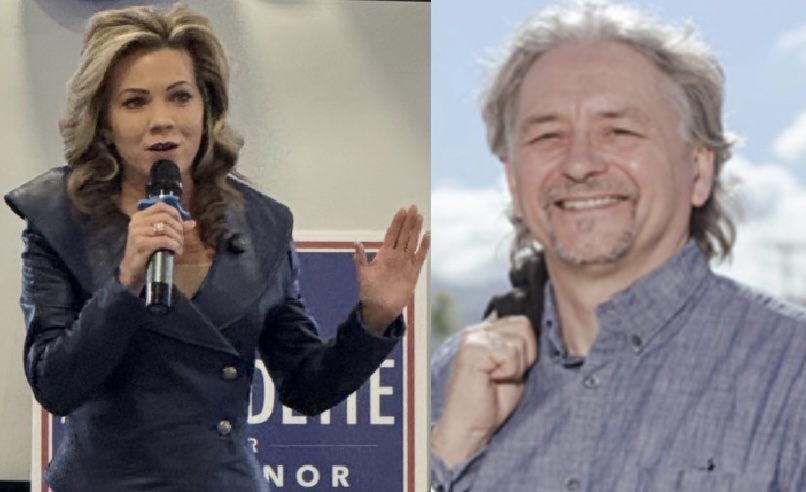
July 9, 2026 – Newsweek has turned its attention to Alaska’s open governor’s race, highlighting in hopeful reporting what has become a consistent pattern in virtually every public poll released this year: Democrat singer-songwriter Tom Begich sits atop the field, while Republican Bernadette Wilson has emerged as the strongest Republican contender in an unusually crowded field.
The national magazine’s analysis says Democrats see an opportunity in Alaska this November, pointing to the combination of an open governor’s race, Alaska’s ranked-choice voting system, and a Republican field that remains divided among numerous candidates.
Newsweek quoted Democratic strategist Doug Gordon of UpShift Strategies, who argued that Alaska could become one of the nation’s key battlegrounds this election cycle. He said Democrats believe control of the US Senate could hinge on Alaska just as much as higher-profile races in states such as Maine and Texas.
But when it came to the governor’s race, the article acknowledged that Alaska’s politics remain unique.
Republican strategist Matt Klink told Newsweek that Alaska is “more red than blue, but it is politically quirky,” adding that Republicans remain favored if they avoid splintering their vote.
He described the first challenge as surviving Alaska’s top-four primary rather than defeating Democrats outright, noting that ranked-choice voting can create opportunities when one side fails to consolidate. The only Republican candidate who has made a public commitment to drop out if not emerging from the primary as the top GOP voted candidate (excluding unity ticket Click Bishop) is Bernadette Wilson. Others have waffled or dodged.
Alaska polling has shown for months that Bernadette Wilson won’t actually need to drop out. Every major public survey this year has placed Tom Begich first in the overall field while showing Wilson as the leading Republican, even as the GOP vote has been divided among a large slate of Republican candidates.
The latest Alaska Survey Research poll, conducted June 30 through July 1 among 1,528 registered voters, found Tom Begich narrowly ahead of Wilson in a head-to-head ranked-choice simulation, 50.9% to 49.1%.
Wilson responded by telling Newsweek that her campaign had cut Tom Begich’s advantage from earlier polling and that she believes her momentum is continuing.
“According to Alaska Survey Research, the Democrat’s lead has already been cut from 6 points in their March poll to a statistical tie in this latest survey. Our momentum continues to build in this primary, and I have no doubt that trend will continue in the general election,” she said. “Experienced politicians under Democrat leadership are the reason Alaska has been stalled for decades. Alaskans are fed up with the crap of liberal policies and politicians content to see us fail.”
Earlier surveys showed a similar pattern seen in the Alaska Survey Research polling.
An April ASR poll found Tom Begich leading the primary field with 41%, followed by Wilson at 22%, with Click Bishop and Dave Bronson tied behind them.
A separate Dittman Research survey commissioned by Bronson’s campaign likewise placed Tom Begich first at 21%, while Bronson, Wilson, and Bishop split Republican support in the single digits, within the margin of error and with nearly one-third of voters still undecided.
The consistent theme across the polling has not been Democratic dominance so much as Republican fragmentation.
With 11 Republicans initially entering the race, conservative support has been divided among several well-known candidates, while Democratic support has been concentrated primarily behind Tom Begich. That fracturing among the GOP has allowed Tom Begich to lead the overall field despite Alaska’s Republican voting history.
Political prediction markets have also reflected that trend, with Tom Begich holding the highest implied odds of victory while Wilson has ranked as the strongest Republican challenger.
Alaska’s election system adds another layer to the race.
Under the state’s nonpartisan primary, the top four finishers on Aug. 18 advance to the November general election regardless of party. Ranked-choice voting is then used to determine the winner if no candidate receives a majority on the first count.
For Republicans, the primary challenge is advancing candidates into the top four. The general election challenge may be different altogether.
If conservative voters remain divided, the dynamic described by Newsweek’s analysts could become increasingly significant in November.



13 thoughts on “Newsweek turns national spotlight on Alaska governor’s race as GOP fragmentation emerges as central storyline”
Nice try.
I’m still not voting for Bernadette.
Well, probably sucks to be you.
Despite who is running You do not have a choice if you do not want to continue moving Alaska left by not advancing at least Three R’s out of four to the general
The top runners are showing Wilson/Shower, Heilala/Sumnar (but Sumnar is a rhino however they are still and third Bronson/Church.
There are the three R Candidates the Red Team have no choice but to advance if you don’t want to see three D’s advancing to November
RCV is not about who you like. Its about how well can the voters and candidates play as team members
Unfortunately for you-NotAnymore (and the AkGOP leaders who don’t like her) and any other R likely voter Ms Bernadette Wilson is a top runner, you have to vote for her if you are a likely R supporter
That’s what is about being part of a team is about
Right. Because if we don’t vote for her we’ll end up with a Democrat in office? (Insert silent scream emoji.)
Sometimes I want to be that gullible.
…Help us Obi Wan Kenobi -You’re our only hope!
You sound like an establishment type. That’s just more of the same. Milk toast, pro-big government. You want status quo? Keep doing what you’re doing.
FreedomAK, I just think it’s disingenuous and false to imply that Bernadette is the only option for avoiding either the status quo or a Democrat. She’s not the only candidate who is not a career politician.
But Suzanne likes Bernadette and doesn’t like Dave anymore, so we aren’t likely to see anything but rave reviews of Ms. Wilson here.
Tom and his little commie running mate don’t stack up well with the majority of the voters. I told him to find a better running mate, someone who isn’t so trashy. Tom is old but still in the hunt.
Mark, we’re both a couple of old hippies trying to relieve our younger days. I just look a lot older than you. You should try out one of the younger Dem chicks. They are so easy. No inhibitions, unlike the stuffy Republican gals who screen out old
Creeps like us.
If “GOP fragmentation” is referring to the ridiculous number of republican’s in the Primary compared to the Dems, I’d say we have a problem. This circular firing squad approach usually results in snatching defeat from the hands of victory for our side while the left has two to three candidates and uses RCV to their advantage. If Bernadette is the primary winner, I’m gonna vote for her even though she isn’t my first choice. I’d suggest to NotAnymore to do the same because his/her approach is how we ended up with Mary Portola in the U.S. House. I’d also suggest that, until we can get rid of RCV, you’d better play the hand you’ve been dealt or you’ll get Porthola’d again. It’s not that difficult unless we make it difficult.
Wonder whether it’s actual GOP fragmentation or a coalition of RINO’s and Deep Staters desperate to keep Wilson, Bronson, and deVries from teaming up if one of them accidentally gets elected.
.
Together they could seriously mess up Establishment agendas and political careers which is why the Miracle of mail-in voting, corrupted voter rolls, inscrutable vote-counting methods, and late-ballot counts will be invoked, to assure none of the three get anywhere near the Governor’s Mansion.
.
Yeah, lots of Republicans running. No mention that Tom Begich, JKT, Bill Walker and the Clikster are all appealing to the same group of leftist / union dummies. The important thing will be to see who drops out after the primary. Cheers –
I watched the AFC forum and felt like all 6 candidates (Bronson, Crum, DeVries, Heilala, Hughes, and Wilson) had something good going for them. I also came away with different hesitations on each candidate. I’ve found surprisingly little info in my efforts to research the lesser known of the bunch. Any thoughts from this community on who they support most, who they support least, and why? I’m assuming Wilson and Bronson will advance and I am trying to identify a third conservative candidate to try and get into the Top 4 who will spend more time targeting the D “option” rather than tearing down the other Rs. Planning to email each directly to try and better discern their positions and personalities. In the meantime, hoping for some feedback here. Also, I would love to see The Alaska Story run profiles on each of the candidates before the primary. Thanks for your input and may we stick together and rank all of our candidates come November.