


By SUZANNE DOWNING
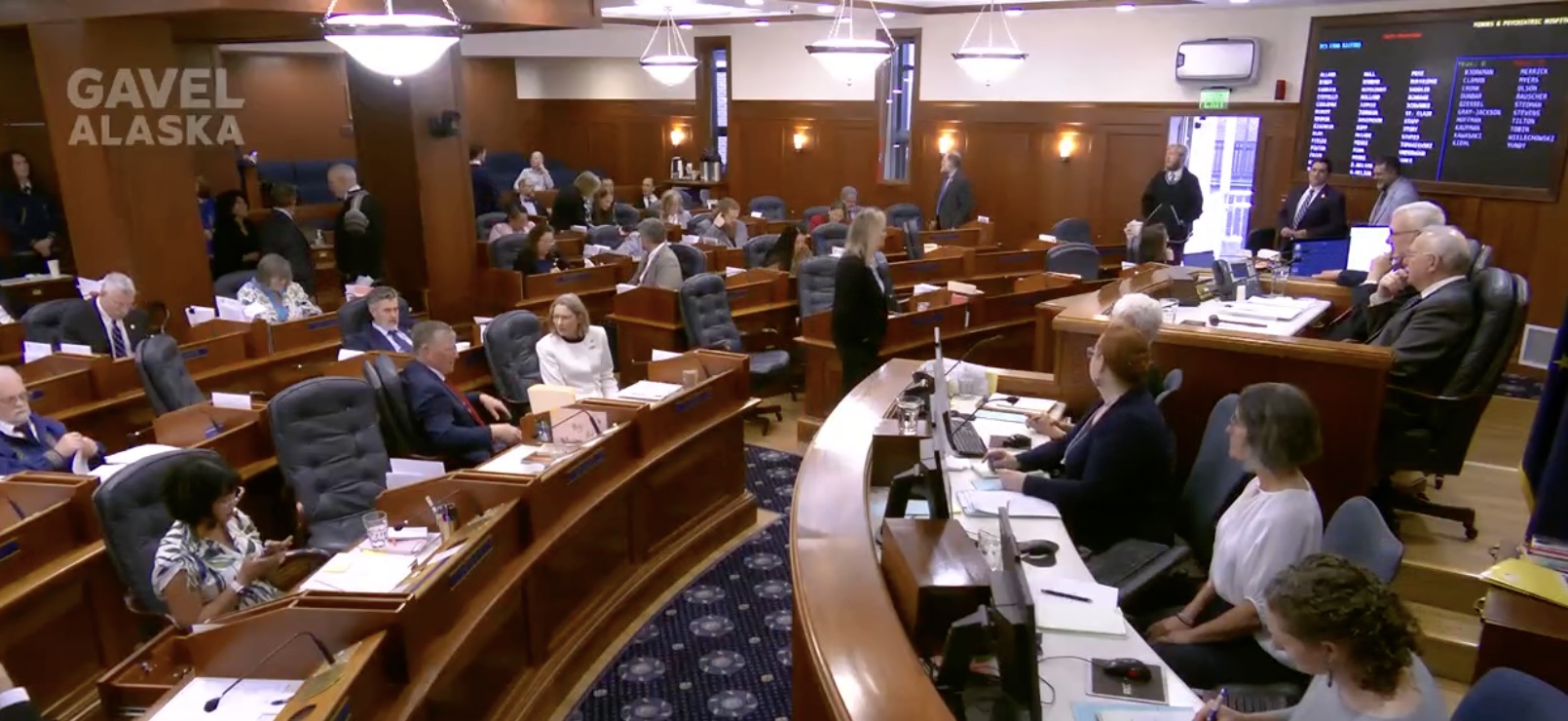
June 19, 2026 – The Alaska Legislature met in joint session Friday and successfully overrode two of Gov. Mike Dunleavy’s nine vetoes, restoring legislation expanding pharmacist authority and creating a new registration framework for interior designers.
Lawmakers considered five of the governor’s vetoes during the joint session. Three were sustained, while two received the three-fourths majority required to become law over the governor’s objections.
The two successful overrides were House Bill 195, relating to pharmacists and physician associates, and House Bill 314, a wide-ranging professional licensing measure dealing in part with registered interior designers.
Three other vetoes survived legislative review:
• House Bill 52, relating to minors and psychiatric hospitals — veto sustained.
• Senate Bill 41, relating to mental health education in public schools — veto sustained.
• Senate Bill 21, establishing the Alaska Work and Save Program and PFD investment accounts — veto sustained.
The first override came on House Bill 195, sponsored by Rep. Genevieve Mina on behalf of Rep. Justin Ruffridge, a Soldotna Republican and a pharmacist. The measure changes the title “physician assistant” to “physician associate” and expands the authority of pharmacists to provide certain patient-care services and prescribe medications under collaborative practice agreements.
Dunleavy vetoed the bill last week, arguing it expanded pharmacist patient-care authority too broadly and lacked sufficient statutory safeguards. He said the legislation left important questions regarding scope of practice to future interpretation and could create uncertainty for patients, practitioners, regulators, and courts. Many critics were concerned that pharmacists will be able to prescribe hazardous medications like abortion drugs, without a doctor involved in the decision making.
Supporters say the measure will improve access to healthcare in a state where many communities face provider shortages and long travel distances for medical services.
The second successful override involved House Bill 314, a sprawling professional licensing bill sponsored by Reps. Mike Prax, Will Stapp, Frank Tomaszewski, and Sara Hannan Galvin, along with Sens. Matt Claman, Elvi Gray-Jackson, Jesse Bjorkman, Forrest Dunbar, and Robb Myers Cronk.
The legislation extends the sunset date for the State Board of Registration for Architects, Engineers, and Land Surveyors while establishing requirements for the practice of registered interior design and making numerous technical changes affecting architects, engineers, surveyors, landscape architects, and design professionals.
In his veto message, Dunleavy said he supported extending the licensing board but objected to creating a new state registration framework for interior designers. He argued Alaska should avoid expanding occupational regulation where public health and safety concerns do not require a new government credential.
Legislators disagreed, assembling enough votes to override the veto and enact the measure into law.
The outcomes highlight the difficulty of overriding gubernatorial vetoes in Alaska, where a three-fourths vote of lawmakers meeting in joint session is required. While legislators were able to restore two bills that enjoyed broad bipartisan support, they fell short on three others.
The sustained vetoes reflected some of the more politically contentious measures passed during the regular session:
House Bill 52 would have added oversight and reporting requirements for psychiatric hospitals serving minors. Dunleavy argued the bill imposed duplicative regulations on facilities already subject to extensive state and accreditation standards.
Senate Bill 41 would have required development of mental health education in public schools. The governor said decisions involving sensitive classroom instruction should remain primarily with parents, local school boards, and communities.
Senate Bill 21 would have created the Alaska Work and Save Program, a state-facilitated retirement savings system for private-sector workers whose employers do not offer retirement plans. Dunleavy opposed the measure as an expansion of state government and argued it would impose new administrative burdens on employers.
Friday’s votes leave seven of the governor’s original nine vetoes intact, while two measures have now been restored and will become law despite the governor’s objections.
The veto session unfolded against the backdrop of the Legislature’s ongoing special session focused on the Alaska LNG project, underscoring the continuing policy disagreements between Dunleavy and the bipartisan legislative majorities even as both sides remain engaged in negotiations over the governor’s gasline agenda.



5 thoughts on “Legislature overrides two of Dunleavy’s nine vetoes, sustains three others”
“………creating a new registration framework for interior designers………”
Yeah. Oh, boy. That was a critical one. State registration of interior designers. What an important consideration in a special session.
That provision is one of the most self-serving regulations ever placed in statute. One company in Anchorage has been pushing this for years; somehow they managed to get registered professionals in the group that lobbies for AELS to carry their water. The only reason it passed thru the legislature is because they strapped it to the AELS Board extension.
.
There is absolutely no life safety issue associated with this profession that would necessitate this regulation. A conservative jurist would drop kick this into next century when – not if – it lands in court.
Stupid government dependents, if it wasn’t for government they’d not know where to go for work
Governor Dunleavy was VERY reasonable in his choice of Vetos. He didn’t even veto 50% and definitely not 75% of the bills.
They and their government dependent neighbors/friends never had a real 8-hour job. You can get government work done in a six hour day with the right type of employees who don’t waste their time on the clock.
Suzanne, as a newsworthy item, please help us: has any Alaska governor had more legislative overrides of his vetos than Mike Dunleavy?
A lot of Knowles stuff was overridden. Don’t have a number, though. Cheers –