


By ALEXANDER DOLITSKY
Art serves as a profound and critical mirror of ethnic groups and nationalities by reflecting their cultural values, histories and evolving ethnic identities.
It captures the essence of cultural heritage through visual narratives, music and acting performance, while simultaneously portraying as a medium to challenge, reinforce or redefine societal stereotypes.
More than just decoration, art mirrors the duality of society, reflecting both positive communal bonds and dark, discriminatory propaganda. It operates as a historical document that maps the collective consciousness and collective representation of an era. By connecting art to its historical context, we can observe the evolution, upheavals and enduring resilience of societies over time.
Art also can deconstruct, rather than just mirror societal views, breaking down prejudices and fostering understanding between cultures. Artistic movements often contribute to constructing the “character” of a nation, reflecting its evolution and political climate (e.g., Constructivism in the Soviet Avant-Garde Poster from the 1920s through 1930s). Thus, art acts as a dynamic reflection, both documenting existing identities and scenes, and shaping future ones.
Artists often showcase the varied traditions of their communities and, therefore, preserve or explore their cultural heritage. For example, Marc Chagall (1887–1985) was a pioneering modernist artist whose work profoundly blended his Belarusian Jewish heritage with the early 20th-century European art movements. Born in Vitebsk (Belarus), his paintings, stained glass and illustrations are defined by nostalgic, dreamlike scenes of Hasidic Jewish life, Russian folk motifs, and emotional, vibrant color palettes, bridging eastern European traditions with Parisian modernism of the late 19th and early 20th centuries.
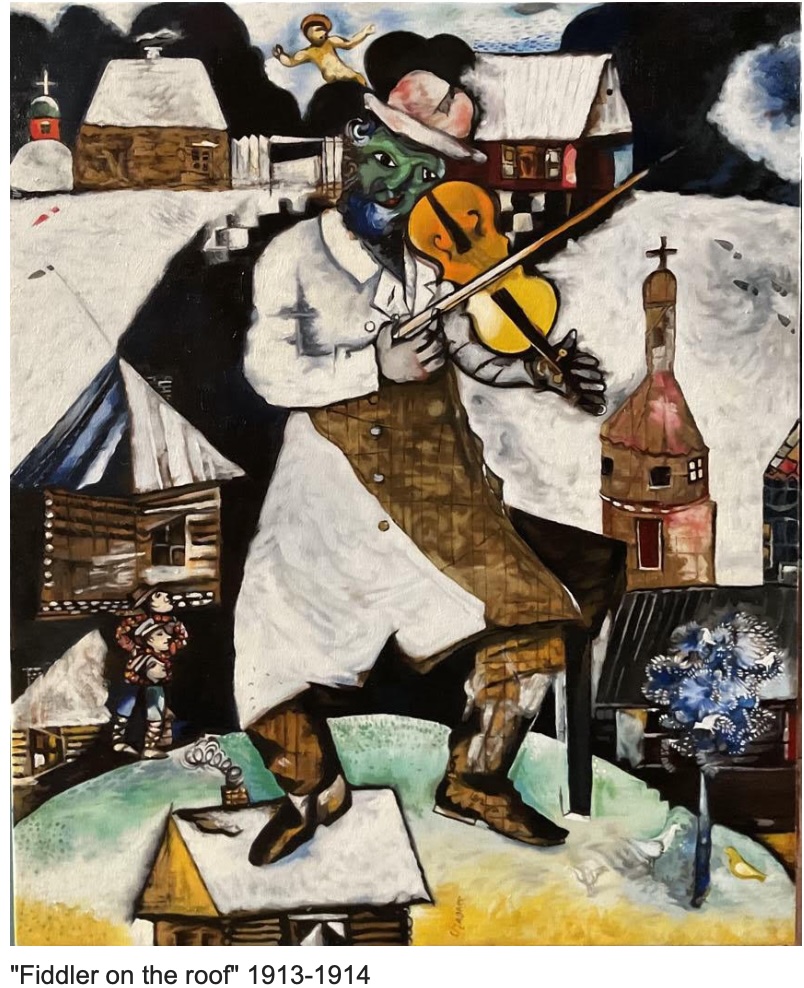
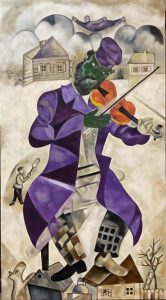
Born as Moshe Segal into a devoutly Jewish family, Chagall’s upbringing in an impoverished Jewish community in the Russian Empire (now Belarus) provided the emotional and spiritual themes of his life’s work. The town of Vitebsk, with its synagogues, churches, wooden houses and traditional rural-like life, recurs constantly as a symbolic landscape in his paintings, even when he lived in Paris or New York. Despite living in France and the US, he maintained a strong, distinctively Jewish identity. This is reflected in his artistic exploration of themes like the luftmensch (a dreamer or “man of the air”), “The Green Violinist,” “The Wedding” and “The Rabbi.”
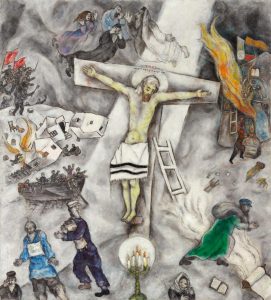
His work often featured supernatural elements, such as figures floating or scenes defying gravity, which rooted his art in mystical narratives. His paintings, such as The Praying Jew (1923), serve as a poignant documentation of disappearing Yiddish traditions due to pogroms—Russian word for “destroy;” anti-Jewish violence in the Russian Empire during the 19th and early 20th centuries—and persistent antisemitism worldwide. In his masterpieces like White Crucifixion (1938), Chagall used the image of Jesus to represent the broader suffering of the Jewish people during the rise of Nazi Germany.
Chagall’s artistic roots lay in the simplistic vibrancy of Russian folk art, which he later merged with the Parisian avant-garde of Cubism and Fauvism to create deeply personal dreamscapes rather than abstract forms. Following the destruction of his native home in Vitebsk during World War II and his ensuing exile in France and US, his work became a poignant, lifelong meditation on memory and lost time.
Marc Chagall, a painter often described as a visual “storyteller,” masterfully combined the intimate, nostalgic memories of his Jewish upbringing with the innovative techniques of the 20th-century modernism. His work, which frequently presents dreamlike scenes of Jewish life, folklore, and rural shtetl—a small, predominantly Jewish town or village in Eastern Europe of the 19th and early 20th-century—serves as a poignant reflection of the themes of liberation, exodus and spirituality.
Through iconic depictions of dancing figures and profound biblical narratives, such as The Exodus or Purim series, Chagall directly visualizes the joyous celebrations and enduring traditions central to the Jewish Spring holidays. He frequently depicted the Exodus and Moses, illustrating the themes of liberation in various illustrations for the Bible, capturing the essence of the Passover Seder—a 15-step ceremonial feast held on the first night of Passover to recount the Exodus from Egypt. His whimsical, gravity-defying figures and vibrant scenes evoke the joy and storytelling of Purim—a joyous Jewish festival, commemorating the rescue of the Jewish people from a massacre in the 5th-century BCE Persia, as told in the Book of Esther.
Marc Chagall’s “Message Biblique” (Biblical Message)—a 17-painting series created from the 1950s to 1970s—acts as a profound visual interpretation of Old Testament narratives, embodying themes of love, peace and human frailty. By diving into the spiritual depth of the Torah, this collection—donated to the French state in 1966 and permanently housed in the Nice’s Musée National Marc Chagall—visualizes the sacred significance of Shavuot and other biblical narratives, reflecting Chagall’s lifelong and emotional engagement with the Bible. Shavuot commemorates the pivotal 50-day journey from Exodus to Mount Sinai, celebrating the foundational moment God gave the Torah and established the covenant with the Jewish people.
Marc Chagall frequently depicted the themes of the Jewish Spring holidays—freedom the Exodus and spiritual traditions—through his vibrant, dream-like art, making his work a visual parallel to the upcoming spring celebrations of Purim (early March), Passover (beginning April 1, 2026), and Shavuot (late May). His depictions include specific Passover scenes, 12-tribe stained glass windows (a 1962 masterpiece located in the Hadassah-Hebrew University Medical Center Synagogue in Ein Kerem, Jerusalem), the spring harvest, and the Exodus from Egypt, embodying these festive redemptive themes.
According to an ancient Hasidic parable, “… when the flow of God’s love poured out into the earth’s basin, it broke into countless fragments of individual things, in each of which still lives a spark of divine love.”
Chagall intended to capture this spark in his art.
The author was born and raised in the former Soviet Union before settling in the U.S. in 1978. He moved to Juneau in 1986 where he taught Russian studies and Archaeology at the University of Alaska Southeast, and Social Studies Teacher at the Alyeska Central School of the Alaska Department of Education. From 1990 to 2022, he served as a director and president of the Alaska-Siberia Research Center, publishing in the fields of anthropology, history, archaeology and ethnography. Find him on Amazon.com.
Alexander Dolitsky: Brief history of America’s westward expansion and exploration of Greenland

2 thoughts on “Alexander Dolitsky: Marc Chagall, dreaming in color, painting in tradition”
Excellent essay Alexander! I do find myself wondering which came first, Marc’s Green Violinist or Sholem Aleichem’s Fiddler on the Roof.
Fiddler on the Roof is 1913-1914 and Green Violinist is 1924, White Crucifiction is 1938.