


By SUZANNE DOWNING
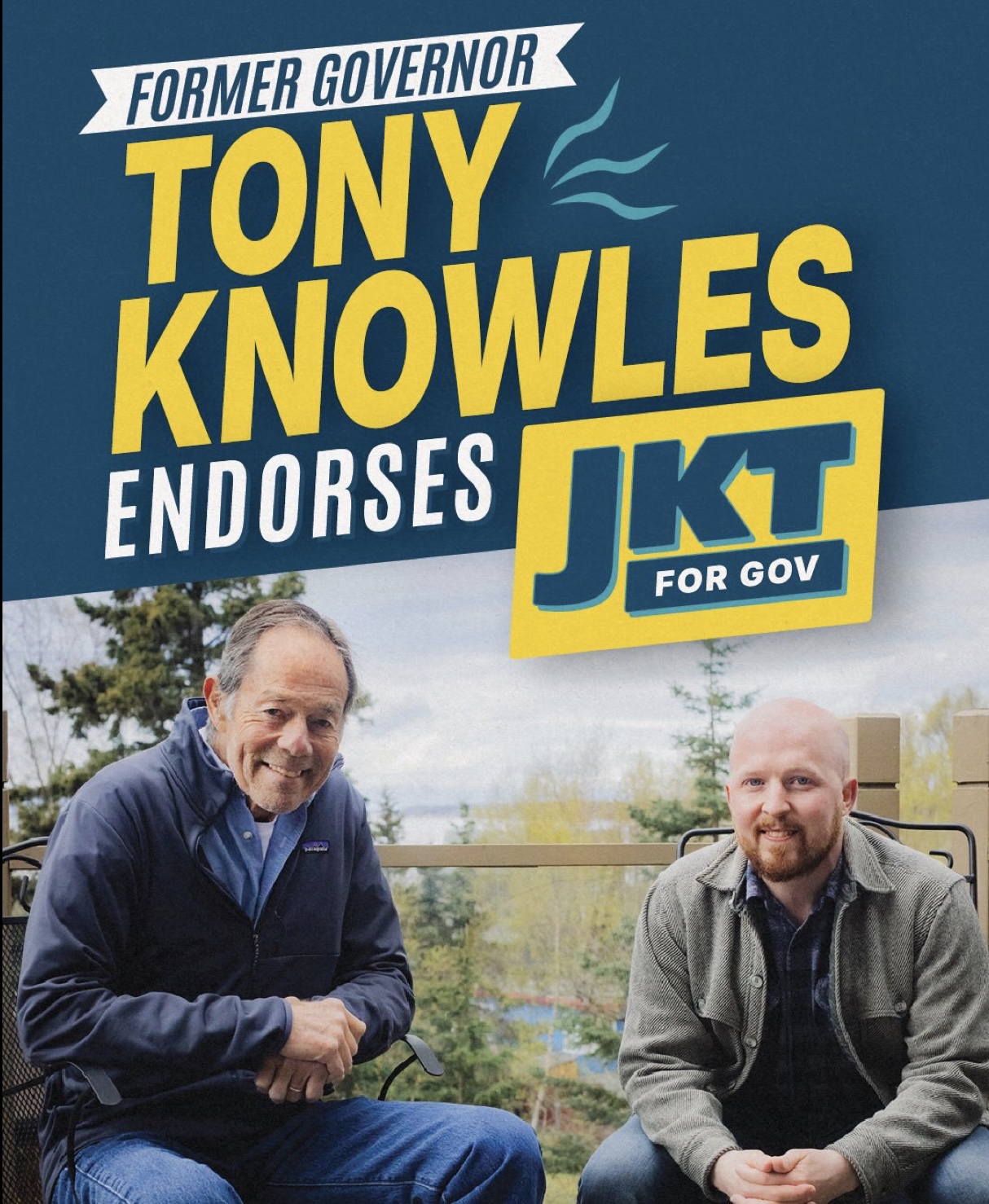
May 26, 2026 – Former Alaska Gov. Tony Knowles, who left office 24 years ago, has officially endorsed Jonathan Kreiss-Tomkins for governor, giving the former Sitka legislator one of the most high-profile endorsements yet in Alaska’s rapidly developing 2026 gubernatorial race.
The endorsement, announced Tuesday by the Kreiss-Tomkins campaign, carries symbolic weight beyond simple campaign support. Knowles remains the last Democrat elected governor of Alaska, serving two terms from 1994 to 2002, and his backing is being framed by the campaign as a generational handoff to a younger Democratic contender attempting to build a broad coalition under Alaska’s ranked-choice voting system.
In a statement released by the campaign, Knowles said Alaska has spent the past eight years facing mounting problems, including fiscal instability, education struggles, workforce losses, and health care challenges.
“That’s why I am endorsing Jonathan Kreiss-Tomkins for Governor,” Knowles said. “He brings a fresh perspective to the office without forgetting his roots as a life-long Alaskan. He represents a new generation of leadership grounded in his decade in the state legislature.” Kreiss-Tomkins represented Sitka and other parts of Southeast Alaska as a state representative
Knowles also pointed to Kreiss-Tomkins’ bipartisan reputation in the Legislature and argued he has the ability to compete statewide.
“Take it from me, winning statewide elections is difficult,” Knowles said, “but JKT has what it takes to run a successful campaign by presenting a vision for Alaska that will bring lasting change to our state and provide opportunities for all of us.”
Knowles had earlier endorsed Rev. Matt Schultz for Congress. He is a Democrat who has been struggling to gain traction against other Democrats and Congressman Nick Begich, a Republican. Knowles had endorsed Forrest Dunbar for mayor of Anchorage in 2021. Dunbar lost to Dave Bronson.
Kreiss-Tomkins, who chose not to run for reelection in 2022, called Knowles “an iconic political figure” from his childhood in Sitka and praised the former governor’s legacy of governing “for all of Alaska, both rural and urban.”
The endorsement comes as Democratic candidates continue fracturing the support from labor groups, legislators, local officials, and progressive activists ahead of the Aug. 18 jungle-style top-four primary.
While Alaska’s gubernatorial race remains crowded and fluid, endorsements are increasingly becoming signals of coalition strength in a state where personal relationships and crossover appeal count.
Kreiss-Tomkins has assembled a sizable bloc of support from Democratic and independent legislators, including Democrat coalition members State Sen. Forrest Dunbar, Reps. Rebecca Himschoot, Robyn Frier, Calvin Schrage, Zack Fields, former Rep. Jennie Armstrong, and former Rep. Dan Ortiz.
He has also received endorsements from several local officials and former mayors, including former Fairbanks North Star Borough Mayor Luke Hopkins and former Kenai Peninsula Borough Mayor Mike Navarre.
Kreiss-Tomkins’ campaign has emphasized both grassroots enthusiasm and fundraising momentum, touting more than $750,000 raised during the campaign’s early months.
In spite of those “insider” endorsements and massive fundraising from Outside Alaska, Kreiss-Tomkins is still polling in the low-to-mid single digits so far, trailing front-runners like Tom Begich. A Dittman Research Poll has him pulling about 5%. An Alaska Survey Research poll has him polling under 3%.
Former Senate Minority Leader and Anchorage singer-songwriter Tom Begich, also a Democrat, has built a different coalition, anchored heavily by Democratic legislators, longtime Anchorage political figures, and organized labor support.
Tom Begich secured the unanimous endorsement of American Federation of Government Employees Local 3028 and has collected endorsements from sitting lawmakers including Sens. Bill Wielechowski, Scott Kawasaki, Jesse Kiehl, Elvi Gray-Jackson, and Loki Tobin, all hard-left Democrats.
Tom Begich has also benefited from strong name recognition tied to one of Alaska’s best-known political families and has consistently remained among the top Democratic fundraisers in the race. Kreiss-Tomkins is not well known across the state.
Meanwhile, Matt Claman, the Anchorage state senator and former acting mayor, has focused more on his bipartisan legislative record and judicial policy work. While Claman has historically enjoyed labor backing in legislative races, no major gubernatorial endorsements have publicly emerged so far, compared to his Democratic rivals.
On the Republican side, former Labor Commissioner Click Bishop has carved out a lane as a Murkowski-style Republican with substantial union support unusual for a GOP candidate.
Bishop has secured backing from Teamsters Local 959 and building trades groups, including support from members of the Western States Regional Council of Carpenters. A pro-Bishop independent expenditure group led by labor figures, including Alaska AFL-CIO President Joelle Hall, has also emerged with significant planned spending.
Bishop’s background as a pipeline worker, Operating Engineers union member, and former labor commissioner has helped position him as a moderate, coalition-oriented Republican.
Under Alaska’s jungle primary and ranked-choice voting system, endorsements can carry strategic importance beyond energizing a party base.
Candidates increasingly seek support that demonstrates crossover appeal, especially from groups with money, such as labor unions, because advancing through the top-four primary and winning in November can require second- and third-choice votes from outside a candidate’s ideological lane.
That dynamic has made coalition-building central to nearly every major campaign in the field and has led to a “uni-party” approach in the Alaska Legislature.
For Kreiss-Tomkins, Knowles’ endorsement may provide both credibility with older Democratic voters and validation for younger progressives looking for a candidate who can compete statewide.
Whether that translates into lasting momentum will become clearer as fundraising reports, polling, and additional endorsements continue to shape what is already becoming one of Alaska’s most competitive governor’s races in years.


14 thoughts on “Alaska’s last Democrat governor backs Kreiss-Tomkins in crowded Alaska governor’s race”
If someone wants to Californicate our beautiful state, then the choice is obvious. Vote for left wing democrats like Begich or kreiss Tomkins. Alternatively, you could vote for the left of center click bishop who is a wolf in sheep’s clothing democrat. He picked a lifelong democrat as his Lt Gov running mate, what more do you really need to know about how he’d govern? Of course you could look at his record, pro tax and said he’d vote for any tax you put before him and every bloated budget while he was a senator. Let’s not forget he’s not a fan of the pfd and believes it’s better spent by government than us citizens. And bishop is one of the muskox politicians who joins with democrats to give them power when there are more republicans in the Alaska senate than democrats. There’s a word for that, traitor, to those who bought the lie he was a real republican and would govern thusly. How do you really think he’ll govern?
Tony Knowles is 83 years old. Joseph Robinette Biden is the same age. Knowles did a lot of damage to Alaska during his two terms as Anchorage Mayor and two terms as Governor. He spawned the political and governmental careers of hundreds of Leftists throughout Alaska. The political career of the always fashionable Mr. Knowles ended after losses to – believe it or not – Lisa Murkowski for the Senate and Sarah Palin for Governor. I expect that the thing that really physically excites Tony about JKT is that they both went to Yale. Which is plenty enough reason for me to vote against both of ‘em.
As mayor, Knowles ruined downtown Anchorage and saddled its residents with the expensive and mostly worthless coastal trail. As governor, he ruined Alaska.
A coastal trail that’s actively eroding onto the mudd flatts (just like the name-bearer’s legacy) and already several places of the coastal trail rerouted by being pushed back . Eventually it’ll lose the land to be pushed further back disappearing all together
Tony Knowles was originally a carpet bagger to Alaska, having come from Oklahoma. His mother actually cleared the way for his success in Alaska, via the Democrat Party. Here’s how it worked:
.
His mother was Ruth Sheldon Knowles, accomplished and knowledgeable about the oil and gas business, having lived in Oklahoma. She wrote a book called The Greatest Gamblers.
Ruth worked under Harold Ickes Sr., who served as Secretary of the Interior under the Democrat Administration of FDR in 1941. Her job was advisor on oil and gas issues to Ickes.
Harold Ickes Jr. became a political strategist for the Democrat Party in the 1980’s, the same time Tony Knowles went into politics in Alaska…..first as Anchorage mayor and then, two term governor in the 1990’s.
Harold Ickes, Jr., a lawyer, then worked as Democratic strategist to elect Bill Clinton in 1992. After Clinton’s election win, Ickes Jr. became Clinton’s Chief of Staff in the White House……the same year that Tony Knowles became governor in Alaska.
Ickes, Jr. also became Hillary Clinton’s top advisor for the Democrat run health care policies under the Clinton Administration.
Most Alaskans never knew how close the Clinton’s were tied into Tony Knowles’ political ambitions in Alaska. It all originated through Knowles’ mother.
Fortunately, Knowles political success withered and he lost subsequent races for the US Senate.
Tony Knowles’ Ken Doll looks got him elected to mayor and governor. But his economic accumen and common sense for Alaska ruined his later political ambitions, just as it will by endorsing a radical environmental wacko from Sitka.
The only reason Knowles got a second term in 1998 is because the RINOs secured him rather than conservative challenger John Lindauer, a PhD intellectual and college president. The ADN, Newsminer, and Empire newspapers kept Lindauer’s messy private life on the headlines for two months, giving Knowles an opportunity to repair his miserable economic policies. And other RINOs like John Binkley supported Knowles in exchange for a life-time appointment to the Alaska Railroad Board. Knowles did not favors to ordinary Alaskans. Favors were handed out to Democrats and campaign supporters.
“………The only reason Knowles got a second term in 1998 is because the RINOs secured him rather than conservative challenger John Lindauer………”
The only reason he won his first term in 1994 (the year of the Republican Revolution) was because Jack Coghill split the conservative vote on an Independent ticket from Republican Jim Campbell. Knowles won that election with a mere 536 votes over Campbell (87,693 to 87,157). Coghill took 27,838 votes.
Great points, Reggie. It seems like the Republicans never get their full support at the polls on election day, while Democrats squeak-in by a narrow margin………or, by whatever dubious method that they can employ at that time. Rank Choice Voting and no closed-primary are the current methods.
“………Rank Choice Voting and no closed-primary are the current methods…………”
Yup. And, as WilliamM noted above, do away with RCV and jungle primaries, and the Democrats (with the RINOs) will come up with another way to divide and conquer.
Forget the top of the ticket and forget your implied notion that voters should only have two choices for a minute (most people I knew of that generation said Joe Vogler took votes away from Bill Egan, not Jay Hammond, in 1974). Republicans made tremendous strides in both 1994 and 1996, even though Casey Sullivan’s narrow loss to Ethan Berkowitz was pivotal in and of itself. There were still plenty of RINOs lurking behind the scenes in the Republican Party, and it bit them in the ass once 1998 rolled around. I’ve said this before: in late 1997, I received a phone call asking me to get on board the Lindauer campaign. By May 1998, the same people were urging me to distance myself from him. The public revelations didn’t occur until after he won the primary. In other words, someone dropped the ball, big time. There were plenty other choices in the governor’s race that year for conservatives to rally behind. As I found out while helping my father run for reelection, the party wasn’t there for their candidates like it was in the prior few elections. In dad’s case, I guess he butted heads with Gail Phillips one too many times and some were happy to see a Democrat in the seat rather than a Republican they couldn’t control.
Good article Chrissy, but I think you meant to say: Tony Knowles …..LACK of economic accumen and LACK of common sense.. ..ruined his later political ambitions …..
Yes. Thank you.
Thanks ChrissyB for joggling everyones memory which makes it easier for me to explain to my voting children the train wrecks that occurred years ago that has stonewalled Alaska from being all it could be with a current legislative “anchor” that dredges the sewage pond every year in Juneau.
Thanks, you’re right, I never knew any of that.