


By SUZANNE DOWNING
May 26, 2026 – For years, Alaskans have heard a steady drumbeat: There is not enough housing. Communities from Anchorage to Juneau to the Mat-Su Borough blare out that there’s a “housing crisis,” with rising rents, low inventory, and growing political pressure for new development.
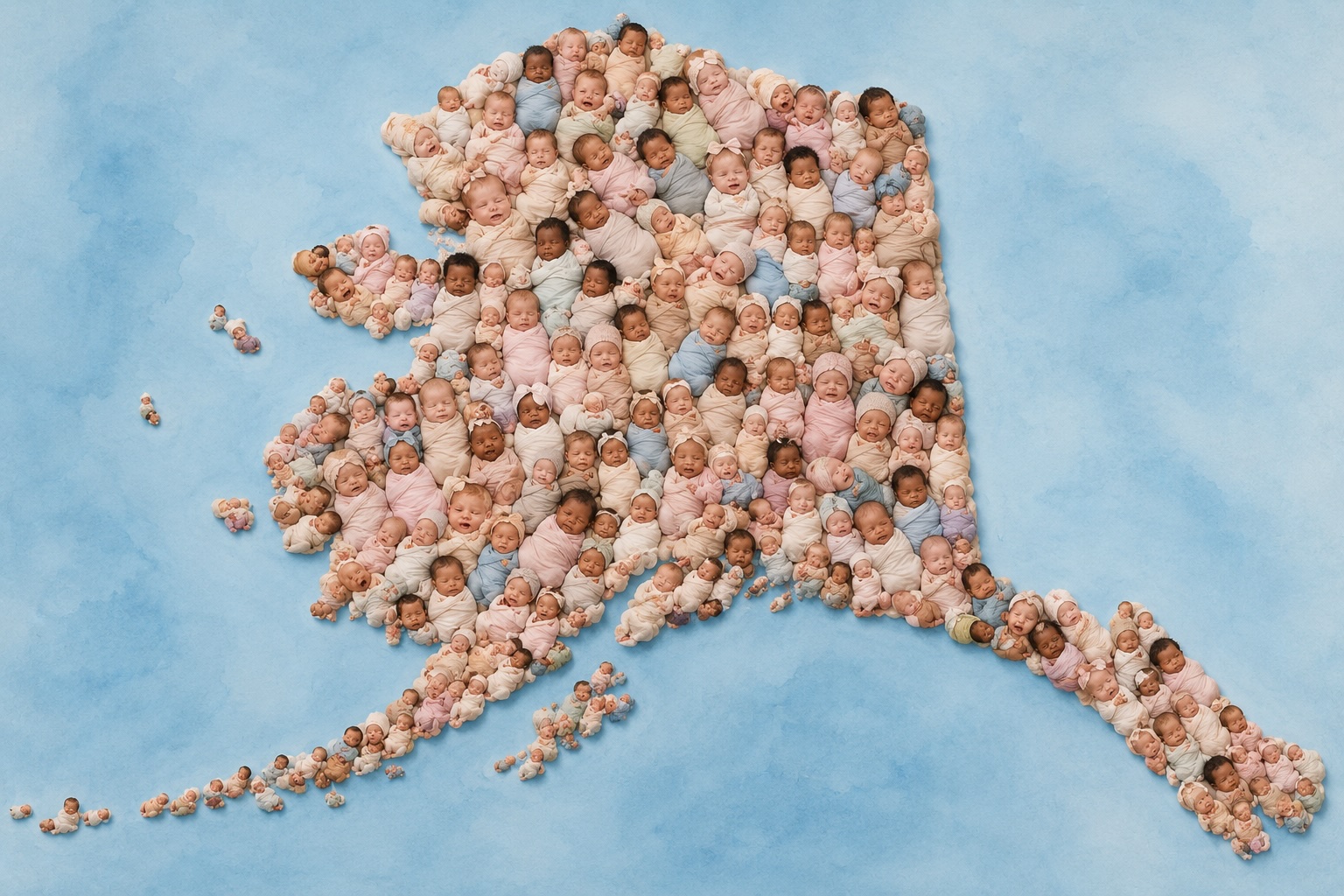
At the same time, another long-term trend has been reshaping the state in the opposite direction: Alaska is having fewer children, fewer young families are staying, and the population is aging rapidly.
According to recent Alaska Department of Health and Alaska Department of Labor data, the state’s annual births have steadily declined from 9,486 in 2020 to roughly 8,950 in 2024, he lowest levels seen since the late 1970s. Alaska’s fertility rate, while still among the highest in the nation due to energetic Natives, has also fallen below replacement level, meaning the current generation is not fully replacing itself over time.
In practical terms, Alaska is adding fewer future residents every year.
The state’s total fertility rate now sits around 1.9 children per woman, below the 2.1 replacement benchmark needed to maintain population stability without migration. Nationally, the US fertility rate has dropped even lower, hovering around 1.6.
Yet despite the decline in births, many Alaska leaders continue sounding alarms about severe housing shortages.
The question is whether today’s housing crunch reflects a permanent shortage, or a temporary mismatch created by migration patterns, construction bottlenecks, and demographic lag.
For now, Alaska’s overall population is still inching upward, but ever-so slowly. The Alaska Department of Labor estimates the state reached about 738,737 residents in 2025, a modest increase from the prior year. That growth is fragile and depends almost entirely on natural increase — births exceeding deaths.
At the same time, Alaska has now experienced more than 13 consecutive years of net domestic out-migration, meaning more people leave the state for other states than move in.
That outflow disproportionately involves working-age adults and young families.
In many communities, school enrollments are already shrinking. Several districts across Alaska have closed schools, consolidated classrooms, or warned of future downsizing because there simply are not enough children to fill seats.
The Anchorage School District alone has seen substantial enrollment declines over the past decade, mirroring demographic shifts occurring across much of the state. Schools are closing, and not just because parents are choosing private alternatives.
Meanwhile, Alaska’s senior population is growing as a percentage of the whole. Residents over 65 are projected to rise sharply through 2050, while younger age groups shrink.
That creates a demographic squeeze: fewer workers, fewer taxpayers, fewer births, and greater demand for healthcare and elder services.
This trend could fundamentally reshape how Alaska talks about housing.
If fewer young families are being formed, and if the childbearing-age population continues shrinking, long-term housing demand may not continue growing at the pace many assume.
Instead, Alaska could eventually face a very different problem: excess housing in some regions, especially rural areas or communities already losing population.
That does not mean the current housing pressures are imaginary.
In Anchorage, for example, inventory remains tight, interest rates have slowed new construction, and many residents struggle with affordability. The Mat-Su Borough continues to grow faster than much of the state, driven partly by exodus out of Anchorage. Construction costs in Alaska remain among the highest in the nation, especially in smaller, isolated communities, and zoning restrictions limit development in some urban areas.
Part of today’s housing pressure stems from household fragmentation rather than population explosion. More people are living alone, marrying later, divorcing more frequently, or delaying children entirely. That creates demand for housing units even while births decline.
Remote work, military rotations, seasonal labor, tourism growth, and migration between regions also distort local housing markets.
In other words, housing demand can rise temporarily even while the long-term population foundation weakens.
Alaska’s economy adds another layer of uncertainty.
Historically, oil booms brought waves of workers and rapid population growth. The Trans-Alaska Pipeline era in the 1970s and 1980s produced birth spikes and migration surges that pushed annual births above 12,000.
Today’s Alaska is different.
Oil production is lower than in past decades, although major projects such as the proposed Alaska LNG project, North Slope development, and even new data center proposals could alter migration patterns again if they generate substantial long-term employment.
Still, state demographers project that without a major reversal in migration trends or fertility rates, Alaska’s population is likely to begin a slow decline sometime in the coming decades.
Baseline forecasts from the Alaska Department of Labor suggest the population could drift downward toward roughly 723,000 by 2050.
That possibility raises questions:
Should Alaska aggressively subsidize large-scale housing expansion if the long-term population outlook is flat or declining?
Are some housing shortages really labor shortages, land-use restrictions, or infrastructure bottlenecks instead?
What happens if Alaska eventually finds itself with too few workers and too many aging homeowners?
For now, the state sits in an unusual middle ground: still growing slightly, still building, still hearing constant warnings about housing scarcity — even as births fall, schools empty, and the next generation gets smaller.
The demographic math does not necessarily point to collapse. It suggests Alaska’s future may look very different from the growth assumptions that shaped the state during the pipeline era, and different from what local leaders are promoting when they talk about building thousands of new homes. Mayor Suzanne LaFrance has a goal of building 10,000 new homes in Anchorage in 10 years, but there’s little data to support that plan.
The bigger question may not be whether Alaska has enough housing today, but whether Alaska will have enough young families tomorrow.



17 thoughts on “Fewer babies, more housing panic? Alaska’s demographic shift has a contradiction”
Fewer babies but increased homeless adults other by choice or circumstances like severely disabled, mentally ill, sickness, or severe abuse, trauma, and depression issues.
Then there are just adults who just don’t earn enough (to which Raising wages do not help with lowering costs) or healthcare debt wiped them out and they lost their home.
Hmmm? … If these homeless make terrible life choices and choose a life of debauchery – uselessness – nonproductive, sticking us with the ‘long-term’ burdens and astronomical endless costs, I’m wondering if we can simply elect to abort them from our society, resolving the issue rather than these politicos? Seems like a workable reasonable solution!
Sadly Tina, the homeless problem is almost exclusively a drug use problem. Not disability. Not mental illness. Not sickness. Not abuse. Not trauma. Not depression. Solve drug abuse, something that is well known and imminently treatable, and you solve homelessness in Alaska (and everywhere else). This isn’t that hard. Cheers –
Increasing building Subsidized housing to increase housing options is like saying we need to raise wages to meet the cost of living. It doesn’t work that way.
We need More houses For sale that workers can buy from banks or in cash to lower the cost of rents and home prices. We don’t need more rentals that out number the number of homes being built that consumers can buy.
If those 10,000 apartments are being built for individual sale then it’ll help
Because then 10,000 or so people will be out of rentals and in an apartment they are buying from the bank freeing up 10,000 rentals for new tenants.
But I know mayor Lafrance developer of those 10,000 units have no intention to sell them for private ownership. He just wants to own the tenants and add to his own fortune by taking their rent. Which! forever renting doesn’t help a person nor building a community, As a person pays mortgage or who “owns” their place betters a community.
A bright spot in being up at the Arctic and Alaska’s wealth (and there is billions worth) is largely undeveloped there will most likely be more single and families one day Rushing up to Alaska (if something happens to America). In the present life for Alaskans will continue feeling like we are living through a famine: a famine that comes from less economic growth and less job opportunities and fewer housing for sale options.
This society kills its babies, then imports enough unvetted criminals from foreign lands to create a homeless crisis. Don’t worry! We’ll create yet another government housing program like “the projects” of the 1960’s in somebody’s neighborhood……….or worse, since that requires actual local workers to build structures, we’ll do it Alaskan style and import pre-manufactured “mobile homes” and put them in “mobile home parks” so nobody here has to work, and the recipients can just sit inside their unit and get stoned.
Friendly amendment offered to your first sentence: “This society kills its babies, then imports enough unvetted criminals from foreign lands to create a homeless crisis.”
Corrected version: Half of this society, democrats and liberals, kill their babies, then imports….
Everything else you list are all due to democrats killing babies. Cheers –
Friendly correction noted and approved…………..
Meanwhile in other news, a report published by the White House Council of Economic Advisers has estimated that the USA is short of at least 10,000,000 single-family homes.
10 million homes built for sale that workers can buy and pay into instead of paying a landlord.
Something that Really is out of Greed is when homeowners keep multiple properties only to rent them out for benefiting only the property owner. When an owner knows he’ll never go back a place or he never lived in a place he owns then sell it so it can actually become a real home because rentals are not homes.
Even in Anchorage its got rentals that likely should become For Sale units for ownership including rental apartments that would was built that can make condominiums for singles or elders.
And the elders and aging GenXers should let go of their mini palaces of extraordinary big homes to be moving into the smaller apartment or smaller house (both Democrat and Republicans leaders and voters).
This way families might be able to afford a larger house if the older and single downsized and put many large homes on the market.
*Converting rentals into condominium units for sale for the aged, single, and lower income doesn’t mean a community can’t remain so anti development that new rentals are being built for the people who are not yet financially qualified to sign a mortgage.
*if the older and single childless adult downsized they will have lesser expenses while their health care costs are rising while their retirement income stays fixed; so they can afford more of their health care cost like a home caregiver or CNA when one is needed.
They want more housing to tax! Tax! Tax!, so they can Spend! spend! Spend!! To buy more votes to keep their power addiction fed
Unless the 10,000 housing units are set up under a Non profit which likely they will be organized, brought up, and managed under non profits and churches
So they won’t be taxed
All awhile the non profits will be applying for federal, state, and municipal grants aka Taxpayers to maintain the tiny houses
It’ll be much better if the 10,000 units were condominiums and townhouses !! FOR SALE!! because then the municipality can then gather its taxes