

By ADAM TROMBLEY
June 17, 2026 – For Alaskans, fishing isn’t a hobby — it’s part of the fabric of our state. It is culture, economy, and subsistence. Reasonable people have long disagreed on how best to manage Alaska’s fisheries, but skepticism should be rooted in data. The data on pollock bycatch tells a story rarely seen in the headlines, in campaign rhetoric and social media accounts.
In 2025, pollock fishing vessels encountered 32,920 Chinook salmon while harvesting more than 3.1 billion pounds of pollock — one Chinook for every 95,654 pounds caught. All Alaskan trawl vessels combined encountered 38,953 Chinook across 4.2 billion pounds of groundfish, or one Chinook per 106,706 pounds. These figures come from federal observers and electronic monitoring with 100 percent trip coverage — not industry self-reporting. (Source: NMFS BSAI and GOA Salmon Bycatch Data, 2025)
Critically, the majority of these Chinook are not from Alaska. In 2023 only 45.58 percent of Chinook encountered by Alaska pollock vessels were of Alaska origin. Of those Alaska-origin fish, just 31 came from the Upper Yukon — 0.10 percent of all Chinook bycatch. Coastal Western Alaska rivers accounted for 5,607, Southcentral rivers for 1,745, while British Columbia and West Coast U.S. stocks made up more than 54 percent of the total. (Source: NPFMC 2023 Chinook Genetics Report)
Looking at total Chinook fishing mortality across Alaska, using 2024 government data, provides even more context on who is responsible for Chinook mortality:
- Commercial salmon fisheries: 53 percent
- Sport and personal use fisheries: 24 percent
- Subsistence: 14 percent
- All trawl bycatch (pollock and non-pollock): 9.06 percent
- Eastern Bering Sea pollock bycatch alone: 1.9 percent (Source: ADF&G/ NMFS BSAI and GOA Salmon Bycatch Data, 2024)
Regionally, pollock bycatch accounts for just 1.75 percent of total Chinook fishing mortality in Southcentral rivers, 0.72 percent in Southeast rivers, and 0.93 percent across all Gulf of Alaska rivers. In most Alaska rivers the impact of pollock fishing on Chinook returns is less than one percent — not enough to crash a fishery.
A similar story emerges for chum salmon bycatch. Data on hatchery releases reveals that a majority of chum salmon encountered are of Asian and Russian hatchery origin. Russia has explicitly stated its intention to double its hatchery production — flooding the ocean with more hatchery fish which will inevitably show up in bycatch numbers.
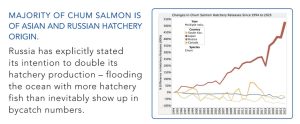
The accompanying chart illustrates dramatic changes in chum salmon hatchery releases from 1994 to 2023 (Source: NOAA). Russia’s production has surged over 500%, dwarfing contributions from South Korea, Japan, and Canada. This international hatchery expansion significantly contributes to chum salmon abundance in the North Pacific, meaning much of the bycatch attributed to Alaskan fisheries is from foreign hatchery sources. It’s well known that the hatchery fish are released when they are larger and older than natural Alaskan stocks. This places the natural stocks at a serious disadvantage when competing for limited food sources.
Pollock trawl bycatch itself is also often misrepresented. According to NOAA’s 2025 bycatch and discards data, squid and jellyfish account for more than 61 percent of all pollock fishery discards. These are non-target, non-managed species with no conservation concern. The salmon and halibut that dominate public debate represent only a small fraction of total bycatch. (Source: NOAA Bycatch and Discards in Alaska Pollock Fisheries, 2025)
Claims that commercial fishing operates without oversight are false. Federal law requires independent observer coverage or electronic monitoring on virtually every pollock trawl trip. Those Chinook encountered are counted and genetically sampled by federally employed workers. The numbers in this piece come directly from that mandatory federal system — the same data used by NOAA and the North Pacific Fishery Management Council to set policy.
Alaska’s seafood industry supports over 48,000 direct jobs and $2.5 billion in US economic activity. The pollock industry annually returns $80-$100 million dollars to 65 Western Alaska villages, accounting for 6300+ Alaska jobs, generates $832 million dollars in Alaska economic activity and $21 million dollars in taxes for state and local governments. The pollock fishery is the backbone of Alaska’s fishing industry.
Hyperbole from candidates, NGOs, Facebook groups, and outside interests should not drive fisheries management.
Facts, science, and data should.
Alaska’s fisheries are too important — economically, culturally, and ecologically — to be managed on incomplete information. Alaskans deserve a factual debate.
Adam Trombley is a lifelong Alaskan, former Anchorage Assembly member, former Chief of Staff to Mayor Dave Bronson, former state director for U.S. Sen. Dan Sullivan, and currently serves as Strategic Director for The Truth.




3 thoughts on “Adam Trombley: Numbers on pollock bycatch don’t match the headlines”
Are the numbers changing during monitoring of catches? The North Pacific Fishery Council is suppose to carry weight in oversight but then International fisheries group sometimes appears to take control and does not follow the plan but acts independent of the North Pacific fisheries council’s agreement with all parties. The other thing mentioned is numbers from the Yukon fishery area. Word of mouth states that the processors are buying off the fishermen a large sum then taking all the catch at the mouths of rivers or from fishermen at those choke points. Also reported was the processors that filled their ships on coastal cannery loads and did not make the run to the contracted canneries in Seattle. Numbers can easily be scattered or misused in those circumstances like “bait and switch” on purpose.
These “numbers” are widely cited and repeated endlessly by trawl proponents. But some do not make logical sense. Why are trawlers at the mouth of the Yukon catching “Russian hatchery fish” in an area known for Yukon River fish? Has genetic testing become so cheap that a very large sample of bycatch salmon were tested and found to be known Russian subspecies? Or were a few fish tested and extrapolated to the group? Full genetic mapping – to the degree we’re asked to believe – is quite expensive. Something doesn’t pass the smell test. The “scientific studies” that I’ve looked at appear to be in order, but I do not believe they are completely unbiased.
A bit more to the point – hear me politicians – is: Why are there so few fish in the Yukon, and what are we going to do about it? Any candidate who is running on a “support the trawlers” platform but fails to have a plan for addressing fisheries decline in our rivers is turning their backs on 100,000 votes, my own included. No dichotomy – we can support both trawling in some form and have fish in our rivers too.
What has happened to the Reds? None on the grocery shelves any more. No one sees them anywhere but they are fished from rivers and taken by the processors for canning and no canned reds are found in Alaska. What’s jappened?