


By SUZANNE DOWNING
Aug. 2, 2026 – Anchorage Mayor Suzanne LaFrance has celebrated a sharp drop in the number of people counted sleeping outdoors, but a lively discussion among residents on the Nextdoor social media platform shows many Anchorage residents are not convinced the city’s homelessness crisis has meaningfully improved.
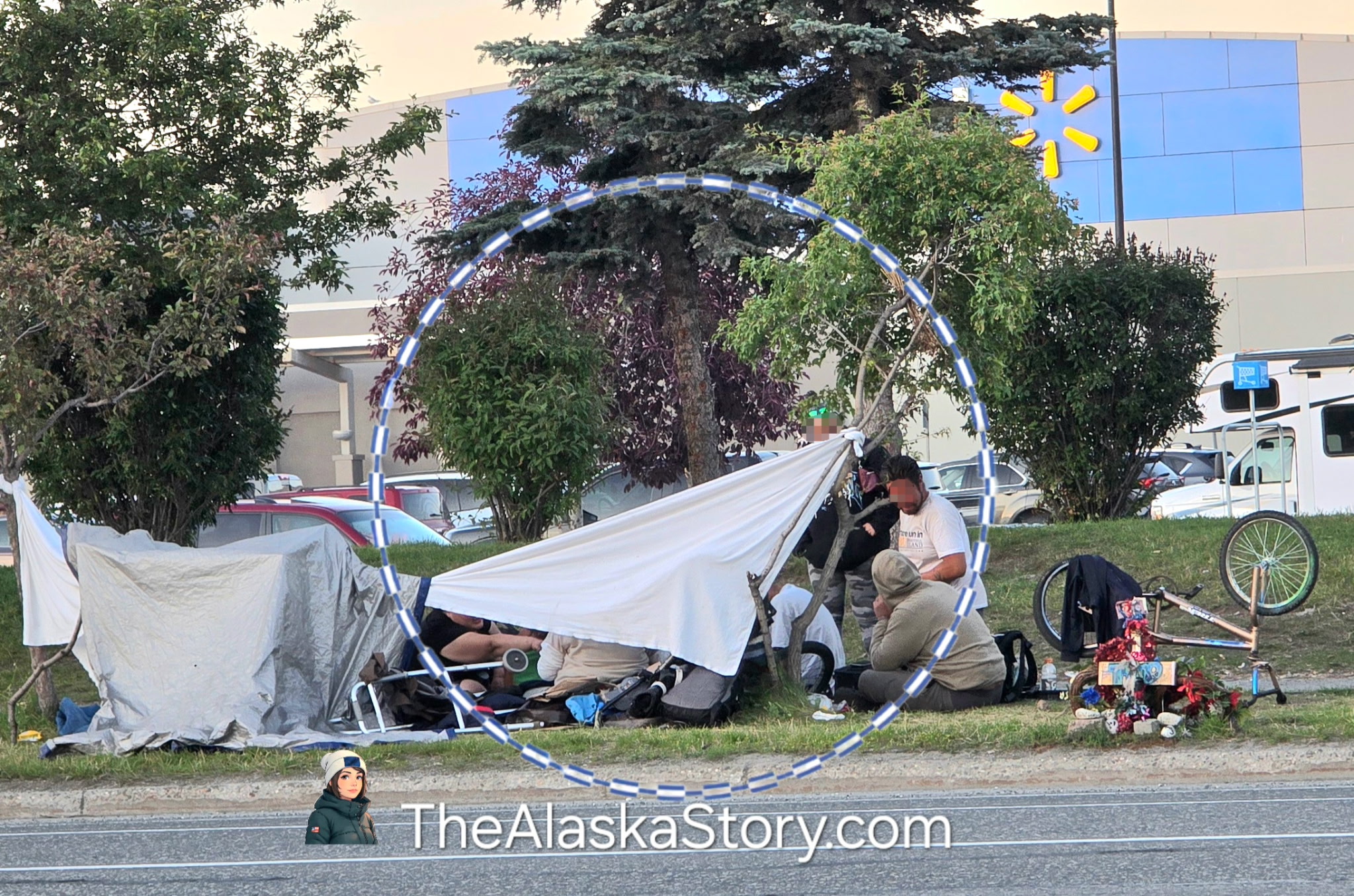
The debate erupted after Bayshore/Klatt resident Bill Bernier posted a question about a gathering near the Walmart store on A Street in Midtown.
“So I wonder how much bigger the camp out front of Walmart on A Street has to get before the city addresses it?” Bernier wrote.
The post quickly drew dozens of reactions and comments from residents across Anchorage. They described accumulated garbage, abandoned shopping carts, public drug use and people moving unpredictably near traffic. Several said they have stopped shopping at the Midtown Walmart because of conditions around the property.
“I don’t go to that Walmart anymore,” wrote Manya W. of Russian Jack Park.
Laura W. of Lower Northeast noted that her husband had experienced too many incidents at the store and no longer shops there.
Karla H. said she drives past the area on her way home from work and watches closely for people who may step into traffic.
The comments offer a striking contrast with the message coming from City Hall.
LaFrance announced in May that Anchorage’s annual Point-in-Time count found 291 people sleeping outdoors in January, down from 402 in 2025 — a 28% decrease. The total number of people counted as homeless, including those staying in shelters, declined by a more modest 6%, from 1,748 to 1,645. The mayor credited expanded outreach, additional year-round shelter beds, crisis-response programs and enforcement against camping in certain public areas.
“That is fewer people sleeping in our public spaces, fewer people susceptible to our cold winter nights, and fewer people unsafe in our community,” LaFrance said at the time.
The Point-in-Time count, however, is a snapshot taken on a single winter night –Jan. 26 this year. It is not a continuous count of camps or people living outside throughout Anchorage, and conditions can change substantially as temperatures rise. The organization overseeing Alaska’s count notes that communities may use surveys, sampling and estimates to identify the unsheltered population. The Alaska Coalition on Housing and Homelessness describes the methodology here.
Anchorage residents say camps are more visible during the summer.
“It grows and shrinks with the weather,” wrote Katy N. of South Addition. Paul H. of North Star agreed, describing “a definite ebb and flow.”
Willie M. of Abbott Loop North wrote that large camps had previously discouraged members of the public from using Cuddy and Lions parks. He said camps often lack sewage and garbage facilities and have become harder to detect as their occupants move into less visible areas.
“If you see them in your area, chances are there’s a nearby camp,” he wrote.
Other commenters expressed frustration with what they see as a lack of enforcement. Some complained that behavior that would ordinarily draw police attention — including theft, illegal drug use and public indecency — appears to be tolerated when it occurs in or near homeless camps.
Thomas M. of Fairview said he had been told the A Street location was on a state roadway and that the municipality would not address it unless requested by the Alaska Department of Transportation.
“That answer was b.s. as far as I am concerned,” he wrote.
One commenter later reported that police had visited the location and dispersed the group. But another resident said several people and nearby garbage remained when he drove past later that night.
The discussion was not unanimous about who should bear responsibility or how the city should respond. Some blamed municipal officials and called for tougher enforcement of laws against vagrancy, public intoxication, drug use and panhandling. Others argued that Native corporations, social-service agencies and the city should collaborate to provide more housing, substance-abuse treatment and mental-health services.
Brian T. of Old Seward/Oceanview described the conditions at the Midtown Walmart, downtown, Cuddy Park and other locations as “disgusting,” but also challenged others to explain what actions they had personally taken to help.
City officials and service providers have acknowledged that shelter capacity remains insufficient. Shelters were reportedly full on the night of the January count and during much of the winter. Even during warmer weather, people have been turned away because beds were unavailable. A mayoral aide estimated Anchorage would need about 200 additional winter shelter beds, at an annual cost approaching $2.5 million.
The Anchorage Coalition to End Homelessness separately reported a gap of 350 shelter beds and 252 transitional-housing placements in its 2025 analysis, along with a much larger shortage of permanent and supportive housing. The coalition’s data dashboard was updated in June,
Anchorage’s homelessness data do not show the problem affecting all demographic groups equally. An Anchorage Coalition to End Homelessness snapshot comparing people newly entering the homelessness-response system with the city’s 2020 Census population found American Indian, Alaska Native or Indigenous residents overrepresented by 29.9 percentage points. Black residents were overrepresented by 14.7 points, while Native Hawaiian or Pacific Islander residents were overrepresented by 1.6 points and Hispanic or Latino residents by 2.1 points.
White residents were underrepresented among new entrants by 35.9 percentage points, Asian or Asian-American residents by 10.1 points and people identifying as some other race by 6.4 points.
The chart does not measure whether homelessness is increasing or decreasing over time; it measures which groups are disproportionately represented among people newly entering the system. The categories are independent because individuals may identify with more than one race, while Hispanic or Latino is recorded separately as an ethnicity.
The snapshot indicates that Anchorage’s continuing inflow into homelessness is falling disproportionately on Alaska Native and Black residents, even as the mayor points to a decline in the overall count.

25 thoughts on “Mayor touts decline in Anchorage homelessness, but residents say street-level reality tells a different story”
My crib is less than half a mile to that Wally-World. I go there to support my own addiction 🥃, because it’s cheap. (Save it, Tina!). However, I often carry 🔫 because you never know what you’ll encounter along the way. Though twice as far, I reserve most of my grocery walks for Freddy’s on Old Seward/ENLB. Even THAT place has a share of the ‘more-animated’ derelicts hanging about, but it’s NOTHING like Wally World.
.
I also like to take early morning walks on the weekend. I managed to capture a video of not fewer than 5 people sleeping between the curb and the sidewalk, one morning. It’s sad, truly. What am I doing about it? A monthly tithe to the Rescue Mission on Tudor road.
.
Blessed or cursed, we’re all God’s children.
Damian, you may be a better man to serve the homeless at Anchorage Gospel Mission than some of the men they got who I see as Luke-warm Christians.
The problem that our Anchorage Faith based homeless ministry has is the very same problem in our community’s churches. Too many lukewarm Christians that I don’t know if someone can be Luke warm and a Christian at the same time. But. The battle the Homeless men and women are fighting is a battle out of this world that Luke warm Christians (do-gooders) do not have the mind and spirit to fight against because they don’t have the Word.
I’ll take the tithe a little further, buy what the Anchorage Gospel needs with your tithe money and deliver it. This way the tithe doesn’t go straight into an employee’s wage instead of helping the homeless.
You know that the men circulating through out the Anchorage Gospel Mission want to be discipled in God’s Word (to understand the Bible and how to apply it in their lives) but Staff do not provide not enough Bible study groups throughout the week and through out the days for reaching these men
I handed Pastor John the very first actual donation — not a pledge — to their needed boiler replacement. It was a “stretch” donation for me.
.
P.S. please note spelling of my name. Mom picked a Flemish Belgian priest as my namesake.
The ROI on taxpayer dollars being ‘wasted’ on this endeavor is woefully weak.
The only effective measure is to offer them free vodka bottles laced with fentanyl.
Rob, euthanasia has been soundly rejected in this country and your comment speaks of depraved indifference. Maybe you should move to Canada where they seem to be of one mind with your stance of providing poison to their people to solve their issues.
If for some ungodly reason you thought this was funny……shame on you.
Back in the day, we had vagrancy laws that were enforced. ==> Zero “homeless”.
These are the same o same liberal neighbors who voted for Lafrance and her liberal assembly cronies. No changes will happen until these same liberals get more moderate to conservative and elect conservative candidates over their liberals. Then accept the Harder changes inflicting discomfort that Conservatives are known for
Yes
Panhandling is way too lucrative over getting a job and much safer since the ASSembly gave all jaywalking rights to the pedestrians using the roadway as their personal space.
Of course, when you don’t enforce the law, statistics always show a decline in crime. In Anchorage, there is no enforcement. The police don’t respond unless there’s already a dead body.
So true
The people we see hanging out, breaking the law, and causing disruptions on A Street near WalMart may not be homeless. It is possible that we taxpayers are paying all of their living expenses (rent, electric, heat, water, internet, television, food, etc.). Because they are not required to do anything “productive” in exchange for their fully paid living expenses, these people are free to hang out everyday, drink to the point of intoxication in public, shout at passersby, and otherwise do whatever they want. Often these people go to Loussac Library to charge their phones and e-cigarettes (vapes) because posted rules do not apply to them.
.
I say this because Thea Bemben, the mayor’s special assistant for homelessness, told me the fifteen to seventeen people, who routinely hang out at “the wall” across from Global Credit Union, WalMart, and Fred Meyer in east Anchorage, are not homeless. She said they are all “housed”. We taxpayers pay all their expanses and these people are free to gather daily at “the wall”, drink to the point of passing out, call passersby the “N-word” and trespassers on their land, and threaten and display physical violence. When I called the Ombudsman’s office about this unacceptable situation, Drew more-or-less blamed me for causing the problem.
.
According to Suzanne LaFrance this is just fine and she will not allow APD to intervene in any meaningful way.
“City officials and service providers have acknowledged that shelter capacity remains insufficient.” Get back to me when the City pays my mortgage for me. Until then, I don’t owe any of these deadbeats a place to live. If they can’t find shelter elsewhere and are living on the street, perhaps some time behind bars would cure them of the notion that doing so is free and allowed.
Many of them get arrested on purpose, especially in the winter. They’ve got it better inside than out. The deterrence factor for that population is minimal. It’s like old home week for most; where all their friends are.
If the Mayor and her scumbag buddies on the Anchorage Assembly enforced the long existing laws against public drunkenness, vagrancy, panhandling, public defecation, jaywalking etc. etc. etc. the problem would not exist. Anchorage voters – you elected these mentally ill “public serpents”. You get what you deserve.
Our elected officials are understandably trying to create a positive narrative. The homeless situation might be less bad. Less bad is not acceptable.
Of course what she says and reality don’t match. Remember how,she called her predecessor ” INCOMPETENT “? I think the word better applies to her, along with ” dishonest” and ” malevolent”
It’s a growth industry
The Anchorage mayor and the assembly are nothing but a bunch of frauds!! The assembly fought Mayor Bronson all the way to fix the homeless problem. And then LaFrance got elected and viola, problem solved. Only it wasn’t solved. They just quit saying anything about it and the Anchorage Daily Snooze quit reporting anything about it. See!! Nothing here, move along. I have some friends in Anchorage and they’re telling me that it’s worse now than ever before. Anchorage needs DOGE and Nick Shirley to take a look into what’s going on there. Cheers!!
I believe it’s .28% decrease, if any, these ngo’s and muni won’t aggressively try to eliminate the homeless problem, they get paid per person, the more people they count the more money they get paid. It’s the golden goose and they aren’t going to let that go, ain’t that right Meg!
Ever since we were saddled with Mail-in voting fraud, one party rule, this city he’s been in rapid decline. Business’s are moving out, people are moving out in droves, buildings are being demolished left and right. Because of the garbage dumps, green areas are disappearing. It’s sad thing to see what this city was under Mayors Sullivan, Fink, Werch to name a few and what we have now. I’m embarrassed by what the city looks like to the tourist who comes from abroad for the Alaska vacation to check off bucket list item and see Anchorage for the cesspool it is now.
The “decrease” Mayor Lafrance might be tooting might mean of the deaths of chronic Homeless Persons from freezing in winter, died by car, and homicides by other homeless.
Anchorage has had lost Too Many souls in the last two and half years during mayor Lafrance’s term that the city stopped tracking and counting deaths of the homeless.
By the way. There are More white adults homeless in Anchorage than Native Alaskans and Blacks. So let’s not be racist just because it’s easier to see the Brown person on the street than the white person. I’m seeing more white adults which makes more physical sense when White Alaskans make the dominate population in Alaska.
Furthermore for White community leaders, Corporations are not social welfare organizations. The Alaska Native Corporations both regional and tribal do not have the responsibility to take care of Homeless shareholder descendants or anything else like paying funeral costs for shareholders. Its responsibility is to make money not give out handouts.
I live in midtown/Rogers Park area, and I prefer riding the buses over to the Debarr Walmart due to the crowd of homeless sleepers laying all over grass on A st. I never know about the safety of getting off bus 25, because they’re sleeping/drunk all over around the bus stop. Besides when they’re all laying, you can’t walk from the bus to the WM parking lot to get to the store.