


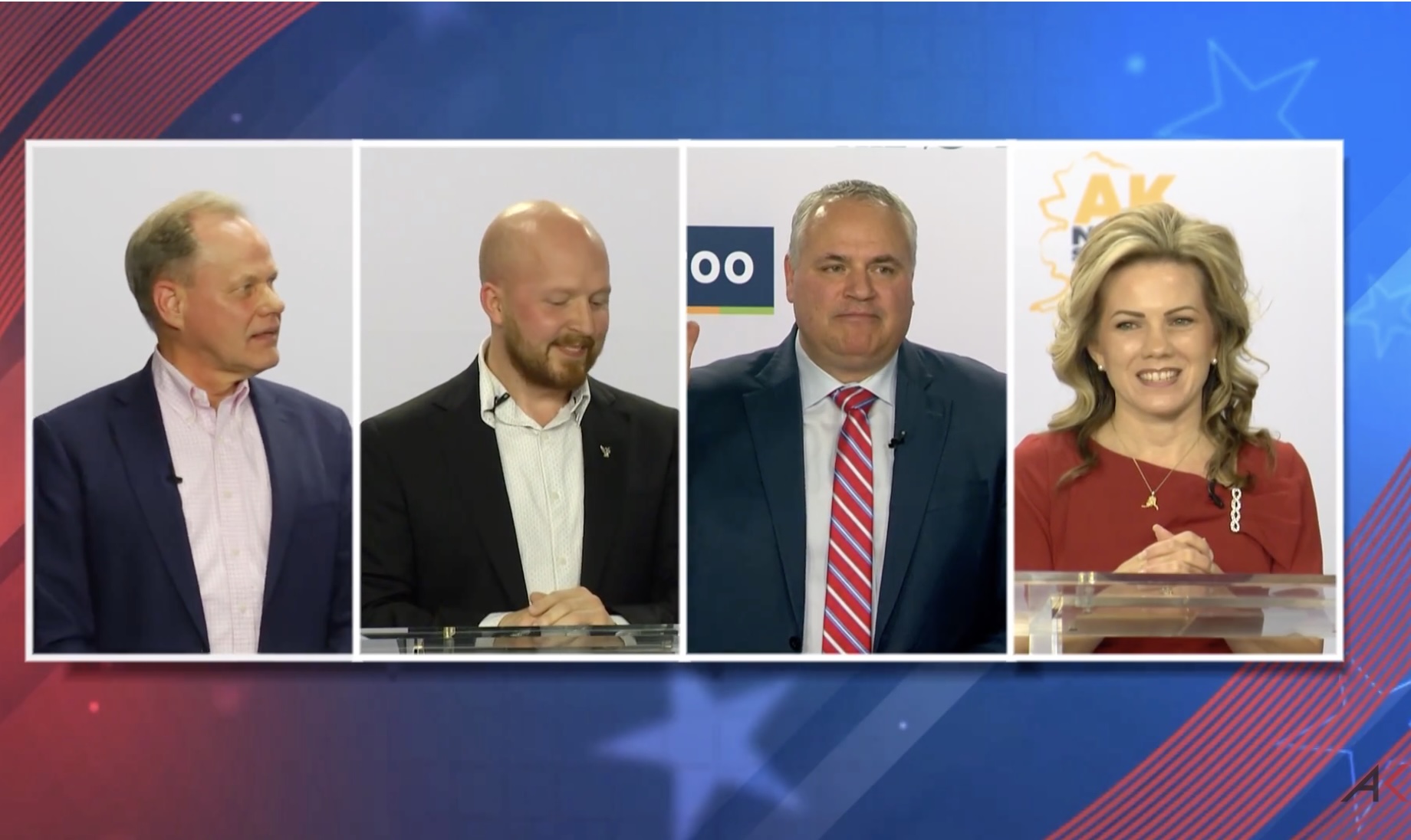
Screenshot from Debate for the State YouTube video.
By SUZANNE DOWNING
Oct. 9, 2026 – Bernadette Wilson delivered the most sustained confrontation with Democrat Jonathan Kreiss-Tomkins during Thursday night’s Debate for the State, challenging his record on income taxes and energy policy, while fellow Republican Dave Bronson repeatedly praised the Democrat and even argued that compromise is necessary to get a gasline.
The Oct. 8 debate, presented by Alaska Public Media, Alaska’s News Source/KTUU and KTOO, featured Wilson, Bronson, former Attorney General Treg Taylor and Kreiss-Tomkins.
Three Republicans are competing against one Democrat for the governor’s seat, a situation President Donald Trump criticized Thursday as he questioned the wisdom of the divided Republican field and attacked Alaska’s ranked-choice voting system.
The debate revealed another division: How aggressively should Republicans challenge the Democrat seeking to succeed Gov. Mike Dunleavy?
Taylor briefly challenged Kreiss-Tomkins on taxes during the opening budget discussion. Wilson returned to the Democrat’s record throughout the debate’s closing exchanges. Bronson, meanwhile, emphasized his personal rapport with Kreiss-Tomkins and their shared belief in compromise.
Asked how he would work with people on the other side of the political divide, Bronson described getting to know Kreiss-Tomkins over coffee on the campaign trail. He presented their relationship as an example of cooperation despite their ideological differences. Later, in his closing remarks, Bronson again praised Kreiss-Tomkins personally while acknowledging that they approach their objectives from different political perspectives.
Wilson took a different approach, questioning whether the bipartisan arrangements already operating in Juneau had produced better results for Alaskans.
“You’ve had bipartisan coalitions in the House and in the Senate,” Wilson said. “How has that worked for you, Alaska? Are you any better off today than you were 10, 20 or 30 years ago?”
She accused her opponents of being more interested in “singing Kumbaya” than confronting the policies she believes are holding Alaska back.
Bronson used a rebuttal to answer Wilson.
“We haven’t been going down there and singing Kumbaya. That’s the point,” he said. “The governor and the Legislature have not been getting along down there. And Jonathan and I, opposite sides of the political spectrum, agree you still need to go down there and work with the other. Everyone’s tired of this fighting and this screaming and hollering at each other. As am I.”
Bronson then linked compromise directly to development:
“When you don’t compromise, you don’t get a gas line.”
Bronson’s remark was yet another criticism of Gov. Mike Dunleavy, someone who he has criticized publicly many times over the past few months. But it overlooked the governor’s repeated concessions in an effort to secure gasline legislation. As The Alaska Story has documented, Dunleavy offered compromises after compromises and still could not get the Legislature to pass a deal, a reminder that compromise requires movement from both sides.
Bronson made the same argument about roads to resources, blaming political fighting for the stalemate. Wilson immediately countered that electing a Democrat would jeopardize the gasline and pledged to fight an income tax rather than concede before the battle began.
Bronson’s conciliatory posture drew a mocking response from the Alaska Democratic Party, which posted on X:
“Is Dave MAGA Bootlick Bronson going to rank JKT?????”
The party’s question was a taunt that revealed how conspicuous Bronson’s kid-gloves treatment of Kreiss-Tomkins had become. But Bronson’s strategy may actually have been to try to win second-place rankings from JKT voters.
Wilson’s criticism centered on records voters could examine.
She pointed to Kreiss-Tomkins’ 2017 vote for a state income tax and the significance he attached to it at the time.
“I think this is one of the most important votes that I or the other members will ever cast,” Kreiss-Tomkins said, according to the Peninsula Clarion report Wilson referenced.
The House approved that proposal 22–17, with the Democratic-led majority supporting it and the Republican minority opposing it. The proposal did not become law.
Wilson also cited an April 21, 2021 letter Kreiss-Tomkins signed urging congressional leaders to pursue a national clean-energy agenda with 100% “clean energy.”
Addressed to then-House Speaker Nancy Pelosi and the other congressional leaders, the letter called for an economic recovery package that would:
“Put the U.S. on the path to 100% clean energy powering everything from our electricity grid, transportation, and buildings with reliable, affordable clean energy.”
The document lists Kreiss-Tomkins among its Alaska signatories. It applauded President Joe Biden’s COVID relief package and advocated additional investment in clean energy, infrastructure and manufacturing.
Wilson described the letter as support for “100% renewables.” The document’s actual wording is “100% clean energy,” a distinction worth preserving when assessing the record.
Taylor also drew a direct contrast with Kreiss-Tomkins. In the opening fiscal discussion, he criticized JKT’s support for additional taxes and argued that Alaska should grow its economy and tax base through resource development. Later, Taylor emphasized his experience working across party lines as attorney general.
Kreiss-Tomkins defended compromise and portrayed Wilson as a continuation of Dunleavy’s approach, arguing that Alaska needed a more cooperative relationship between the governor and Legislature.
The exchanges unfolded against the larger Republican concern Trump raised Thursday: Democrats have consolidated behind Kreiss-Tomkins, while three Republicans remain on the general-election ballot.
Democrat Tom Begich withdrew and endorsed Kreiss-Tomkins after the primary. Wilson, Bronson and Taylor continue to compete for Republican first-choice votes, leaving later-round consolidation dependent on how voters rank their ballots.
As The Alaska Story reported Thursday, Trump questioned the sanity of that arrangement and condemned the ranked-choice system governing the race.
Thursday’s debate put the candidates’ different approaches on display. Taylor challenged JKT’s tax agenda. Bronson stressed cooperation with him. Wilson repeatedly brought the discussion back to the Democrat’s record, and whether singing Kumbaya on those policies would really serve Alaska.


One thought on “Wilson presses JKT’s record at governor debate as Bronson praises Democrat, urges compromise”
I am not impressed with Bronson’s quotes. Weak.