


By SUZANNE DOWNING
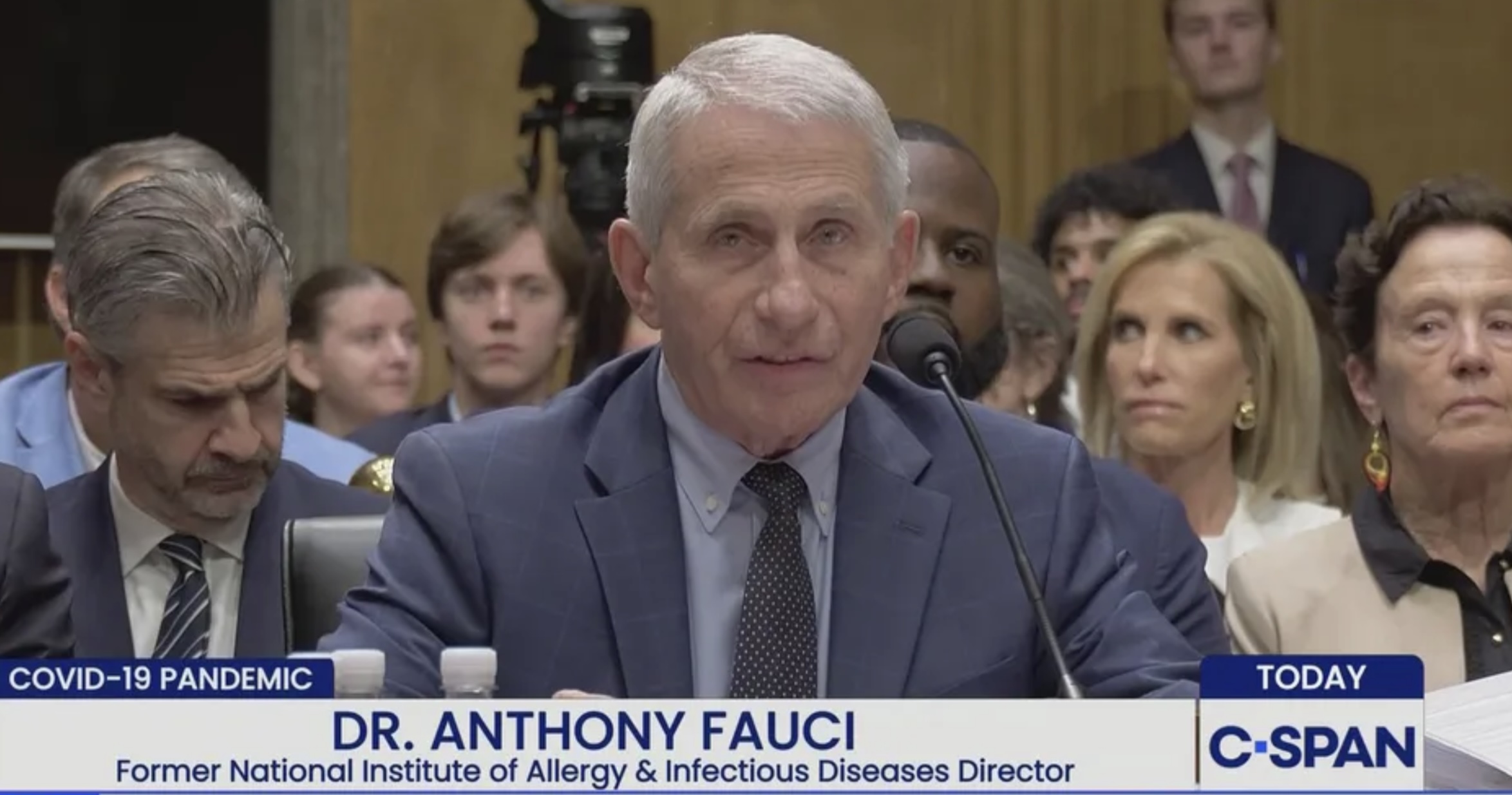
Aug. 6, 2026 – A US Senate committee voted Thursday to hold Dr. Anthony Fauci in criminal contempt of Congress after the former federal health official refused to answer questions about the origins of Covid-19, federal funding of research in China, and decisions he made during the pandemic.
The Senate Homeland Security and Governmental Affairs Committee approved the contempt resolution on a party-line vote, with eight Republicans voting in favor and five Democrats opposing it.
The committee then referred the matter directly to the Justice Department for possible prosecution, bypassing what could have become a prolonged fight and potential Democratic filibuster on the Senate floor.
The referral does not guarantee that Fauci will be charged. That decision now rests with the US attorney’s office in Washington and the Justice Department.
Committee Chairman Rand Paul of Kentucky said the confrontation was no longer simply about Fauci’s controversial pandemic policies. He framed Thursday’s vote as a test of Congress’ ability to compel testimony from a witness appearing under a lawful subpoena.
“Oversight is not a courtesy this committee extends or a favor a former official grants us,” Paul said. “A subpoena is not an invitation. A subpoena with no consequence is not a subpoena. It’s a suggestion.”
Fauci appeared before the committee July 29 after Paul subpoenaed him to testify. During the nearly three-hour hearing, Fauci invoked his Fifth Amendment right against self-incrimination 111 times, refusing to answer questions about the government’s pandemic response and the still-disputed origins of the coronavirus.
Senators sought answers about whether the National Institute of Allergy and Infectious Diseases, which Fauci led from 1984 until 2022, funded risky virus research conducted through intermediaries at the Wuhan Institute of Virology in China.
The Wuhan laboratory remains at the center of questions about whether Covid-19 emerged through natural transmission or resulted from a laboratory-related accident. No definitive public conclusion has resolved that dispute.
Republican senators also wanted Fauci to explain communications surrounding the early response to the virus, discussions about masking, vaccines and business and school shutdowns, and allegations that government officials sought to avoid disclosure of pandemic-related communications.
Paul has also pointed to Fauci’s recently released private diary entries, arguing that they show Fauci privately took the possibility of a laboratory origin more seriously than his public statements suggested.
Fauci refused to answer even after Paul ruled that his Fifth Amendment claim was invalid and directed him to respond.
Former President Joe Biden issued Fauci a sweeping pardon shortly before leaving office in January 2025. The pardon covered any and all potential federal offenses committed between Jan. 1, 2014, and the date of the pardon arising from Fauci’s government service.
Paul argues that because Fauci cannot be federally prosecuted for conduct covered by that pardon, he no longer faces the threat of self-incrimination for truthful testimony about his pandemic-era actions. Therefore he cannot claim the Fifth Amendment for protection.
“Dr. Fauci appeared under subpoena and invoked the Fifth Amendment to refuse answering questions,” Paul said when announcing the contempt resolution. “During the hearing, I ruled that the Fifth Amendment did not apply because of the pardon, and that Fauci had waived any remaining privilege by giving opening testimony. I ordered him to answer and warned him about contempt, yet he still refused.”
Fauci and his attorneys dispute that conclusion. They argue that the Biden pardon does not protect him from every conceivable legal threat, including state prosecutions or potential allegations arising from testimony given after the pardon.
Anything Fauci said during the 2026 hearing could itself be scrutinized for perjury or false statements, his attorneys argued. Fauci said Paul’s previous public statements about wanting him prosecuted gave him reason to believe the hearing was designed to place him in legal jeopardy.
Fauci, now 85 years old, used his opening statement last week to accuse Paul of having an “unhinged obsession” with him. He said he was invoking the Fifth Amendment on the advice of his attorneys despite his previous cooperation with congressional inquiries.
Democrats defended Fauci and attempted unsuccessfully Thursday to postpone the contempt vote.
Sen. Gary Peters of Michigan, the committee’s ranking Democrat, called Paul’s inquiry rushed and one-sided. He argued that punishing a witness for invoking a constitutional right could damage the committee’s ability to conduct future investigations.
Republicans said Fauci could not use the Fifth Amendment as a blanket shield after receiving a federal pardon covering the period under investigation.
Sen. Bernie Moreno, an Ohio Republican, offered one of the morning’s sharpest condemnations when his name was called.
“On behalf of the millions of people harmed by Anthony Fauci, resoundingly yes,” Moreno said as he voted for the resolution.
A criminal contempt referral accuses a witness of willfully refusing to comply with a congressional demand for testimony or documents. Under federal law, a conviction can carry up to one year in jail and a fine, although contempt prosecutions of executive branch officials and former officials have historically been uncommon and often become entangled in constitutional disputes.
Two former Trump advisers, Steve Bannon and Peter Navarro, were convicted and imprisoned for contempt of Congress after refusing to comply with subpoenas issued by the Democrat-led House committee investigating Jan. 6.
Republicans are now arguing that the same enforcement standard must apply to Fauci.
The Justice Department must determine whether Fauci’s invocation of the Fifth Amendment was legally valid, whether the committee followed the procedures necessary for a criminal referral and whether prosecution is warranted.
Whatever the department decides, Thursday’s vote marked a dramatic reversal for a government official who was once treated by much of Washington and the national media as the authoritative voice on Covid-19.
For Republicans who have spent years investigating the pandemic response, the vote was also a declaration that Fauci’s presidential pardon does not end Congress’ search for answers.



11 thoughts on “Senate Committee votes to hold Fauci in criminal contempt of Congress”
The left: we want the Epstein files
The right: we want the Epstein files
The center: we want the Epstein files
Trump: best I can do for you is Fauci’s diary, some lies about the reflecting pool, and a failed war in Iran
The Epstein files probably likely won’t fully be released until the last of the boomers and GenXers generations died
The leaders in it are rightfully so ashamed of themselves.
Millennials (the remaining ones who are still alive) and GenZers and GenAlpha and GenBeta will finally be able to see how disgusting the leaders of their grandparents and parents generation were.
Epstein Files are old Democrat business. Meaningless, hence forward. With LGBTQ nonsense and children being groomed and indoctrinated to be homosexuals and trannies by our public schools…….who gives two sh*ts about Epstein? Move on!
It just broke our coalition and a central campaign promise. No big deal…
It’s not just the sex that Epstein and company used to blackmail- though its victims paid a heavy price- it’s the purpose of the blackmail and for whom. No big deal. ..
I never thought I would see the right act so much like the left did during Biden > “Don’t believe your lying eyes, ect.” No big deal…
Note that this story was about Fauci….BUT when the left can’t win an argument, they simply re-direct, deflect and otherwise gaslight.
Classic leftism! BTW, if Lisa Murkie were on this committee she’d have supported Fauci just like she did with DEI SCOTUS nominees!
Not a good look for Dems to oppose this. Old Guard Dems seem determined to pull defeat from the jaws of victory in the mid-terms. They are soooo out of touch with the electorate!
To quote Stephen A Smith:
“….if there ever was a moment in time the American people have a right to know the truth and hear it out of the mouth of one particular individual it was yesterday….”
“…while he was pleading the fifth how come no Democrat got on his ass? This nation is indebted to his service, but that don’t make you flawless!….”
“This is all shady sh*t and the Democrats have nothing to say…”
“…when you are the authority on something you can not plead the fifth!”
I can highly recommend watching his entire segment on the subject.
Death by injection. Stabbed by the vaccine until turbocharged, and no longer twitching.
” It puts the needle in its skin or else it wears the mask again! ” – buffalo bill Fauci
Best comment.
Not to worry, Tony. Analysis of the contents of your mobile phone during the Covid period should expose much more of your deception. It might be that even the Deep State will stop defending you.