



By SEN. ROBERT MYERS
Conservatives often ask me why we don’t cut the budget. In my past article, I wrote about the difference between economic decisions and political decisions. This is one of those cases. According to the Kaiser Family Foundation, Alaska has the highest per capita spending of any state in the nation at $21,485 per person (please note that this includes federal money spent by the state) in fiscal year 2023. That’s far ahead of #2 Delaware at $14,923 and the national average of $8625.
The problem is not in finding things to cut. I get suggestions of what to cut on a somewhat regular basis. Instead, the problem is in finding the motivation to cut. Let’s look at the spending that we’ve done since statehood. Agency ops are the spending we do through the various state departments. Statewide ops are things like debt service, retirement payments, and transfers to state-owned corporations. Capital spending is what builds things like roads, airports, and buildings.
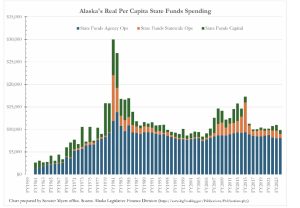
As the above chart shows, the size of our budget is nothing new. The trends are fairly clear. We had one operating budget level in the 1960s before oil. Once oil was discovered in 1968, our operating budget started to steadily increase across the 1970s. After a spike in the early 80s, we’ve stayed at roughly the same level once accounting for inflation and population. The variation has largely been in statewide operations and the capital budget. Since operating spending is things that we largely expect to continue year after year, it makes sense that we take cuts in the other areas before we look into operations.
Comparisons between that last budget before oil on the Slope (FY 68) and the budget we just passed (FY 26) are instructive as well. If we had just taken that 68 budget and adjusted it by inflation and population, we would be spending just under $2.2 billion. Instead, we spent just over $6 billion. Without surprise, the biggest agency jumps are in education, health, and social services. But we did have two agencies that have seen cuts compared to that ‘68 budget. The office of the governor has dropped by nearly half. Surprisingly, DOT has seen its operations cut by over a third. That says something about how the state sees road maintenance.
The simple explanation for these changes is that we have a lot of people in this state that make money off of state spending. As conservatives, we often point to welfare, and that’s part of it. But it’s also about how many companies and individuals make their living from state government. We have a high proportion of our workforce as government employees (federal, state, and local), roughly 21%, giving us either the highest or second-highest proportion of government workers in the country depending on the year. But that doesn’t include the people in private companies whose jobs depend on state spending. If we include industries like health care, education, construction, and utilities that are heavily dependent on government spending, my estimate is that we’re at roughly 45% of our workforce depending on government spending.
As I mentioned in my last article, giving the government the lion’s share of the resources changes people’s attitudes from getting government to do the right thing to getting their hands on the government’s lucre. Forty-five percent of the state’s workforce is a lot of people who will either directly benefit from state spending or be heavily sympathetic to it. It’s unlikely that we can convince a lot of these people to vote for lower spending without significant structural changes to our fiscal situation. As Upton Sinclair wrote over a hundred years ago, “It is difficult to get a man to understand something, when his salary depends on his not understanding it.” It’s going to be difficult to get people to agree to put our government back in proper proportion to our population when their livelihoods depend on things remaining the same.
The simple result is politicians in Alaska figured out decades ago that they can win reelection by spending money. Take that 45% of our workforce who make their living from government spending. Then add in spouses. Then add in people who have a philosophical bent towards more government intervention. We’re probably looking at more than half of the electorate voting for more government spending (or at least against cuts). This is why Governor Dunleavy faced a recall when he did attempt to make budget cuts in 2019.
On the other side, we have very little pressure to cut spending. In most states, that direct pressure is provided by a statewide tax. People know that they can’t vote for more spending than they can afford to pay themselves. Some states get around this by having highly progressive taxes, effectively leveraging larger numbers of voters who pay little taxes but get the benefits of spending against the fewer numbers who pay the higher taxes. The federal government uses both highly progressive taxation and debt to hide even more of the true cost of spending. Alaska avoids the pressure to cut by just not having significant state-wide taxes.
If a state can use these types of schemes (and a population in favor of more government spending in general), they still run up against the effects of the government taking up more of the state’s economic output, eventually chasing business out of the state and lowering economic output, thereby lowering government revenue. California is starting to run up against this problem, creating multi-billion dollar deficits. Instead of dropping taxes, they’re starting to lower regulations like simplifying building codes and making it easier to get permits. But Alaska is largely unaffected by this problem because the state doesn’t get money from most businesses. We can chase out the majority of the businesses in this state, and the government’s bottom line will be unaffected. Instead, chasing people out of the state actually helps the government’s spending because that’s fewer kids in school, less road maintenance, and fewer Troopers that we’ll need to pay for.
We can make an argument that the ACES oil tax chased oil out of the state at the same time that oil investment and production was surging across the rest of the country (more on that in a later article). That helped drive the interest in Gov. Sean Parnell’s More Alaska Production Act (aka, SB 21). But we’re also at a point where oil is making up much less of our state budget than it used to. This past fiscal year, we pulled in approximately $1.8 billion from oil. In contrast, the state got $3.7 billion from the Permanent Fund. Other unrestricted revenue brought in just under $600 million. A couple of years ago, I did some back of the envelope math. We could end the Permanent Fund Dividend, shut down oil production, and institute a small (2-4%) broad-based tax and run the entire state government without a deficit. That’s a scary place for the private sector to be in.
Let’s contrast that with an incident up here in Fairbanks. In 2024, the Assembly wanted to give the school district an extra $10 million. They could have looked for places to cut from like the Parks and Rec Department, but they decided to raise taxes instead. In order to do that, they had to run a special election to raise the local tax cap by $10 million. The group promoting it said that it didn’t necessarily have to come from property taxes, which was accurate, but we all knew where it would come from since roughly 85% of the borough’s revenue comes from property taxes. In the election, roughly 2/3rds of the voters said no. A number of people commented that they wanted the extra money to go to schools, but they didn’t want to pay extra taxes for it. At the state level, we don’t have that kind of pushback. So spending goes up so long as well have the money.
So we’re back to the question that started this article: why is it so impossible to cut spending unless the state runs out of money? In short, we’ve set up a system where most people have a reason to ask for more spending but very few have a reason to ask for less. Until that changes, our spending will keep going the same way.
Senator Robert Myers was born in Fairbanks and spent much of his young childhood at the Salchaket Roadhouse, owned by his parents. He attended the University of Alaska Fairbanks, where he studied philosophy, political science, and history. While in college, he drove for a tour company, sharing Alaska with countless visitors. He currently drives truck and travels the Dalton Highway (Haul Road) frequently. He ran for office because he wants an Alaska his children will choose to make their home down the road. When not working for his Senate District B, North Pole, he enjoys reading, history, board games, and spending time with his wife Dawna and his five kids.
Sen. Robert Myers: Why does Alaska look so good on paper, but perform so badly?

5 thoughts on “Sen. Robert Myers: Why is it so impossible to cut spending unless the state runs out of money?”
It’s impossible to cut spending, Robert, unless the state runs out of money, in part because:
.
(a) as the Lobbyist Directory shows, the registered special-interest half of Alaska’s lobbyist-legislator team outnumber the legislative half 5 to 1, which gives an idea why spending won’t be cut
.
(b) forensic audits which would reveal why it’s allegedly impossible to cut spending aren’t conducted on state finances and management practices,
.
(c) extent of fraud and waste in Medicare, Medicaid, welfare, and subsidies such as power cost equalization don’t seem to be known or reported,
.
(d) Alaska’s education industry, one of America’s worst performing and most expensive, does not appear to be accountable to anyone for anything,
.
(e) Anchorage School Board voted unanimously to steer contracts over $1M to union-run enterprises leading to the question of whether said contracts are routinely padded to exceed $1M so they can be steered to union-run enterprises,
.
(f) the Alaska Municipal League reports $838,646,565.50 stashed out of taxpayers’ reach, to use as they wish,
.
(g) the extent of fraud, waste, and abuse occurring because state infrastructure maintenance is “deferred” instead of performed before minor issues are deliberately allowed to deteriorate into major problems from which contractors can profit even more is unknown,
.
(h) Alaska’s grand-jury system, through which waste, fraud, and abuse can be investigated and prosecuted is broken,
.
(i) Alaska’s election and voter registration systems through which fiscal conservatives could be elected to fix the money problems are broken,
.
(j) but the top priority of the Senate Majority Leader and member of the Legislative Budget & Audit Committee is whether a fellow senator should be allowed to advocate for PFD’s because he has too many children, while another senator on the Finance Subcommittee worries about people getting information from sources which don’t meet his approval such as, presumably, this one.
.
(k) Undoubtedly there’s more stuff which makes a lot of money for a lot of Important People in and out of government, but you get the picture, Robert.
Nice summary.
Morrigan, you have hit the proverbial “nail on the head”. Alaskans need to face it. The state is pretty much a socialist state that has lived off the petroleum money. Now that the state legislature has taken the state to the brink of the fiscal cliff, the only thing most legislators (those in the majority with THE power) see is to get more revenue via some type of tax.
The spending side of the equation is hardly ever looked at. That’s because the state has a huge “spending cartel” which can only exist with state funds. I include the thousands of nonprofits which are never audited for ROI. It also includes many of those companies which only exist to suck off the state’s teat. These are our crony capitalists and rent seekers.
Has anyone ever seen a bureaucrat reduce spending with personnel reductions? Has anyone seen a Department ask the Finance Committees for LESS money? And please don’t tell me that the state needs to run like a business. We need a complete manpower study for the entire state bureaucracy to determine overlap of functions, nonessential functions, excess personnel, etc. Only through that will the state spend less.
Let’s look at all the quasi-government agencies which seem to exist for routing “special” people through again and again. Look at the state rocket launch organization–why should any state operate/maintain that facility?
ROI audit for each of the 5,735 IRS registered tax-exempt organizations in Alaska? Now that’s a summer project for aspiring CPA’s, no?
(https://www.irs.gov/charities-non-profits/search-for-tax-exempt-organizations)
.
What’s wrong with the Peoples’ Rocket Club? Even the Anchorage Daily News reported on that one: “Rocket launches and allegations of government waste: The hidden story behind that Glenn Highway bridge wreck”
(https://www.adn.com/alaska-news/2018/06/19/rocket-launches-and-alleged-government-waste-the-hidden-backstory-of-that-glenn-highway-crash/)
.
Manpower study’s a great idea. Challenge is planning and executing without interference from the mob responsible for government in its present form. Can you imagine, for example, Co-governor Giessel facilitating a study that could jeopardize the orderly flow of power and money, a study that could make Alaska look like Minnesota on steroids, with all sorts of low-hanging fruit ripe for federal prosecution?
.
Taking peoples’ money via some type of tax could be risky for the Ruling Class. More folks leave because they can’t afford their homes and new taxes and the few productive residents left behind after another 80’s-style exodus can’t be taxed enough to support spending-cartel members in the manner to which they’ve become entitled. What happens then?
.
Could it be that spending-cartel members do what they do because they’ve no reason to be concerned about voters or grand juries?
.
Suppose voters and grand jurors figure out how to restore integrity to their election and grand-jury systems, what happens then?
Exactly. It’s a heart issue where Alaskans need a new heart. Only God can change a persons heart.
I think your tone used sounds like tiredness and your jaded.
Because you make a bunch of excuses why Alaska can’t right size government and cut some people and services out of government.
No budget is so hard to cut that it can’t be done. Cuts can be made to Medicaid, Alaska public employees like the less public employees one hires then the less retirements we have to pay for, as well as education can be cut since Ak kids are learning nothing. Actually local communities should be funding their own school districts instead of the greater Alaska. Cuts to budgets all always unpopular,
If one cares about the state, that one will make the hard decisions necessary. If one doesn’t love Alaska then go ahead bankrupt Alaska let us run out of money when we have to crawl and grovel at DC to force other states in the union to pay 100 percent Alaskas bills! You know A lot of good can come out after experiencing extreme hardship and maybe this is exactly what Alaskans needs. Extreme hardship because of our selfishness.