

By THE ALASKA STORY
July 30, 2026 – A new partnership announced Thursday could move Alaska closer to using small nuclear reactors to provide dependable electricity and heat in communities and industrial sites where conventional energy is costly and difficult to deliver.
NuCube Energy Inc. and Alaska Fund announced July 30 that they have signed a memorandum of understanding to create NuAlaska, a joint initiative intended to develop, finance, own and operate advanced nuclear energy projects in Alaska.
The initiative would combine NuCube’s NuSun-1 micro-modular reactor technology with Alaska Fund’s mission of financing projects suited to Alaska’s distinctive energy and infrastructure needs.
The companies are targeting remote communities, mines, military installations and other isolated locations where severe weather, long transportation routes and dependence on imported diesel fuel can drive energy costs to punishing levels.
NuCube says its reactor is designed to produce both electricity and heat without refueling for as long as 25 years. A reactor with that operating life could sharply reduce the need to transport millions of gallons of diesel fuel into remote areas, although the technology must still clear federal licensing and project-specific permitting requirements before it can be deployed.
“Alaska is one of the places in America where advanced nuclear can make the biggest impact because the need for reliable remote power is real and it is urgent,” said Cristian Rabiti, co-founder and chief executive officer of NuCube Energy.
Rabiti said NuAlaska would bring together the technology, local relationships and long-term commitment needed to pursue projects designed specifically for Alaska.
Under the proposed arrangement, Alaska Fund would take the lead in financing the construction, ownership and operation of projects using NuCube’s technology. The financing structure is also intended to provide opportunities for Alaska investors to participate in projects developed in the state.
“Alaska Fund was created to give Alaskans a meaningful opportunity to invest in projects that shape Alaska’s future,” said Matt Larkin, founder and chief executive officer of Alaska Fund. “NuAlaska brings that mission to life by pairing breakthrough energy technology with a financing model designed to create lasting value for Alaskan communities, investors and the state as a whole.”
Alaska Fund has already invested in NuCube through the company’s latest financing round.
The memorandum is an initial framework rather than a final joint-venture agreement or commitment to construct a reactor. The two organizations will now work toward a definitive business structure, evaluate possible additional partners and begin discussions with communities, state and federal officials and the US Department of Energy.
No proposed Alaska reactor site, construction schedule, power price or project cost was announced.
Any NuCube project would face an extensive regulatory process. The US Nuclear Regulatory Commission has authority over civilian nuclear safety and licensing, while the State of Alaska retains authority over facility siting.
Alaska has already taken steps to prepare for the technology. In 2022, Gov. Mike Dunleavy signed Senate Bill 177, which streamlined the state siting process for microreactors. Regulations implementing that law were adopted in 2023, including requirements for developers to involve affected communities early in the permitting process.
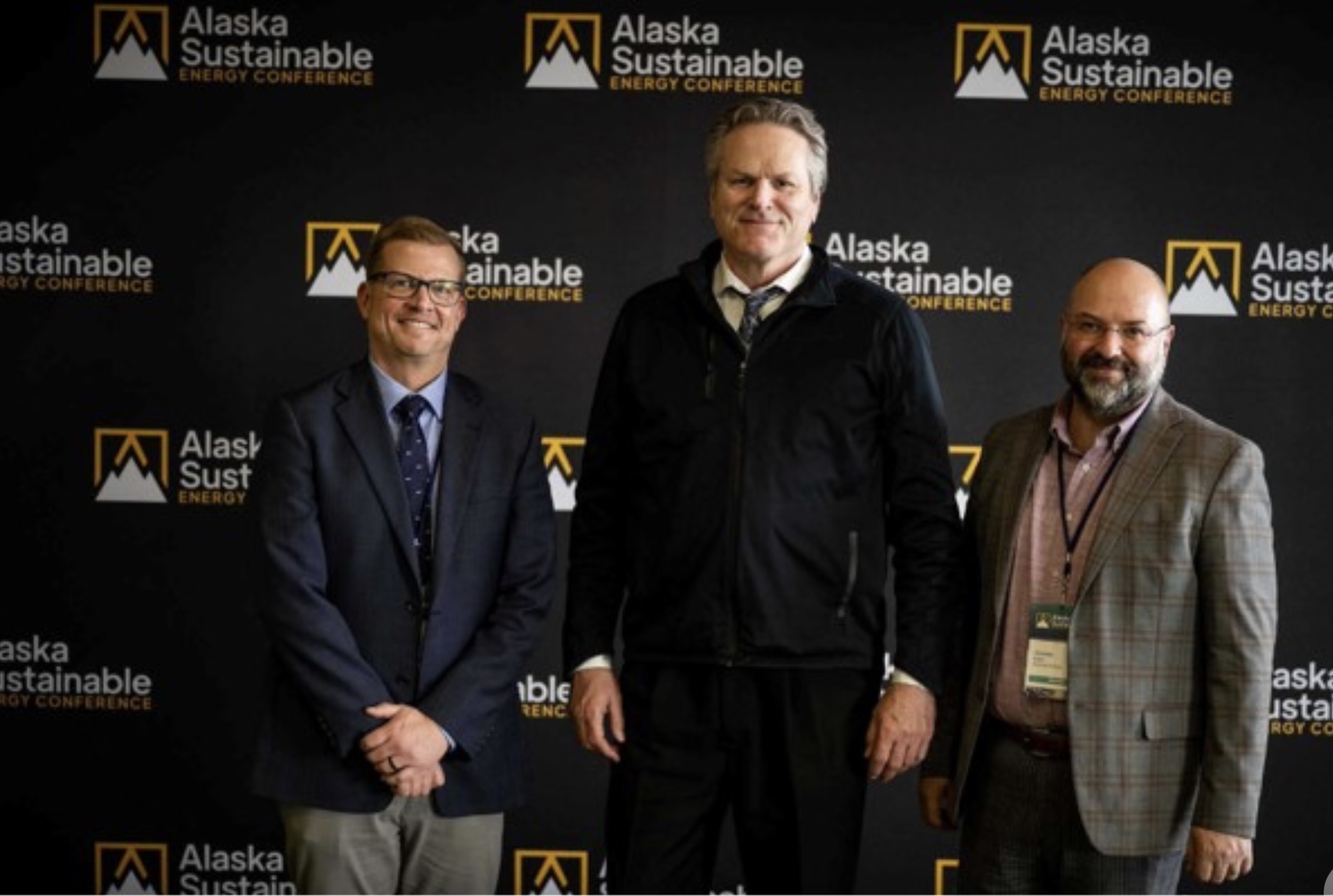
NuAlaska was discussed during the Alaska Sustainable Energy Conference, where Larkin and Rabiti briefed Dunleavy about the initiative.
“Alaska has always been a place where innovation is driven by necessity,” Dunleavy said. “Advanced nuclear energy has the potential to provide reliable, affordable power to communities and industries across our state, particularly in places where traditional energy solutions are costly or difficult to deliver.”
Dunleavy said he was encouraged to see an Alaska-focused effort attempting to convert the potential of advanced nuclear energy into operating projects.
Microreactors are considerably smaller than conventional commercial nuclear power plants. Their compact designs are intended to allow major components to be manufactured in a factory, transported to the operating location and installed with a much smaller physical footprint.
NuCube describes its technology as a solid-state, factory-built reactor using TRISO fuel and heat pipes. The company says minimizing moving parts can improve reliability and make the reactors suitable for isolated locations. NuCube’s broader reactor platform is being designed to produce as much as 15 megawatts of power and high-temperature heat for industrial uses.
The NuAlaska announcement comes as NuCube works toward becoming a publicly traded company.
In June, NuCube entered into a business-combination agreement with Launch Two Acquisition Corp., a publicly traded special-purpose acquisition company listed on Nasdaq under the symbol LPBB. The proposed transaction values NuCube at approximately $500 million before the merger and could generate up to $125 million in gross proceeds.
The transaction is expected to close during the second half of 2026, subject to shareholder approval, regulatory requirements and other closing conditions. The combined company is expected to seek a listing on Nasdaq or the New York Stock Exchange.
For Alaska, the question will be whether the emerging technology can meet its promises on safety, cost and reliability, and do so on a schedule that addresses the state’s immediate need for affordable energy.
The NuAlaska agreement does not answer those questions yet. But it establishes a vehicle through which the technology, financing and local participation needed for an Alaska project could begin to come together.
Photo: Matt Larkin, left, and Dr. Cristian Rabiti, right, meeting Gov Dunleavy during the Alaska Sustainable Energy Conference in Anchorage.



18 thoughts on “NuAlaska initiative aims to bring long-life nuclear microreactors to remote Alaska”
Four micro nuclear companies have reached criticality in June, they didn’t produce any power. There are a lot of steps to get through before a micro reactor design is proven safe, gets approval, and becomes available for power generation at remote sites. There are quite a few companies further along in the process than NuCube.
The Elelson / Wainwright reactor is supposed to go critical late 2028, in two years. Sounds like a lot of the steps have already been passed. Cheers-
Seems like I’ve heard that project is almost two years away for the last 4-5 years. OKLO is the manufacturer chosen for the Eielson project, it wasn’t one of the ones who just recently went critical to prove their concept however last week they received startup authorization which allows according to their press release “clears the way for fuel loading, startup testing, and reactor operations” (I am an OKLO shareholder). Currently I think anyone with knowledge of this would be pretty surprised if there was a gen iv reactor in operation and generating power anywhere in America in 2028.
I think that exploring new ways of providing services in Alaska is a good idea. On the other had there is always a hunger to come up with press releases and the like in the waning days of a lame duck administration, every lame duck administration. However the main response I have is that rural villages have always been challenged and continue to be challenged to merely maintain the diesel generators shipped by state government and by the federal government to rural villages. The only new proven technology so far has been government agencies being able to monitor those units from urban offices – offices in Anchorage for example. Someone might opine that it’s human nature to not value what is freely given, perhaps especially when it’s replaced for free (to the village, not free to actual taxpayers of course) whenever lack of maintenance causes it to burn, explode or whatever (or the fuel tank leaks and no one notices). So taxpayer-provided nuclear technology should be handed out very carefully and then monitored consistently.
Nuclear power is a disaster waiting to happen. Chernobyl aside (the Russians can’t do anything right), Fukushima should be the lesson the whole world should have learned. 880 tons of solidified melted fuel debris remain inside reactors 1 through 3, requiring continuous cooling water injection and a decades-long decommissioning process, not to mention the current 370 sq. km. evacuated, contamination, and recovery zones.
Just say no. Alaska has lots of alternate options.
Name them. Its easy to sit on the sidelines and obstruct, like you’re doing. Put your grand plan out there!
Alaska is the best place on the planet for small scale hydroelectric like Bradley Lake. There are literally thousands of such rivers that can so serve.
Alaska has the excellent prospect of tidal generation.
Alaska has geothermal potential like few other locations on Earth.
For Pete’s sake, we’re right now screwing up gas generation that can provide both heat and electricity for the next century through sheer stubborn stupidity. With Juneau currently screwing that up, tell us that new nuclear technology is “safe” and that somebody can’t screw it up.
The options are many.
Reggie, you could also mention the rash of coal fired steam locomotive explosions, and tidal wave tsunami’s in Glennallen.
It’s 2026 …….21st century
Don’t need to. The Denali Quake, Great Alaska Quake, Fairbanks flood suffice, not to mention an infinite number of human caused runaways that are possible.
Steam explosions don’t cause radiation problems that last half of forever or get carried by the winds over entire regions.
Meltdowns don’t last forever, but close. The Corp of Engineers is STILL cleaning up SM-1A, and it didn’t even melt down.
https://www.nab.usace.army.mil/SM-1A/
Reggie, tell us you don’t know anything about a micro reactor without actually telling us.
I’m not going to tell you what I know, how I know it, and my experience, because I’m not going to give away who I am. I’m giving you an invitation to do a bit of homework and inflection. Ignore the invitation at your peril. The bottom line: humans can (and eventually will) screw anything up, and nuclear screwups last (effectively) forever. It’s one thing for a nuclear warship to run away and safely sink under a couple miles of ocean. It’s quite another for it to happen on a land surface with no ocean next to it for an endless supply of cooling water. Imagine if Fukushima didn’t have an ocean of cooling water right now (and for the next century).
You really don’t have a clue about GenIV nukes, do you? You do remember that Fukushima was a light water reactor, based on designs dating back roughly to 1960, right? And your assumption is that no progress has been made in operability and safety in the intervening 3 generations? Quite the assumption, that. Remember that the reactor that had problems was about to be retired, shut down, before the earthquake intervened. GenIV is kind of fun in that it burns current radioactive waste fuels. It is designed not to melt down. It doesn’t need outside support like Fukushima. When the power goes off, it simply stops and ossifies, freezes in place.
Note also that the NRC, headed at the time by a guy named Greg Jaczko, one of Harry Reid’s old aides, who led Reid’s opposition to the Yucca Mountain disposal site, recommended evacuation of the area around Fukushima. Turned out that the human toll in lives lost (displaced oldsters) was many, many times more than the wildest estimates of human suffering had they not evacuated.
One of the reasons people like horror stories is because of the thrill of being scared. OTOH, it is a remarkably poor way to live your life. Try not to make your horror fantasy a reality. Cheers –
All the clue I need is that it’s nuclear, because I know I don’t need it. What I (and everybody else in South-central) needs for the next century is that gas line.
No, I have no desire to make any horror fantasies a reality. I’ve seen more than enough horror in my life, thanks. And I’ll likely be dead before people like you build your new toy. I’m concerned for my grandchildren and their progeny.
“…….. Nuclear evangelists insist that the power of learning curves will inevitably bring down the costs of these mass-produced smaller reactors over time.
That’s the theory behind the efficiency of small reactors, at least………”
https://www.canarymedia.com/articles/nuclear/air-force-rescinds-100m-award-for-oklo-microreactor
Little late to the party but, good news on diversifying the power sources in AK907.
Might want to incentivize and fast track this and any other like projects.
The Legislators will find a way to screw anything good for Alaskans
There are many of those that shout not in my backyard, but I’d be quite happy to have one in mine.
Actually it would be ideal when the first one is placed in a remote area to have a duplicate here in the middle of Alaska, on the rail belt, with road access. In other words in my back yard were it could be monitored, modified as necessary, quickly as a test block before the expense of such changes in remote areas.
Based on today’s heating oil prices it looks like I’ll have close to a ten thousand dollar heating bill this winter, I’d much rather utilize waste heat off a mini-reactor right smack in my back yard.
Seriously NuAlaska, you want ten or forty acres, relatively close access to rail, road and airport? Give me a holler, I think we could work something mutually beneficial out.
Nuclear has a lot of promise. But what are you going to do with the spent fuel?