


By SUZANNE DOWNING
July 27, 2026 – The Alaska Legislature opened its third special session on the Alaska LNG project Monday, but Alaskans should not expect quick action. Or perhaps any action at all.
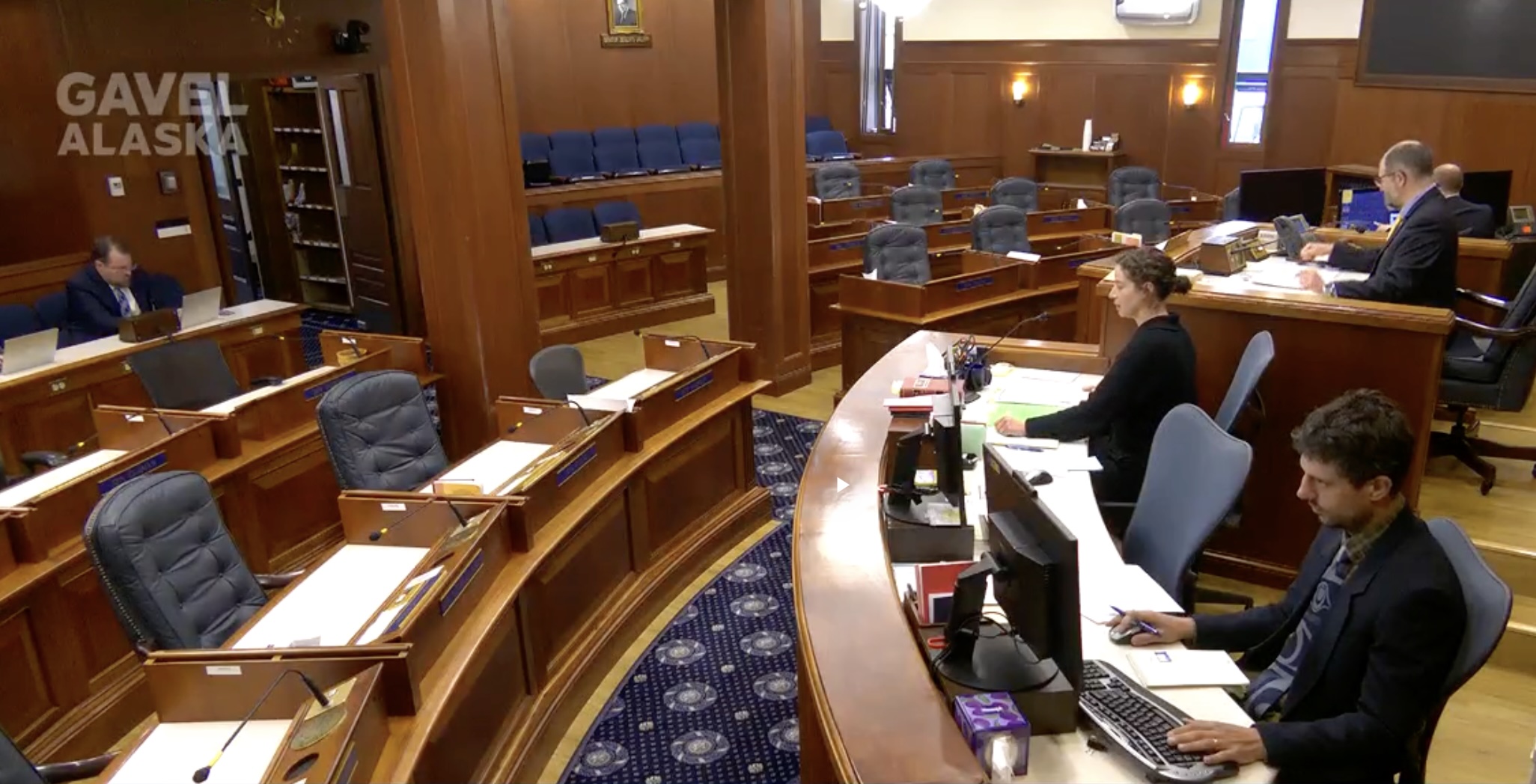
The House and Senate convened in technical sessions, meaning there were not enough lawmakers present to conduct substantive business. No bill was introduced, no committee hearing was held and no vote was taken. The plan was to gavel in and gavel out without a quorum.
The Senate adjourned until Aug. 10, two weeks into the 30-day special session and just eight days before Alaska’s Aug. 18 primary election.
In other words, the special session has begun, but the Legislature is not really in session. They’ll be campaigning.
Gov. Mike Dunleavy called lawmakers back to Juneau after the previous special session failed to produce an acceptable version of House Bill 381, legislation intended to establish predictable construction-period taxes for the proposed Alaska LNG pipeline.
The original bill would have replaced property taxes during construction with a tax based on the volume of gas eventually moving through the pipeline. Project developer Glenfarne has said tax certainty is necessary to attract financing for the multibillion-dollar project.
The House passed a clean version of HB 381 in June. The Senate later loaded the legislation with additional provisions, including a controversial expansion of Alaska’s corporate income tax to certain pass-through businesses, widely viewed as targeting Hilcorp.
A conference committee produced another version of the bill, but it failed in the House on a 19-19 vote July 16 after Dunleavy said he would veto it because of the corporate tax provision.
Dunleavy called the third special session almost immediately.
“A third special session to provide tax relief so the Alaska LNG project can move forward is scheduled to begin today,” Dunleavy wrote Monday on X. “Before reintroducing the legislation, my administration is going to continue meeting with all parties to determine the best path forward to an agreement.”
“I believe that by having these discussions now we can come to an agreement on a bill that would get the support it needs to pass both bodies and get this vital project moving forward and conclude this special session quickly,” he added.
That is the optimistic view.
The more realistic expectation is that the House and Senate majorities will continue to stall while negotiations, if there are serious negotiations, take place behind closed doors.
The political calendar is now working against the governor. The primary election is only 22 days away, and many legislators would rather be in their districts campaigning than in Juneau casting difficult votes on taxes, the gasline or both.
The Senate’s decision not to return until Aug. 10 consumes nearly half of the special session before lawmakers even contemplate taking up legislation. Rep. Louise Stutes is making a play for the Senate seat being vacated by Sen. Gary Stevens, the Senate president. Democrats want to increase their power in both the House and Senate, and Stutes is one of those key votes.
There is also a larger political calculation.
Political observers have increasingly speculated that Democratic-aligned legislators have little incentive to give Dunleavy a major gasline victory during his final year as governor. Dunleavy has long been mentioned as a possible Republican challenger to US Sen. Lisa Murkowski in 2028. Helping advance a project that Alaska governors have pursued for generations could give him a powerful legacy issue and a potent argument in a future US Senate campaign.
No legislative leader is likely to admit that national and state political considerations are influencing the gasline debate. But in Juneau, policy and politics are rarely separated for long.
For now, Alaskans should lower their expectations. The third special session is underway in name, but lawmakers have gone home. The administration will continue its private discussions, legislators will campaign and the clock will keep running.
Unless the House and Senate majorities decide they genuinely want an agreement, this special session may end exactly as the last one did … with no gasline tax bill.

7 thoughts on “Lights on, but nobody home as Alaska Legislature gavels in, promptly gavels out”
It has become painfully clear that southcentral Alaska will have to import LNG from Canada in order to continue heating our homes and keep the lights on. I hope Enstar can do that before the decreasing pressure shuts down furnaces, boilers, and generators causing the necessity of rolling blackouts during the coldest periods of winter.
Remember this during this election cycle, and think about how you as an individual are going to prepare for this. It’s coming.
This is a goddamned joke. You get voted in to do your damned job, not to campaign. Do your damned jobs!
How about just passing a gasline bill that gives them an abatement for the construction phase and ramp up to a defined flow. Then we do not need to change out tax structure to an untested AVT which is no used anywehere else in the USA.
Your are spot on “The Alaska Story”, a Gas Line is a defeat for the Democrats in Alaska.
By NOT passing Gas Line Legislation, the Democrats can attack Dunleavy as a no accomplishment Governor. Regardless of his record.
It is the Gas Line issue that will define
Dunleavy’s next step Politically.
The wreck less approach to win at all costs of the Modern Democratic Party, is in stark contrast to the Former Great Democrats in Alaskan History that put Alaska before Party.
Louise Stutes is being challenged by Heath Smith (Homer resident). There are enough Homer voters that can make a difference in this race. Ones who do not want another RINO like retiring senator Gary Stevens. Stutes, claiming to be a Republican, showed up to campaign in Homer……at the local Democrat legislative office. 🤔🤨 She is counting on Rigged Choice Voting and Democrats/lefty undeclareds to get her elected (shades of Murkowski).
On August 18 vote for Heath Smith.
Do Not Ask the Legislature to Violate Article VIII to Rescue a Failed Gasline Tax Bill
Governor Dunleavy,
Alaskans want affordable energy. Alaskans want responsible development of North Slope gas. Alaskans want a real gas line if it can be built lawfully, transparently, and for the maximum benefit of the people.
But Governor, do not ask the Legislature to violate the Alaska Constitution to do it.
The Anchorage Daily News now reports that after multiple failed attempts, legislative leaders are again waiting to see what your administration proposes before moving forward. The article states that the Senate passed two bills providing a property tax cut for the Alaska LNG project, but the House rejected the legislation. The same article reports that the most recent compromise bill died in the House on a tie vote after you stated you would veto it because it included a corporate income tax expansion.
That is not leadership. That is confusion.
The Alaska LNG project may be important. ADN reports the project is proposed at up to $55 billion, with an 800-mile pipeline intended to deliver North Slope gas first to Alaskans and later to export markets. But the size of the project does not reduce the Constitution. It increases the duty to obey it.
Article VIII of the Alaska Constitution requires Alaska’s resources to be developed, used, and conserved for the maximum benefit of the people. It does not authorize the State to create a private financing shelter, suspend borough taxing power, conceal material project economics, or place one developer’s banking needs above the public’s constitutional rights.
You have called another special session. ADN reports the third special session on Alaska LNG is scheduled to end August 25. Before asking legislators to vote again, your administration should answer the constitutional questions openly:
Where is the full public record proving maximum benefit under Article VIII?
Where is the borough-by-borough revenue comparison?
Where is the school-funding impact analysis?
Where is the explanation for why ordinary borough property tax authority should be displaced?
Where is the legal justification for creating one tax system for Alaska LNG and another tax system for similarly situated resource infrastructure?
Where is the disclosure of the AGDC-Glenfarne agreement sufficient for Alaskans to judge the public risk?
Where is the proof that tax certainty has not become tax immunity?
Where is the proof that bankability has not become constitutional surrender?
ADN reports that Glenfarne owns 75% of the project and the State, through AGDC, owns 25%. That structure makes transparency even more important. When the State is a project owner, regulator, taxing authority, and public fiduciary at the same time, the danger of conflicted decision-making is obvious.
The failed bill was not a clean gas line bill. It became a property-tax replacement bill, a corporate-income-tax fight, a borough-tax bill, a labor bill, a confidentiality bill, and a developer-financing bill all tied together. ADN reports that business groups and Glenfarne said the corporate tax language would hurt the project by increasing the price of produced natural gas and should be considered independently. Hilcorp also warned that taxing the upstream producer would increase upstream development and production costs and that those costs would flow through the Alaska LNG value chain.
That proves the point: this is not one simple tax break. It is a chain of public and private consequences.
Governor, do not ask the Legislature to “do something” merely for the sake of doing something. Worse yet, do not ask the Legislature to pass a bill that violates Article VIII, weakens boroughs, hides material facts, or creates a preferred tax class that future litigants may challenge under equal protection, uniform application, due process, and taxing-power principles.
Alaska needs leadership, not another rushed special-session package.
Bring forward a clean, constitutional gas line bill. One that protects in-state gas. One that preserves borough revenue. One that discloses project economics. One that keeps public taxing power intact. One that treats similarly situated parties fairly. One that proves maximum benefit to Alaskans before asking the Legislature to vote.
Build the gas line, yes.
But do not build it by asking legislators to violate the Constitution they swore to uphold.
Respectfully,
Ed Martin Jr.
Kenai Peninsula Borough Resident
Where the Spirit of the Lord is, there is liberty. — 2 Corinthians 3:17
I have always said, don’t be surprised at the ability of the Democrats and rhinos to screw this up.