



By SUZANNE DOWNING
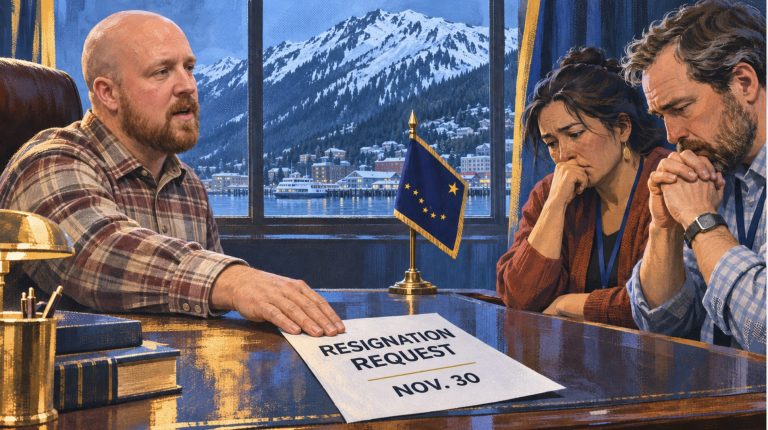
Nov. 19, 2026 — Jonathan Kreiss-Tomkins’ victory gives Alaska’s national popular vote advocates a supporter who is now in a position to sign their bill into law. There’s also a plausible scenario in which Alaska’s three electoral votes could put the agreement over the threshold for the 2028 presidential election.
The Democratic governor-elect, who takes office Dec. 7, chaired the House State Affairs Committee when it advanced House Bill 175 in March 2017.
He signed the committee report with a “do pass” recommendation. The bill went to House Judiciary and died there. A later attempt, Senate Bill 61, stalled in 2023.
Under the National Popular Vote Interstate Compact, each member would award all of its electoral votes to the presidential ticket that receives the most votes nationwide. The agreement takes effect only after members control at least 270 electoral votes, enough to elect a president. The Electoral College would still meet and cast its votes. The compact would use that machinery to elect the national popular vote winner.
For Alaska, that means a presidential candidate could win the state and see all three of its electoral votes go to the other ticket if that ticket won the national count. Alaska voters’ ballots would still count toward the national total. The change is that the statewide result would cease to determine who gets Alaska’s electors.
In 2024, all three went to Donald Trump, who carried Alaska and also won the national popular vote. The two rules can produce the same result. Where it goes haywire is when the state vote goes one way, and the popular vote goes another nationwide.
Eighteen states and the District of Columbia have enacted the compact, for a total of 222 electoral votes. Virginia was the latest addition, bringing 13 this year. If Alaska joined today, the total would rise to 225 and the gap would shrink from 48 to 45.
The bigger shift came in five states where Democrats are poised to hold the governorship and both legislative chambers after the midterms. Pennsylvania has 19 electoral votes, Michigan 15, Arizona 11, Wisconsin 10 and Nevada six. Together they have 61. Pennsylvania, Michigan and Arizona would add 45. Either Wisconsin or Nevada would take that combination across the threshold, and Alaska alone could bring it to exactly 270.
There’s another route, however. Pennsylvania, Arizona, Wisconsin and Nevada would add 46, leaving the compact at 268. Alaska would bring it to 271 and make it possible to reach the threshold without Michigan.
A Democratic majority makes those bills easier to bring up.
Incoming House Speaker Calvin Schrage is an independent and incoming Senate President Cathy Giessel is a turncoat Republican. Both lead coalitions that are controlled by Democrats. An Alaska bill would ordinarily need 21 votes in the House and 11 in the Senate, and those coalitions would have to supply or find the votes. A governor who is willing to sign would give supporters a clearer path once they do.
For the compact to govern the 2028 election under its own terms, it would have to be in effect by July 20, 2028. Clearing 270 would also set up a likely court fight.

Supporters point to Article II, which gives state legislatures authority over how their electors are appointed. A central question for challengers is whether the Compact Clause requires congressional consent. Supreme Court precedent limits that requirement to agreements that increase state power in a way that could encroach on federal authority.
Formally abolishing or changing the Electoral College through Article V would require a proposal backed by two-thirds of both houses of Congress or a convention called after applications from 34 state legislatures. Either route would then require ratification by 38 states.

15 thoughts on “How JKT’s win puts Alaska in play in the push to bypass the Electoral College”
The National Popular Vote Interstate Compact is a clear work around of the US Constitution and would not pass a SCOTUS decision. The three liberal Justices would support it but be hard pressed to find any reasoning in doing so. If the left were to stack SCOTUS, as they’ve promised to do, then there will be no need for judicial restraint and lawlessness will prevail.
It would be great if our schools taught that we are a Constitutional Republic, but since that doesn’t fit the narrative we have uneducated voters electing uneducated representatives who would support this kind of unconstitutional nonsense.
A very fair analysis from an Alaska perspective. And you got the key legal question right: “Supreme Court precedent limits that requirement to agreements that increase state power in a way that could encroach on federal authority.” Since federal authority has no role to play in how individual states choose to allocate their electoral college voters to a presidential candidate, under a states-right theory this proposed compact seems both legal and wise. High time we honor the voters of America by letting them, on a voter-by-voter basis, to choose our presidents.
“And you got the key legal question right: “Supreme Court precedent limits that requirement to agreements that increase state power in a way that could encroach on federal authority.” Since federal authority has no role to play in how individual states choose to allocate their electoral college voters to a presidential candidate, under a states-right theory this proposed compact seems both legal and wise.” I think you misunderstand the statement, this agreement would or could increase certain states power over other states in a number of ways, since choosing our President and Vice President as our only federally elected representatives, this would encroach upon the authority granted by the Constitution to individual states.
“High time we honor the voters of America by letting them, on a voter-by-voter basis, to choose our presidents.” Voters already have that honor. If we wanted to nullify parts of the Constitution this isn’t the way to do it…there is already a process in place to ammend the Constitution, why not use it instead of a legally questionable method?
“this would encroach upon the authority granted by the Constitution to individual states.” Just saying it doesn’t make it true. You can’t identify an authority in the US Constitution that would prevent states from choosing to allocate their electors to the winner of the national popular vote. “there is already a process in place to ammend the Constitution, why not use it instead of a legally questionable method?” So what? The US Constitution could be amended to make the speed limit on the Kenai Spur Highway in Soldotna 35mph. That hardly means that the Kenai Peninsula Borough can’t change the speed limit by itself. This compact is an easy, simple way to keep American voters in better control of who becomes President.
“You can’t identify an authority in the US Constitution that would prevent states from choosing to allocate their electors to the winner of the national popular vote.” Actually Article 1 Section 10 does just that. Clause 1 states in part that “No State shall enter into any Treaty, Alliance, or Confederation” Clause 3 (the Compact Clause) states in part that “No State shall, without the Consent of Congress…enter into any Agreement or Compact with another State” further The 14th Amendment Section 1 is called The Equal Protection Clause, Section 2 deals with voting apportionment as well.
“So what?” You should have led with that. You don’t care about the US Constitution, the rule of law, or having an informed discussion. Your speed limit argument is beyond absurd and shows you do not understand the conversation.
The plan does not require any state to enter into an agreement with any other state. Each state, acting on its own, pledges to send to the Electoral College electors who pledge themselves to vote for the candidate who received the most popular votes in the nation. Nothing in the US Constitution bars a state from making such a choice for itself. Read the plan, then spout your nonsense.
What’s the name of the plan again?
The Supremacy Clause in the US Constitution. Go back and read it,
Ittybitty.
The compact isnt anywhere close to getting states totaling 270 votes on board. It is currently at 222 according to the National Conference of State Legislatures which keeps a running count. The bipartisan Congressional Research Service published a paper on the compact circa 2019. I will link the two papers for anyone who wants to be more literate. I think the compact is a non-starter for Alaska and I suspect legislators of both parties would agree on policy. The cultural issue is even more severe. Difficult to believe that Alaskans would want to surrender our unique voice in presidential elections to the collective wisdom of NY, California etc. So yeah, ask the Gov-Elect is part of his legislative program before spinning up our fellow Alaskans. Havent we been through enough spinning up this year? Have a happy and peaceful holiday season. And to all a good night.
What idiot small state would give their power to elect an president to a large group of States? Oh yes, idiot Democrats would do that. This would be the stupidest thing any small state could ever do. So in other words, Alaska would do this under the Democrats.
People who believe in the primacy of American voters would do that. Why should 737,000 Alaskans get three electoral votes while 39,355,000 Californians only get 54? That makes an Alaskan voter worth 2.967 California voters. Sure, you’ll snicker at that. Say it’s good for Alaska. But that’s because you don’t believe in one person, one vote.
Well if we get rid of the electoral college then I guess Alaskans can just stay home and watch CA, NY, TX, FL and PA pick our future. At approx 125 million these 5 states boast a large chunk of the US total population count of 341 million (2025 estimate).
It is clear that we are dealing with historical illiteracy here. The electoral college was established to give states with small populations at least some impact. I further agree if they want to change the constitution they should go about it with amending instead of nullification.
Sure, amending the constitution would be better. But that ain’t happening. Far better we do this than allow minority candidates like Bush 2000 and Trump 2016 become super terrible Presidents.
Or you can make Alaska competitive in Presidential races. Perhaps Alaska leaders will travel to get to know the candidates and educate them on the way Alaskans look at federal policy. We’ve taught the “experts” that we are purple and purple means both parties ought to be competing for our support.
Canada does not have an electoral college system as we do. Their provinces west of Ontario have almost no inflence in national elections due to their small population. The overwhelming leftist eastern population elect their premier and don’t need any western votes for a majority.
Are you ignorant, subversive, or both ittybrain?
The goal behind the curtain is to re-write our constitution through a states convention and destroy God given rights we all have in it.
We must ensure the Juneaustineans never consider this.