


By SUZANNE DOWNING
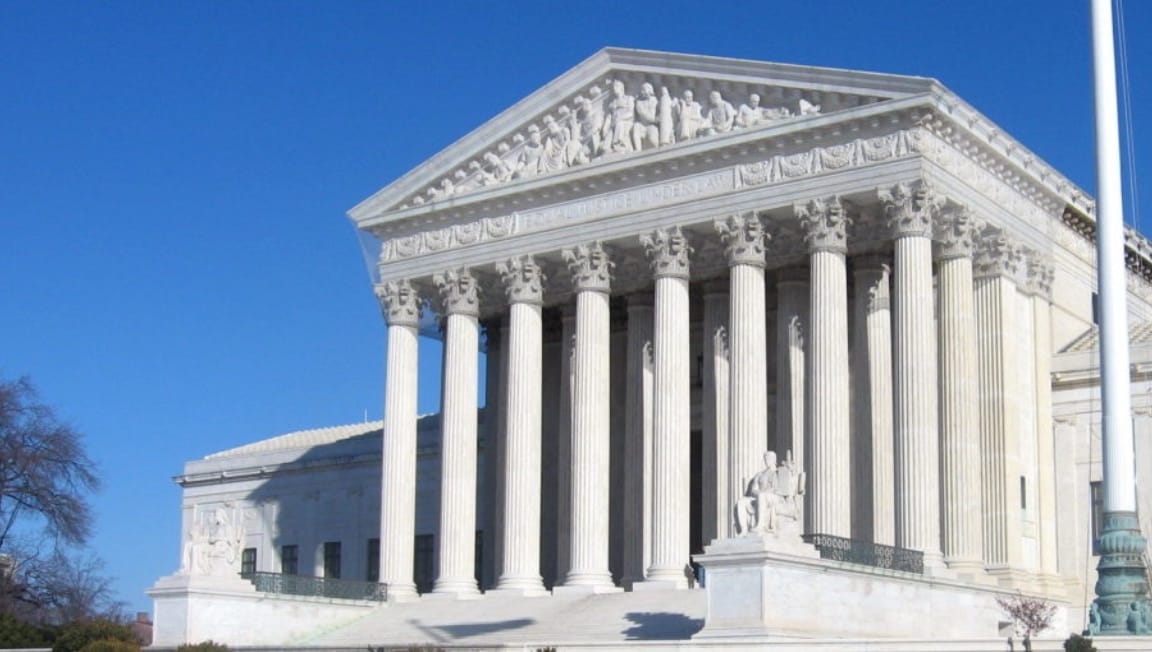
Aug. 21, 2026 – A dozen amicus briefs have been filed urging the US Supreme Court to hear Alaska Policy Forum’s First Amendment challenge to a state ruling that treated the think tank’s educational work on ranked-choice voting as regulated campaign activity.
The briefs represent a broad coalition that includes the Foundation for Individual Rights and Expression, US Chamber of Commerce, Alaska Chamber, Americans for Prosperity Foundation, Manhattan Institute, State Policy Network, Philanthropy Roundtable, Republican Governors Association and numerous other nonprofit, advocacy and legal organizations.
The filings support Alaska Policy Forum’s petition for Supreme Court review in Alaska Policy Forum v. Alaska Public Offices Commission.
The case began in 2020, when Alaska Policy Forum joined a national coalition formed to educate the public about ranked-choice voting. The Anchorage-based 501(c)(3) nonprofit shared a coalition press release and video and published its own article, white paper and press release examining the voting system.
None of Alaska Policy Forum’s communications mentioned Ballot Measure 2, the 2020 initiative that proposed adopting ranked-choice voting and making other changes to Alaska election law. Most did not refer to the upcoming election, and some of the material was aimed at a national audience.
Supporters of Ballot Measure 2 nevertheless filed a complaint with the Alaska Public Offices Commission alleging that Alaska Policy Forum’s communications amounted to advocacy against the initiative.
APOC agreed and concluded that the think tank had engaged in regulated campaign activity. The commission required Alaska Policy Forum to register and file reports with the state and subjected its communications to campaign-style disclaimer and donor-disclosure requirements.
The commission cleared the national coalition that produced some of the communications but penalized Alaska Policy Forum for sharing the material.
Alaska Policy Forum appealed, arguing that APOC had unconstitutionally transformed protected discussion of a public policy into regulated campaign advocacy.
The Alaska Supreme Court upheld APOC’s decision in February. The court relied on a test that considers the speaker’s intent and the potential effect of the communication on its audience.
The Institute for Free Speech, which represents Alaska Policy Forum, filed a petition for a writ of certiorari in July asking the U.S. Supreme Court to review the ruling.
The petition argues that the Alaska court used a decades-old Ninth Circuit test instead of the objective standard set out in the U.S. Supreme Court’s controlling opinion in FEC v. Wisconsin Right to Life. Under that standard, the Institute contends, speech may be regulated as campaign advocacy only when it is susceptible to no reasonable interpretation other than an appeal to vote.
The petition also challenges Alaska’s donor-disclosure requirements, arguing that the state may demand disclosure regardless of how small a contribution is or whether the donor gave money to support the regulated communication.
“Alaska’s rule means that any nonprofit that speaks about a policy issue risks being forced to register as a campaign committee and expose its donors, just because the issue happens to land on a ballot,” Institute for Free Speech Senior Attorney Owen Yeates said. “That result punishes the exact kind of educational political speech that lies at the heart of the First Amendment’s protections.”
Two amicus briefs were filed Aug. 7, including one by attorney and campaign-finance scholar Randy Elf and another by the Honest Elections Project. Ten more followed Thursday.
The later briefs include filings by FIRE; the U.S. Chamber and Alaska Chamber; Americans for Prosperity Foundation and the Upper Midwest Law Center; the Republican Governors Association; the American Legislative Exchange Council; and a coalition consisting of People United for Privacy Foundation, Philanthropy Roundtable, Manhattan Institute and State Policy Network.
Other participating organizations include the American Center for Law and Justice, Foundation for Government Accountability, Thomas More Law Center, Center for Individual Rights, Illinois Policy Institute, Advancing American Freedom and several free-speech and privacy organizations.
The briefs raise concerns about donor privacy, compelled speech and the danger that vague campaign-finance laws will discourage nonprofits from discussing public policy.
The US Chamber and Alaska Chamber argue that expansive registration and disclosure requirements burden speech and association. Elf’s brief argues that political committee-style obligations generally should be limited to organizations controlled by candidates or groups whose principal purpose is influencing elections.
The case could have implications beyond ranked-choice voting. Nonprofits routinely publish research about taxes, education, resource development, criminal justice and other policies that may later become the subject of ballot initiatives.
The Supreme Court has not decided whether it will hear the case. The petition and all 12 supporting briefs are available on the Institute for Free Speech case page.


8 thoughts on “First Amendment group urges Supreme Court to hear Alaska Policy Forum free-speech case regarding ranked-choice voting”
RCV and campaign contribution do violate First Amendment rights. Any common sense person knows it.
Proponents can spin and twist their language arguing how it doesn’t. But manipulators are never correct.
Huh? Explain Tina?
wut?
It is amazing to me no one looks at non-profits like the League of Women Voters. They constantly have presentations where only one side is invited. Guess we don’t watch the liberal organizations as we do the more conservative ones!
Judy, it is surprising how many conservatives and common sense independents are clueless about the League Of Women Voters leftist progressive leanings while pretending to be “nonpartisan.”
From internet AI:
1. “The League’s support for policies like carbon pricing, abortion rights, and police reform, which critics say mirror the Democratic platform.
2. Funding from left-of-center donors such as George Soros’s Open Society Foundations and the Ford Foundation.
3. Increased Republican refusals to participate in League-sponsored candidate forums since the 2010s, citing perceived liberal bias. “
Huh, it’s too bad the Alaska Supreme Court couldn’t or didn’t consider “the speaker’s intent and the potential effect of the communication on its audience” in the Decoy Dan case…
Maybe you all are just stupid! Didn’t Mike porcarro get rich accepting murkowski bribes? Money he used to play over the airwaves lies about ridding ourselves from dark money? And he is a conservative republican!!! I think you all are stupid!!!
[…] First Amendment group urges Supreme Court to hear Alaska Policy Forum free-speech case regarding ran… […]