


By SUZANNE DOWNING
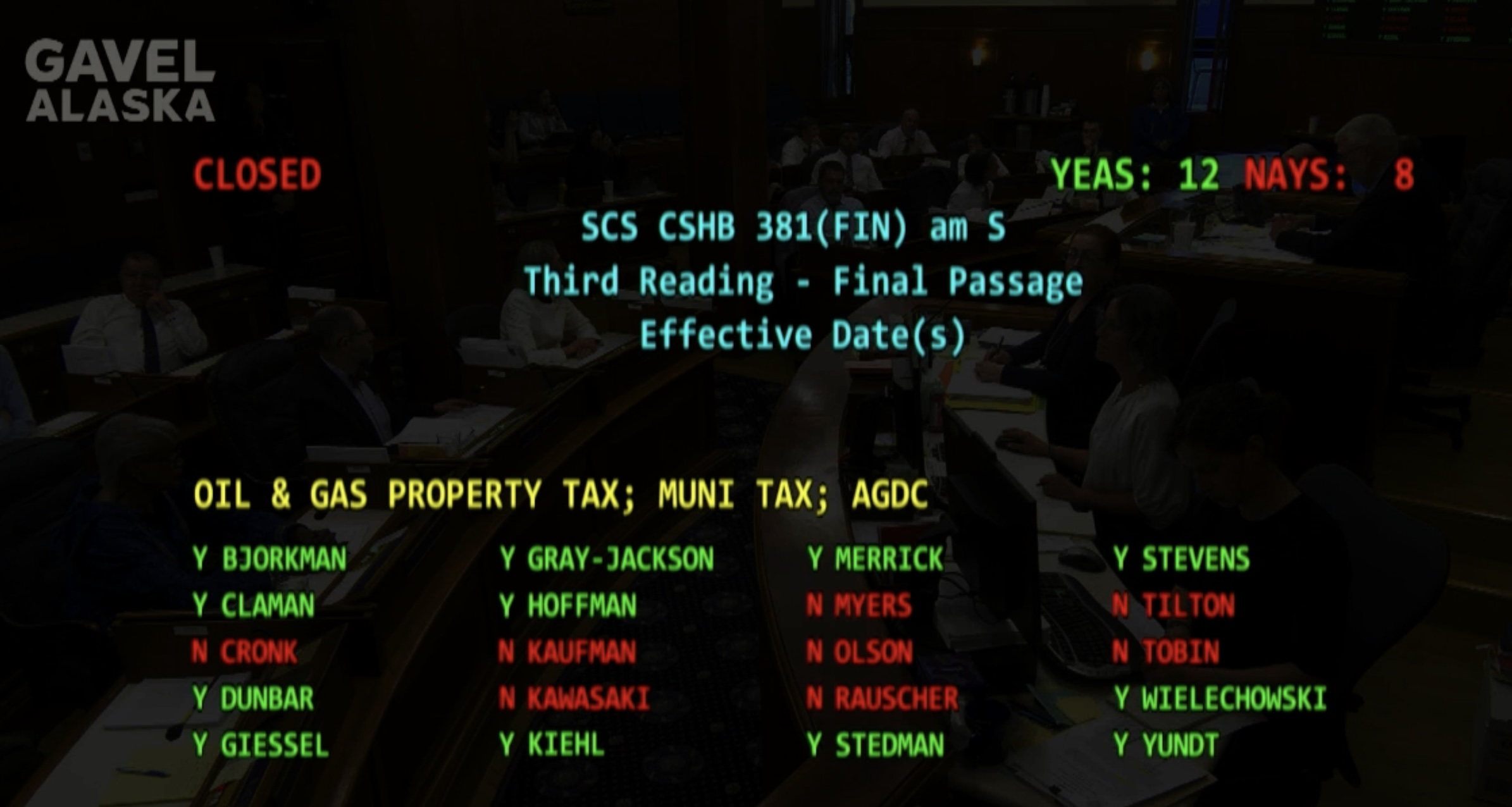
June 19, 2026 – The Alaska Senate passed a heavily amended version of House Bill 381 on Friday night, adding a controversial new tax on pass-through entities and prompting Gov. Mike Dunleavy to immediately announce he will veto the legislation and call lawmakers into yet another special session beginning Saturday.
During an 8 pm press conference, Dunleavy blasted the Senate’s handling of what began as a narrowly focused effort to improve the economics of the Alaska LNG Project. The governor said the Senate Majority had transformed the legislation into something entirely different from the clean gasline bill he requested and indicated he would reject the measure if it reaches his desk in its current form.
The Senate approved the amended bill after a marathon day of floor debate that became “Filibuster Friday.” Senators spent hours offering and debating amendments while the clock ticked down on the final day of the special session.
The most significant changes were taxes on gas companies that are S corporations the addition of a new state income tax on pass-through entities involved in oil and gas activities.
Ironically, the Senate’s first attempt to add the tax failed.
Amendment No. 1, a seven-page proposal offered by Sen. Lyman Hoffman, would have imposed a new tax on S corporations, partnerships, LLCs, and sole proprietorships engaged in various oil and gas activities in Alaska. The concept has long been championed by Senate Democrats, particularly Sen. Bill Wielechowski, but Friday’s version was carried by Hoffman, who is not seeking reelection.
That amendment failed on a 9-11 vote, falling short of the 11 votes needed for adoption.
For supporters of a clean gasline bill, the vote appeared to be a victory. But it was a short-lived one.
After 4 pm, Senate Majority members returned with Amendment No. 2, which largely replicated the failed proposal but delayed implementation until Jan. 1, 2028. This time the amendment passed by an 11-9 vote.
The final bill, loaded up with amendments, creates a progressive state income tax on pass-through entities engaged in oil and gas production, transportation, treatment, carbon capture, LNG processing, or LNG shipping. Tax rates begin at 5% on income above $1 million and climb to 9.4% on income above $5 million.
“We are extremely disappointed to see new taxes added to legislation intended to advance the gasline. Last week, the Alaska House provided a strong bipartisan path forward when they passed a bill that focused on the project itself without unrelated tax increases. Major energy projects require stable, competitive policies that attract investment, and we hope the focus returns to advancing Alaska’s energy future rather than increasing taxes on the very companies needed to invest in Alaska,” the Alaska Support Industry Alliance, Alaska Chamber of Commerce, and Alaska Oil and Gas Association in a joint session.
Glenfarne Alaska LNG, the private developer leading the Alaska LNG Project, had warned lawmakers throughout the debate that the S-corp tax would undermine financing efforts for what could become one of the largest energy infrastructure projects in U.S. history.
“If the Senate passes a bill with the proposed S Corp tax, it will introduce major hurdles for Alaska LNG to secure the right financing to build the project,” the company said in a statement. “The S Corp tax increases financial burdens on the project and signals uncertainty to investors.”
Glenfarne also warned that the proposal could discourage investment far beyond the gasline itself.
“A broad tax on all pass-through entities would have unintended consequences that would negatively impact new investment in Alaska including renewables, data centers, and other energy infrastructure projects,” the company said. “A poorly constructed pass-through entity tax change would be shortsighted when the State is on the verge of the largest capital raise initiative for energy infrastructure in U.S. history.”
Business groups delivered a similar message.
In a joint statement, the Alaska Support Industry Alliance, Alaska Chamber of Commerce, and Alaska Oil and Gas Association urged lawmakers to pass a clean version of HB 381 focused solely on advancing the Alaska LNG Project.
The organizations warned that taxing pass-through entities would directly affect both current Cook Inlet gas suppliers and future North Slope producers expected to supply the Alaska LNG Project.
“Adding S-corp/pass through entity tax provisions to the bill, including those with delayed implementation dates, is entirely counterproductive and undermines the project economics this legislation is intended to improve,” the groups said.
They also warned that higher costs would eventually be passed on to consumers.
“Most importantly, these proposals would harm hundreds of thousands of Alaskans by increasing energy costs for families and businesses that are already struggling to afford everyday life.”
The S-corporation tax was only one of several major changes adopted by the Senate.
Lawmakers approved additional amendments expanding labor requirements, adding inflation adjustment provisions, increasing legislative oversight of the Alaska Gasline Development Corp., establishing new utility cost-recovery rules, and adding protections for the state if project partners fail to meet development milestones.
Among the most significant was a labor amendment requiring prevailing wages and apprenticeship participation across broad portions of the project because of the state’s ownership interest.
Another amendment requires AGDC to provide quarterly reports to legislative leaders regarding legal relationships with foreign entities.
By the end of the day, the bill that emerged from the Senate looked dramatically different from the version passed by the House just one week earlier.
The Senate Majority knew the House would have little or no opportunity to fully review the extensive changes before the special session expired.
Whether by design or circumstance, the result was a direct collision with the governor.
Dunleavy’s announcement Friday night effectively ensured that the fight over the Alaska LNG Project will continue.
Rather than ending the special session debate, the Senate’s passage of the amended bill has launched a new round. Lawmakers are now scheduled to return to Juneau on Saturday for another special session focused on the governor’s gasline legislation and the growing dispute over whether the project should be coupled with new taxes and additional policy mandates.
There will likely be another joint session to try to override the governor’s promised veto.


5 thoughts on “Filibuster Friday: Alaska Senate loads gasline bill with new taxes”
Yundt! Don’t forget the Jesse Sumner connection at the 18 August 2026 primary election. Sumner is running as Heilala’s Lt. Gov mate. Enough with the Rinos.
good reason to NOT vote for hey-la-la land
I just can’t believe the stupidity!!! What is it that “they” think they’re doing? and who is paying them to kill Alaska?
You want to see how selfish and self centered Ak leaders are. Alaska Landmine got lucky to be caught in the middle video recording of a really bad fight between Sen Wielechowski and Rep Bynum after this Senate vote
It really revealed what happens when leaders stay in politics too long, it’s time for All those in the video to get out of politics. Staying in politics too long, the politics makes you look ugly. Absolutely no class. No dignity. No decorum. Staying in politics Too long you stop learning how to take care of yourself both inside and outside; life becomes more about the Fight and winning than building.
https://youtube.com/shorts/WjDM9Vy2gvE?si=8vz6ABNIS5lg3RIo
It was,only a,bad fight in that Wielechowski wasn’t clobbered unconscious. He needs it