


By SUZANNE DOWNING
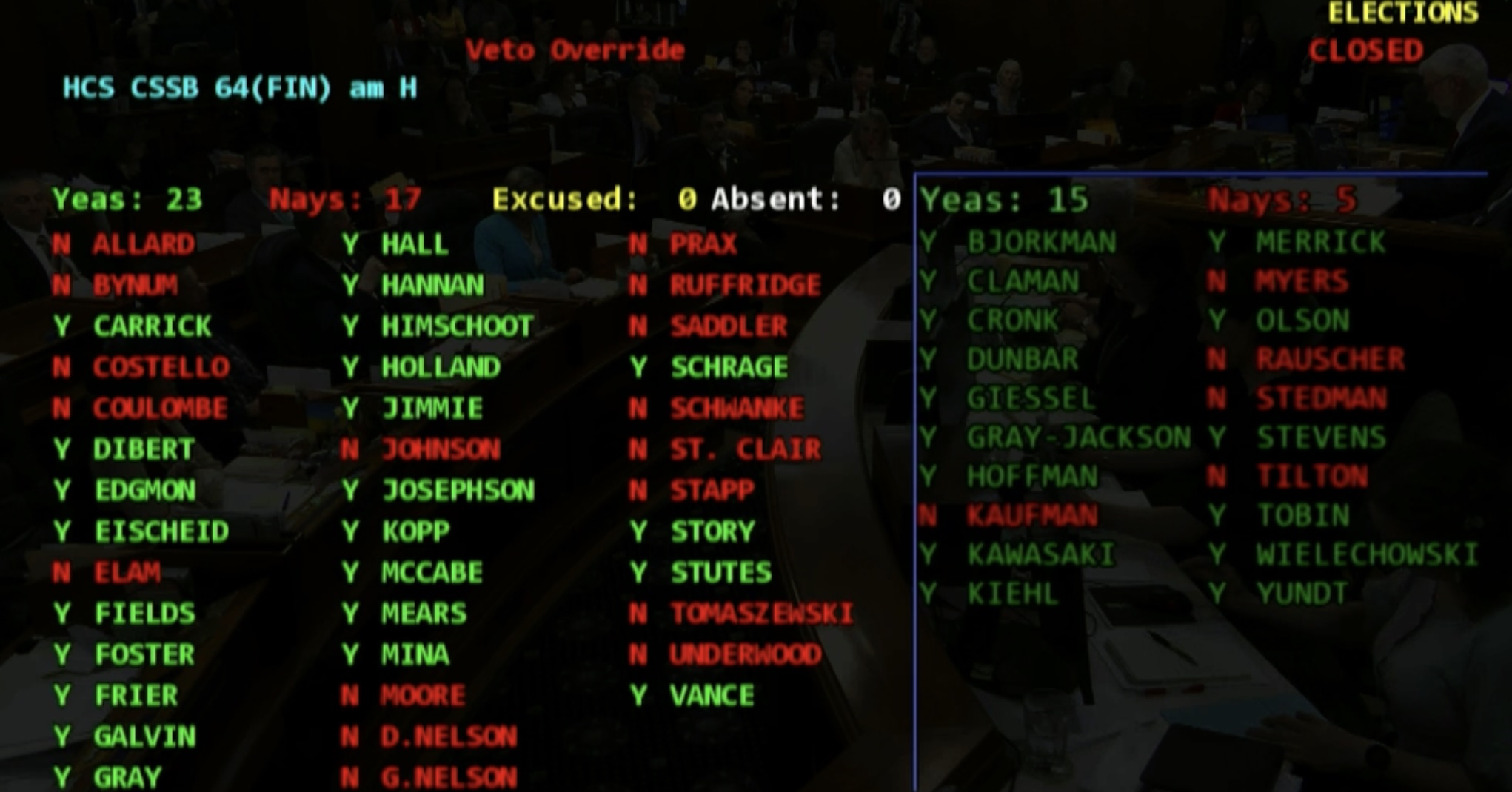
May 4, 2026 – The Alaska Legislature fell short Monday in its attempt to override the governor’s veto of the complicated election legislation known Senate Bill 64, after a lengthy joint session that ended in a 38-22 vote. It was just two votes shy of the 40 needed to enact the controversial bill.
The failed override followed extended floor debate, with lawmakers mostly on the pro-override side making their final arguments on what has become one of the most contentious election bills in recent years. They filibustered until it became obvious that the old saying, “If you have the votes, vote, and if you don’t have the votes, talk,” was applicable.
Sen. Bill Wielechowski, the bill’s sponsor, delivered an impassioned defense, even injecting a moment of levity by remarking, “I think you’re already smart and pretty,” in response to criticism circulating from The Alaska Story about his efforts to win over Republican support through his legendary charm. He may not still think that, now that the votes have been taken.
Wielechowski framed the legislation as the product of years of stalled election reform efforts, noting that more than 160 election-related bills have been introduced in recent years, with only a handful becoming law. He said SB 64 represented a bipartisan attempt to break what he described as a cycle of gridlock. He even said former Sen. Mike Shower supported the bill, which he did not.
According to Wielechowski, the bill would have improved ballot tracking, allowed voters to correct minor errors through ballot curing, expanded access in rural communities, and strengthened overall confidence in election outcomes. He argued that the governor’s veto was not rooted in policy disagreements, but rather concerns about implementation challenges.
He likened the legislative effort to finishing a difficult job in Alaska, like building a road or putting a roof on a house, saying lawmakers should “power through” rather than delay the work another year. He also invoked well-known Alaska figures, including the late Susan Butcher, who he called “Suzanne Butcher,” and longtime Congressman Don Young, as examples of perseverance.
“This bill is that road,” he said, comparing the legislation to a project that should not be abandoned before completion because “Alaskans don’t quit.” Of course, Alaska has not seen a road built in 47 years.
Rep. Sarah Vance, a Homer Republican, spoke in a quavering voice in favor of overriding her own Republican governor, calling the measure a necessary step to ensure every vote is counted and to restore public confidence. She said she had faced significant criticism, bullying, and pressure over her position but stood by her belief that she upheld constitutional principles.
In contrast, Republican Rep. Rebecca Schwanke, from rural Alaska, said she opposed the override, raising concerns about how the bill’s 10-day ballot curing window would function in remote rural communities. She also criticized provisions related to donor disclosure in ballot initiatives, saying they could obscure transparency.
Democrat Rep. Ashley Carrick supported the override, emphasizing provisions she said would benefit rural voters, including the use of tribal identification and expanded ballot curing. But then, Sen. Loki Tobin, a Democrat from urban Anchorage, also backed the override, arguing the bill would help her district most in ballot curing because of the number of mistakes her constituents make.
Sen. Mike Cronk highlighted provisions such as prepaid postage for ballots and the creation of rural election liaisons, calling them practical improvements to accessibility.
Opponents, however, said the bill weakened safeguards.
Rep. Mike Prax argued the legislation failed to address inaccurate voter rolls and could increase the risk of ballot harvesting, particularly with the removal of the witness signature requirement for absentee ballots. He also questioned whether the Division of Elections could realistically implement the changes in time.
Rep. Kevin McCabe of Big Lake delivered an impassioned critique, apologizing to all voters he said would continue to face challenges under the current system. His speech made it obvious the votes to override were not there.
Throughout the debate, both sides invoked rural access, election integrity, and voter confidence, often reaching sharply different conclusions about whether SB 64 would improve or undermine those goals.
What was never mentioned is that SB 64 was intended to prepare the way for full mail-in elections, like Anchorage has, with a curing process already in place and ready for the next round of Democrat-led legislation.
In the end, the override effort failed, leaving the governor’s veto in place and effectively killing the bill’s path forward this session.


20 thoughts on “Election ‘monster’ slain: SB 64 dies as override fails 38-22”
Best political news I’ve heard all day.
.
Better news from my cardiologist this morning: I actually DO have a heart!
.
😄😄😄💓💓💓💓😄😄😄
Yes!
Amen!
Excellent!
Great that the override failed! Depressing that the bill even made it to the Governor’s desk. Can we just go back to paper ballots, in the fall, at the polls, everything on ONE voting day? Get rid of the PFD application auto enroll. Why do the miserable need to make everything so sneaky and complicated?
Make Sara Vance ………history!
Dunleavy cruises again. Lisa Murkowski is history in 2028. Go, Big Mike!!!
I agree with Suzanne that this bill, if passed, would lead the way for democrats to push legislation for a full mail in voting system. That’s their plan. The dems have done it in Anchorage and talked about it in Fairbanks. If that ever happens, it would be the end of republicans winning seats in our legislature.
Just say it like it is Libby. Democrats are cheaters…. liars……and election thieves.
Libby Dalton Slane, 100% correct. Pretty much every former red state that went to all mail ballot elections turned blue to deep blue within 10 years of it. The Democrats know this which is why they keep pushing it while telling gullible voters it will “make elections easier and fairer.”
And this is why AKDemocrats want to change the needed. override votes from 3/4 down ti 2/3. If it only needed 2/3, they’d have their override.
There is nothing to celebrate here.
It just barely failed.
If AkDemocrats get their governor and keep a senate and house majority in 2027, the public can see AKDemocrats changing the necessary overide votes by legislation and stamp of approval by their governor if God lets them get who they want next year.
One of many problems with Republicans, conservatives is they cheer whenever they get the ball even though their team is like 20 points behind
For the AKRepublican Party they had their opportunity to move the state back over the center line on the Right side when they had Gov Frank Murkowski, a Senate and a House Republican majority, the stars were in alignment to move the state dramatically right. But they let political membership bickering, leadership infighting and corruption waste up their time and nothing got done; and they lost their governor after four years and the Senate went left. There went a gasline dream out the window in 2006.
If AkDemocrats are given their Democrat Governor keep the senate and house majority They will demonstrate to the AKrepublican members and leadership what the stars in alignment means; and that’s why I say if that happens in 2027 AKGOP is finished.
Cronkshould get the crank and we should Pundt Yundt surprisingly, Costello was on the right side on this one.
McCabe voted “YES.” He, surely, must have accidentally hit the wrong button.
Truly. I find it hard to believe he would vote to override. Maybe he will weigh in on that? Inquiring minds would lie to know…..
I really have to question the ‘R” after Senator Cronk’s name. He was on the wrong side of the override of the education bill last year that was successful.
Yes!!! I’m so glad that 22 Representatives and Senators had the backbone to stand up to the Demoncats and fake Republicans. Hopefully Alaskans remember this vote come election time!
Happiness! Good news along with the rain stopping and sunshine 😅
It’s great that the Governor’s Veto stood. We also learned which Republicans turned their back on Governor and the President.
I loved this part where they are trying to sell it as if it would “strengthened overall confidence in election outcomes” if any of them that voted against the Governor’s veto today really wanted to strengthen and build confidence in our election all they had to do was listen to the people, 75-80% of both parties want the Save America Act.
They could have started with the basics like only allowing US citizens to register to vote. Next vote and count it in one day. Limit ballot that goes through mail to the sick, disable, people traveling, and Military.
Voter ID doesn’t matter until you fix the proof of citizenship. The reason I say this is because the data shows non-citizens voting in-person. This happens because they were added to the pole book and they have a voter registration card. A picture ID still confirms who they are. The Pole Workers assume the pole book provided to them by the DOE is a list of legal registered voters which it is not.
Now on the other hand we have felons who were removed from the pole book and they voted in-person, in these cases they should have cast a question ballot, but they voted a regular ballot. This shows how broken the system is.
If they want people to be confident in our elections, they should address the real issues. That’s not going to happen because all they want is to make it easier to vote, with no checks and balances. President Trump has drawn a map for both parties of what the people want. Why are these legislators standing in the way?
David Johnson
Wasilla AK
Per the article regarding Rep.Sarah Vance: “She said she had faced significant criticism, bullying, and pressure over her position…”. No Sara, what you faced was honest feedback and disgust from the District 6 conservatives who voted to put you in office. No Democrat in this district voted for you. But let the left send out a nasty letter about you to voters and amazingly you sponsor and vote with the Democrats (and a few RINOs) for SB64 PLUS vote to override your party’s governor.