


By SUZANNE DOWNING
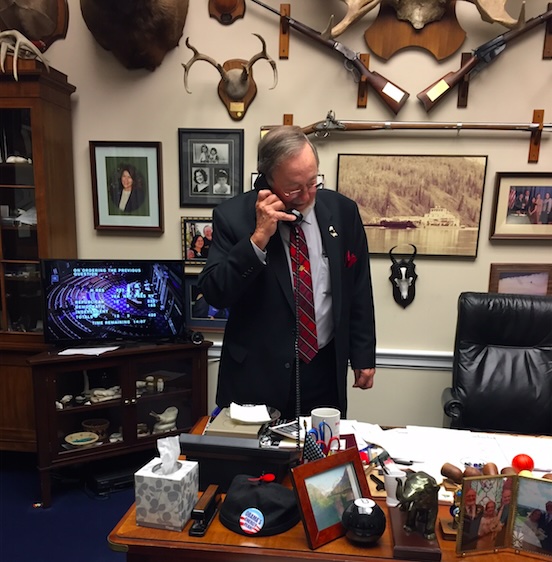
June 9 marks the birthday of the late Don Young, the larger-than-life congressman who represented Alaska in Washington, DC for nearly half a century and became one of the most influential figures in the state’s political history.
Born June 9, 1933, in Meridian, California, Donald Edwin Young arrived in Alaska in 1959, drawn north by the frontier spirit he had discovered in Jack London’s “Call of the Wild.” Like many who came to Alaska seeking opportunity and adventure, he wore many hats before entering politics: teacher, riverboat captain, and gold miner among them.
Few could have imagined that the young newcomer would go on to become the longest-serving Republican in the history of the US House of Representatives.
Young’s political career began in rural Alaska, where he served as mayor of Fort Yukon from 1964 to 1968. He then moved through the ranks of state government, serving in both the Alaska House and briefly in the Alaska Senate.
His opportunity on the national stage came in 1973, when he won a special election to fill Alaska’s lone congressional seat following the disappearance and presumed death of Congressman Nick Begich. What began as a special election victory turned into one of the longest congressional careers in American history.
For the next 49 years, Young became synonymous with Alaska’s representation in Congress.
Whether Alaskans agreed with him or not, few doubted his relentless commitment to advancing what he believed were the state’s interests. He fought for transportation projects, military infrastructure, fisheries, resource development, Native land issues, and greater state control over federal lands.
His fingerprints are found on many of the policies that shaped modern Alaska.
Among his most significant achievements was his role in advancing the Trans-Alaska Pipeline System. Young became one of the strongest congressional advocates for Alaska’s oil industry and spent decades defending resource development as the economic backbone of the state.
He also played a key role in passage of the Magnuson-Stevens Fishery Conservation and Management Act of 1976, which extended US fisheries jurisdiction to 200 miles offshore. The legislation transformed fisheries management and remains one of the most consequential laws affecting Alaska’s commercial fishing industry.
Throughout his congressional tenure, Young was perhaps best known nationally for his efforts to open portions of the Arctic National Wildlife Refuge to oil and gas development. While the debate remains unresolved politically, his advocacy helped keep the issue at the forefront of national energy discussions for decades.
In Congress, Young rose to become chairman of both the House Resources Committee and the House Transportation and Infrastructure Committee, positions that gave Alaska outsized influence in federal policymaking.
By December 2017, he had become the “Dean of the House,” the title given to the longest-serving member of the U.S. House of Representatives.
Young’s political style was uniquely Alaskan: blunt, colorful, independent, politically incorrect, and often unpredictable. He was known for speaking his mind, occasionally creating controversy, but also for building relationships across party lines in pursuit of projects and priorities important to his state.
His longevity in office reflected an ability that few politicians ever achieve: maintaining support across generations of Alaska voters as the state itself evolved.
Young died on March 18, 2022, while traveling home to Alaska. He was 88.
In recognition of his extraordinary service, Young lay in state in National Statuary Hall at the U.S. Capitol, one of the highest honors Congress can bestow. Only a small number of Americans have received that distinction.
Today, many of Alaska’s roads, airports, ports, military facilities, and economic development projects bear traces of Young’s decades of advocacy. His legacy continues to influence debates over energy, transportation, fisheries, and the balance between federal authority and state control.
More than three years after his death, Don Young remains one of the towering figures in Alaska history — a congressman whose tenure lasted longer than many Alaskans have been alive and whose impact on the state will be felt for generations.
And in one of Alaska politics’ more remarkable full-circle moments, the seat Don Young won after the disappearance of Nick Begich is now held by Nick Begich’s grandson, proving that history doesn’t always repeat itself, but it often rhymes.



5 thoughts on “Don Young’s 93rd birthday, a remembrance”
Even though he was a member of the Silent generation and too young to had really felt the impacts of the Great Depression and too young to fight in WW2; it was him and his tenure and generation who Encouraged Baby Boomers to hold on to power and the nation’s wealth as long as they are today. As well as it was his generation who increased government dependency and government growth and spending Baby Boomers, GenX, Millennials refuse living without their government jobs and support services.
Same thing about US Sen Ted Stevens being in politics too long just like US Sen Murkowski Even US Sen Sullivan is reached their point they’ll both serving too long; that the power and control of being a statesman increases one’s vulnerability to corruption and the distance being at the top for so long they lose sight of the people and the influences and direction people are going. I doubt US Sen Ted Stevens and Congressman Young realized how government dependent Alaskans grew over the decades or that millennials and GenZers k-12 education quality was failing and the impact when they leave high school. Or even that local roads are in such poor conditions because of Alaskans government dependency to pay for support services at the expense of not putting that money into maintaining local roads.
Yes, Tina. Alaska has changed from the land of the individual and other endangered species to the last bastion of freeloading whiners masquerading as rugged individualists. Sad, but true.
But your rage is misdirected at Don and Ted who did more for all peoples of Alaska than any angry boomer hating snowflakes ever will.
I first met Don Young as a young kid growing up in Alaska. Later, I ended up working for Don Young in Washington, DC.
Suzanne’s article does a great job describing a brief biography of the man and his many talents. Don was rough around the edges. Any of his 100’s of staffers during his 50 years in Congress will attest to that. What most will also tell you is that he served far too long. During his last 25 years serving, the greed factor and special interest factor is what drove him. To this day, Don Young is the defining poster boy for term limits.
There is an access way off of a major freeway in Florida that leads straight to a huge shopping mall which is owned by a huge financial contributor to Don Young, while Don served as the Chairman of the US House Committee on Transportation.
.
Don Young Boulevard.