


By SUZANNE DOWNING
Oct. 22, 2026 – Alaska’s first early-voting snapshot shows Democratic-leaning voters accounting for a larger share of ballots than at the same point in either 2022 or 2024, while overall participation is running substantially behind both elections.
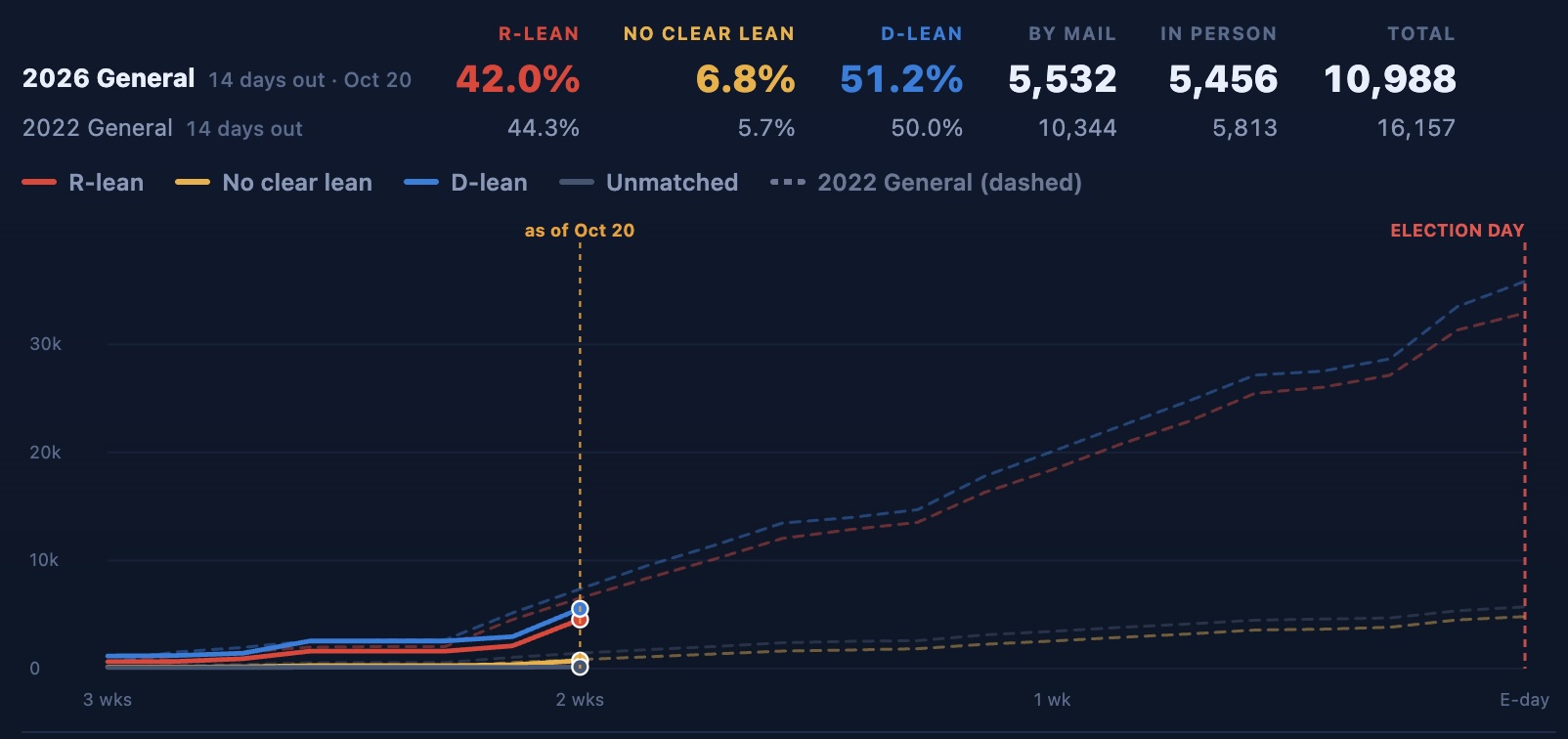
As of Oct. 20, measuring participation 14 days before Election Day, Democratic-leaning voters are making up 51.2% of ballots, compared with 42% for Republican-leaning voters. Another 6.8% fall into a “no clear lean” category.
That puts the Democratic-leaning advantage at 9.2 percentage points, compared with 5.7 points at the same stage of the 2022 midterm and just 1.6 points in 2024.
Juneau leads Alaska’s early voting start, with Eagle River and Mat-Su close behind
These figures describe the apparent political lean of people participating.
| Measure, 14 days before Election Day | 2022 | 2024 | 2026 |
|---|---|---|---|
| Republican-leaning share | 44.3% | 46.2% | 42.0% |
| Democratic-leaning share | 50.0% | 47.8% | 51.2% |
| No clear lean | 5.7% | 6.0% | 6.8% |
| Democratic-leaning advantage | 5.7 points | 1.6 points | 9.2 points |
| Total ballots reported | 16,157 | 25,096 | 10,988 |
Compared with 2022, the Republican-leaning share has fallen 2.3 percentage points, while the Democratic-leaning share has increased 1.2 points. The remaining shift is toward voters with no clear lean.
The comparison with 2024 is more pronounced: The Republican-leaning share is down 4.2 points, while the Democratic-leaning share is up 3.4 points.
But the larger Democratic-leaning share comes within a considerably smaller pool of ballots.
The 10,988 ballots reported for 2026 are 5,169 fewer than at the comparable point in 2022, a decline of approximately 32%. They are down approximately 56% from the 2024 presidential election.
The previous midterm provides the closer comparison, and its breakdown reveals where most of the decline occurred.
By-mail ballots fell from 10,344 in 2022 to 5,532 this year, a decrease of approximately 46.5%. In-person ballots declined much less, from 5,813 to 5,456, or approximately 6.1%.
Mail ballots account for 4,812 of the 5,169-ballot shortfall compared with 2022 — about 93% of the difference.
The figures show a substantial slowdown in reported mail returns, alongside a much smaller decline in in-person participation.
District 39 shows an increase of 258%, District 40 an increase of 135%, District 38 an increase of 103%, and District 37 an increase of 24%.
Across the rest of the map, requests are lower in every district except District 27, which shows a 1% increase.
The concentration of increases in western and northern Alaska makes those districts worth watching.
Is this a bellwether?
For now, it is an opening signal of who is participating first. Democratic-leaning voters hold a larger share of the reported early electorate, Republicans are contributing a smaller share, and rural absentee requests appear to be moving against the broader statewide pattern.