


By THE ALASKA STORY
April 17, 2026 – The race for Alaska governor is beginning to take shape, even as it remains one of the most unpredictable contests in the country, according to a new analysis from the Cook Political Report.
The nonpartisan election forecaster describes the open-seat race as a “convoluted free-for-all” and a “chaotic brawl,” driven by Gov. Mike Dunleavy’s term limit and a crowded field of 19 candidates competing in Alaska’s unique election system.
Despite the uncertainty, Cook has shifted the race into the “Likely Republican” column, while noting that a competitive general election remains possible in Alaska, which is known for its independent streak and now has a hard-to-predict jungle primary and ranked-choice voting general election.
Under Alaska’s system, all candidates will appear on a single primary ballot on Aug. 18, with the top four finishers advancing to a ranked-choice general election in November.
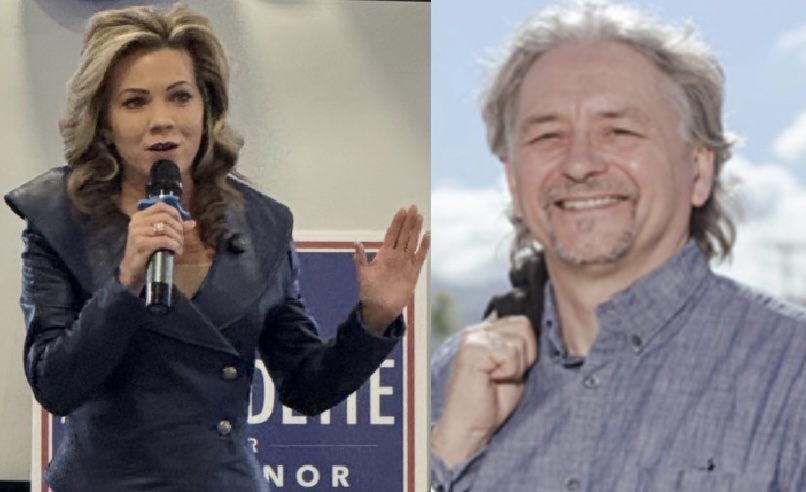
Cook identifies two candidates as currently best positioned to secure spots in that general election: Democrat Anchorage singer-songwriter Tom Begich and Republican businesswoman Bernadette Wilson.
Begich, a former state senator, enters the race with significant name recognition as part of one of Alaska’s most prominent political families. He is the brother of former US Sen. Mark Begich, and like Mark is a Democrat. He also is the uncle of Congressman Nick Begich III, who is a conservative Republican. According to Cook, he leads the field in both public and private polling, campaigning on what he calls an “affordable and self-reliant Alaska,” including alternative energy development and early childhood education investments.
In a classic Alaska twist, it was Wilson who served as senior advisor to the Nick Begich for Congress campaign, while Nick’s uncle Tom Begich was hosting fundraisers for Nick Begich’s opponent Mary Peltola. Now, Tom Begich and Bernadette Wilson are being identified by national prognosticators as the top two candidates.
Wilson, is described as being in a strong position among the baker’s dozen Republican candidates. A longtime conservative activist, she led the successful 2010 parental notification referendum campaign and previously hosted a talk radio program. The great-niece of former Gov. Wally Hickel, she has placed second in early public surveys and has built her campaign in part around opposition to ranked-choice voting. She is also the only candidate so far to publicly pledge to withdraw from the general election if she does not finish first in the primary.
Cook describes the remainder of the race as “considerably more muddled,” with several Republicans competing for a potential spot in the top four, including former state Sen. Click Bishop, who is a Murkowski-style candidate, and former Anchorage Mayor Dave Bronson.
Other candidates drawing attention include Republicans Dr. Matt Heilala, Shelley Hughes, and Adam Crum. Former state Rep. Jonathan Kreiss-Tomkins, a Democrat from Sitka, has also emerged as a contender after quickly assembling a sizable campaign war chest.
Cook Political Report suggests the most likely primary outcome could produce two Republicans and two Democrats advancing to the general election, setting up pressure within each party to consolidate support behind a single candidate. Alaska law allows candidates to withdraw after the primary, with the next-highest finisher moving into the general election, a dynamic that played a role in the state’s 2024 congressional race. There are some Republicans who have indicated they will not necessarily withdraw if they are not the top vote-getting candidate in August. Wilson, however, has pledged that if she is not the first among Republicans, she will withdraw.
Cook notes that internal divisions among Republicans could complicate things. Candidates in the GOP field range from more liberal “in name only” figures like Bishop to conservatives, raising questions about whether the Alaska Republican Party could unify behind a single candidate in a ranked-choice contest.
On the Democratic side, while Tom Begich currently leads in polling, the report suggests that support may be soft and tied largely to his name recognition. Kreiss-Tomkins, who has significantly outraised Begich in recent months, could emerge as a stronger contender if fundraising disparities persist and his name identification improves statewide.
The broader political environment also remains a factor. The amount of money being raised for messaging in the US Senate race could drown out all other campaigns this year, including state House and Senate seats that are in play.
With a large field, jungle primary, and ranked-choice voting, and no incumbent on the ballot, Cook concludes that Alaska’s 2026 governor’s race is one of the few contests in the nation where “anything is possible.” But most possible is that Tom Begich and Bernadette Wilson will be big factors in November.


8 thoughts on “Cook Political Report: Alaska governor’s race is a ‘chaotic brawl’ that’s coming into focus”
I know that if Wilson doesn’t rank first in the top four I’d support the leading Republican only on principle that I’m a team player however all those other candidates both Republican and Democrats are government dependents
I don’t get the AkGOP why they need to waste their time and money when they got a winning ticket in Wilson/Shower
And this woman isn’t a quitter like Palin bowing out because of the political negativity at her in bogus ethics complaints got too much for her.
While Shower is perfectly suited for the Lt Governor’s office even better than Meyer and Meyer was good but Shower would be in his element.
Tina , you seem apolitical to a fault ! Please there surely sometime you could be less sure about? Apolitical shows your hand with not all the cards are dealt….Conversation with you would be enlighten to me but doesn’t necessary require a washing of each others faces in public …. please call me Liberty Ed Martin 907-252-7857
How would we know, she refuses to answer any of the questions that the Alaska Watchman has been asking the candidates, just like most of the Dems.
I’m leaning towards Bernadette. Dunleavy is my new bro and I would be a big disappointment to him if I supported Tom. And Tom has gotten creepier over the years. He needs a hair cut too.
All of the generic comments at this time are for grab some attention comments. As the primary gets closer candidate failings will get exposed. Wilson’s flash may vanish as personal indiscretions are exposed and the actual voting and financial actions of others are made public.
Hold on to your seats and watch the show.
THEN the General election campaign will take the limelight.
The only worse candidate than Wilson would be Mark Begich! And Suzanne, why are you by accident perhaps advertising for Wilson? Everywhere you look including this story you see Wilson, is that accidental?
Wilson’s history in Ak politics, and her association with lower 48 politicians would cause pause by some of your commenters, unless they’re not really conservatives.
Dig a bit and you’ll see the problem with getting on the Wilson wagon!
Several Republicans similar, and to my liking. But to the average uninformed voter, Wilson stands out and would cross the Finnish line. Despite future attempts to smear her, she’ll come through strong, as you’d expect from a fighter.