


By SUZANNE DOWNING
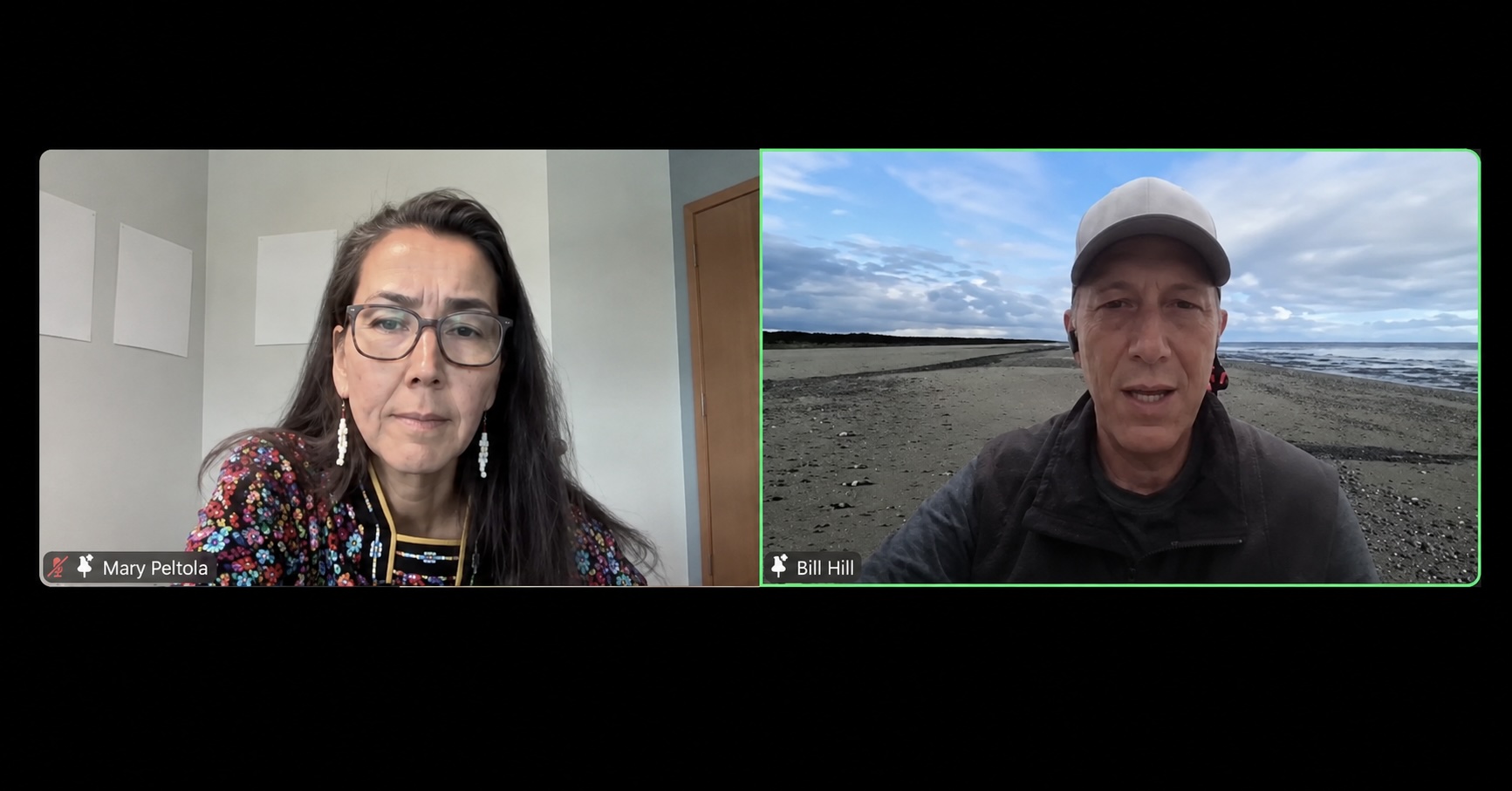
Aug. 27, 2026 – Congressional candidate Bill Hill joined Democrat US Senate candidate Mary Peltola for a Big Tent USA town hall, and used the appearance to call for moving Alaska communities away from oil and gas and toward renewable energy.
“For communities in Alaska, we need to get off the sauce and start implementing renewables,” he said.
Hill, who is running as a no-party candidate for Alaska’s lone US House seat, but who is endorsed by the Alaska Democratic Party, also called for restoring federal renewable-energy initiatives dismantled by the Trump administration. That would effectively revive elements of the Biden-era green-energy agenda, including federal subsidies and tax incentives for renewable projects.
The pairing with Peltola and the choice of host offered another glimpse at the political alignment behind Hill’s “independent” label.
Big Tent USA promoted the event as a conversation between Peltola, whom it identified as Alaska’s Democratic Senate candidate, and Hill, whom it called an “Alaska Independent congressional candidate.” The organization said the two would outline a shared vision of putting Alaskans ahead of partisan politics.
But Big Tent USA’s published 2026 environmental talking points portray opening federal public lands to oil, gas and mineral development as a threat to national parks, Native sacred sites and community water supplies. Its suggested message warns voters that public lands used for hunting, fishing and recreation could be “leased to a drilling company.”
In Alaska, federal public lands include areas containing some of the country’s most important undeveloped oil and gas resources, including the Arctic National Wildlife Refuge and large portions of the National Petroleum Reserve-Alaska.
Hill’s “get off the sauce” remark comes as Alaska remains heavily dependent on oil and gas not only for energy, but also for employment, business activity, state services and the Permanent Fund.
An economic-impact study prepared by McKinley Research Group for the Alaska Oil and Gas Association found that oil and gas activity generated approximately $3 billion, or 19%, of Alaska’s total state revenue in fiscal year 2024. The industry’s primary companies spent another $5.8 billion with more than 1,000 Alaska businesses during 2024.
Including direct, indirect and induced economic effects, the industry supported an estimated 70,425 Alaska jobs and $6.6 billion in wages, according to the AOGA economic-impact report.
Oil companies are also planning an average of $3.7 billion annually in new Alaska projects and in-field development between 2025 and 2030, representing about $22 billion in anticipated investment.
Renewable technologies can play a useful role in rural Alaska, particularly where communities rely on expensive imported diesel. But Hill did not explain during the quoted portion of the town hall how intermittent wind and solar generation would replace the reliable power, transportation fuel, revenue and employment now supplied by Alaska’s oil and gas economy.
His proposal to reinstate Biden-era programs would also return Alaska to an energy framework that frequently put federal regulators at odds with the state.
During the Biden administration, federal agencies restricted or attempted to restrict development across millions of acres in the National Petroleum Reserve-Alaska, canceled oil and gas leases in ANWR and imposed additional regulatory barriers on Alaska projects. At the same time, Washington poured taxpayer subsidies into wind, solar, electric vehicles and other favored renewable industries.
Hill’s joint appearance with Peltola adds to the evidence that his independent branding is more a ballot strategy than an indication that he would operate independently of national Democrats.
Before the primary, Hill’s campaign posted — and later removed — a strategy document stating that one of its “north star goals” was for Hill to advance to the general election with “no Democratic candidates.”
Democrat Matt Schultz subsequently suspended his congressional campaign and endorsed Hill. Schultz said defeating Republican Congressman Nick Begich and restoring a Democratic majority in the House were more important than continuing his own candidacy. Hill has also said he would caucus with Democrats if elected.
Peltola, meanwhile, has attempted to maintain an Alaska-friendly image on energy while aligning nationally with Democrats whose policies restrict fossil-fuel production. While serving in Congress, she voted against Republican energy legislation intended to expand domestic production on federal lands.
The Big Tent event brought his true political agenda into the open: He’s congressional candidate who would caucus with Democrats, and work to end oil and gas sector of the Alaska economy, and would be beholden to the Alaska Democratic Party, which seeks to end oil and gas entirely in Alaska.
The next Big Tent event is “Beyond Trumpism: America at a Crossroads” on Sept. 1.

11 thoughts on “Bill Hill tells Peltola town hall Alaska must ‘get off the sauce’ of oil and embrace renewables”
Best for Hill to lead by example.
Bill Hill and the Bethel skwa. Sounds like cowboys and Indians. Hi ho silver, and away.
Your skwa and skwaker comments are boring, offensive and against the values of conservatives. Please refrain.
LOL …..so says the Chief. Get in line with the Democrats, pal. You are just another whiner. Go call your mama.
The “sauce” of Oil has been very generous to Alaska and Alaskans! Without it, Alaska would most assuredly look a lot different than it is now. AND(!!!), there would be “NO” Permanent Fund in existence that Legislators could raid. A continuance of Oil exploration // development can and will provide further opportunities. We had an opportunity to maximize with LNG but, the democrat’s clearly obstructed that endeavor. If there were an opportunity to maximize with renewables, why hasn’t it already been done? Most likely, there is “NO” opportunity to maximize with renewables in Alaska because it’s uneconomical.
Please recognize that many on the Left of today would prefer that oil and gas development would have never occurred in Alaska. They hate the private economy and want government control at all levels.
There will be no government control withou $
This is the problem with politicians, instead of actually becoming informed, they form an opinion and then try to get votes based upon it. Bill Hill has just shown himself to be the worst kind of politician, one who has absolutely no principles and no idea what he is talking about. What renewables does he want us to implement? Where does he want them to go? How are they going to provide reliable power throughout the winter? He has no idea, but it plays to the uninformed leftist base of ignorant voters who think sunshine and wind can keep the lights on and the heat going. If they could bottle unicorn farts the left would have it made.
The Left is quite serious about this: They want to stop the use of fossil fuels at any and all costs – even if it means wrecking or shrinking the economy and bankrupting individual Alaskans. In their minds, the Left believes they are acting in everyone’s best interests and accordingly they do not care about the consequences.
There are lots of other components of this worldview. Many of these components end up sending folks like me to re-education camps or simply disappeared. I am not kidding.
@JMARK,
I agree with you. Funny thing, though. They gobble up fossil fuels at a rate equal or greater than the rest of the public. Airline vacations. Long car trips. Boilers and heaters to warm their homes. Their ideology about fossil fuels is meant for the rest of the population…..not themselves. How did climate action end up controlling their lives to the point of obsession?
Answer;
stupidity, gullibility, obsequience, government employment.