


By SUZANNE DOWNING
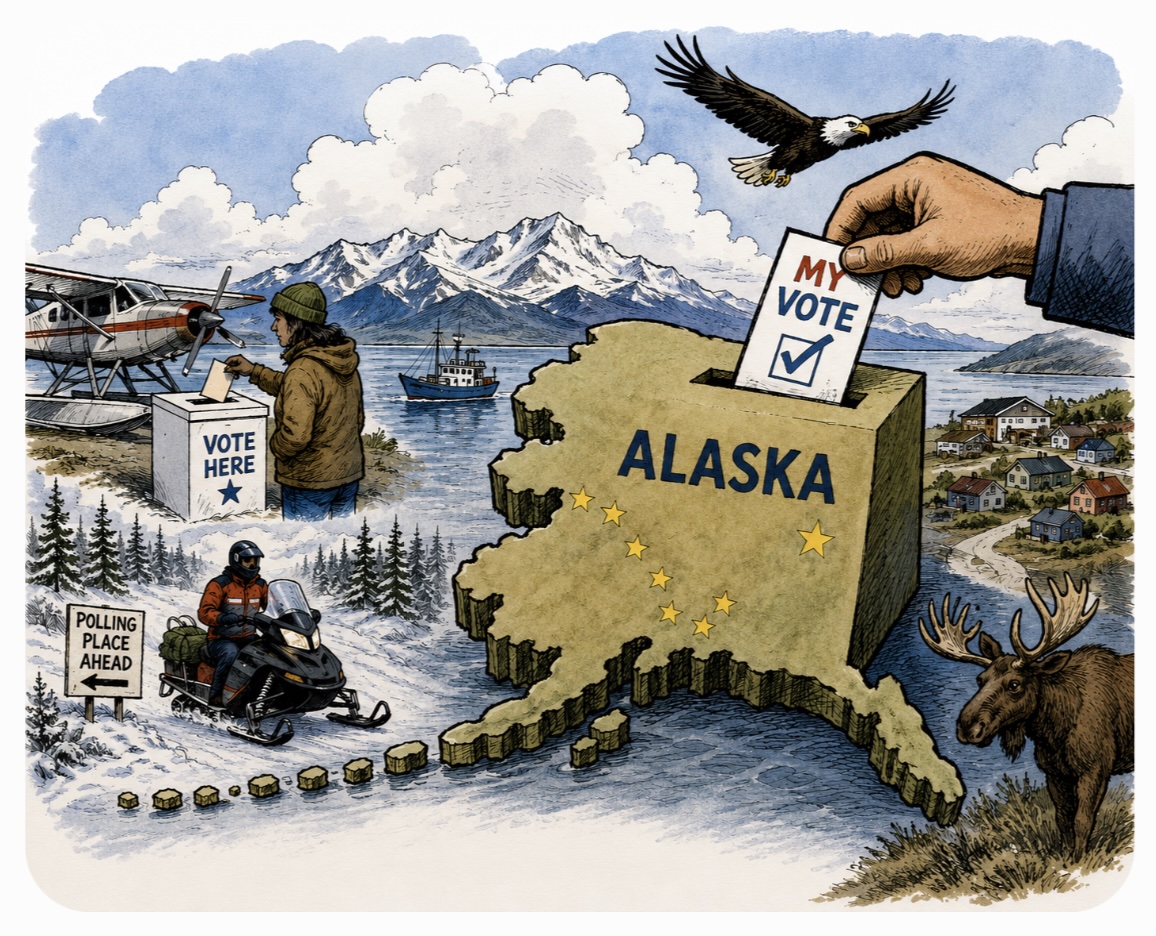
July 26, 2026 – Alaskans voting in the Aug. 18 primary will decide whether to impose new campaign contribution limits, but one of the measure’s less-advertised effects would be to increase the relative power of business, union and special-interest political action committees while diminishing the role of political parties.
It’s complicated, and the pushers of the measure are characterizing it as getting rid of dark money, an argument that appeals to voters. It’s important to note that it’s Democrats who are advancing Ballot Measure 1, formally known as the “Establish Campaign Contribution Limits for State and Local Elections Initiative,” which would cap an individual’s contribution to a candidate at $2,000 per election cycle. An individual could give up to $4,000 to a joint ticket for governor and lieutenant governor.
A political group that is not a party, including a PAC supported by a business organization, labor union, trade association or ideological interest, could give $4,000 to a candidate or $8,000 to a gubernatorial ticket.
That means a business or union PAC would be permitted to give twice as much to a candidate as an individual Alaskan.
Dahlstrom sets public hearings on three Alaska ballot measures
Any association of people with a common interest may organize an Alaska political action committee, register with the Alaska Public Offices Commission and raise money to influence elections. It need not be a major corporation or labor organization. The Alaska Peony Growers Association, for example, could establish a PAC to support candidates sympathetic to its industry. There are dozens of groups that are in this category, including the Last Frontier Republican Club, which is not a club and is not part of the Republican Party.
That makes the difference between individual and PAC contribution limits especially important.
Before a federal court ruling, an individual could give a candidate no more than $500 per year. A PAC could give $1,000 — twice the individual limit.
The 9th U.S. Circuit Court of Appeals concluded that Alaska’s $500 individual limit placed too great a burden on political speech. The court noted that the limit was among the lowest in the country, had not been adjusted for inflation and significantly restricted the money available to challengers attempting to compete against incumbents.
The court removed the $500 individual-to-candidate and individual-to-group limits. That opened the door for wealthy donors to contribute $20,000, $50,000 or more directly to their preferred candidates.
But the court did not remove the $1,000 limit on contributions from a PAC to a candidate. That limit remained in effect before and after the decision and is still listed on the Alaska Public Offices Commission’s contribution chart.
Ballot Measure 1 therefore would not merely restore a limit on individual donors. It also would quadruple the amount a PAC may give directly to a candidate, from $1,000 to $4,000.
Consider the multiplication effect.
Under the existing $1,000 limit, 10 separately organized labor-union PACs could collectively give a candidate $10,000. Under Ballot Measure 1, those same 10 PACs could give that candidate $40,000. Add several more union PACs and the total could reach $50,000 in direct contributions to a single campaign.
The same opportunity would be available to business, environmental, trade and other interest-group PACs. But Alaska’s labor unions already have numerous established political committees capable of concentrating contributions in targeted legislative races.
Critics warn that the higher limit could give organized labor an even stronger hand in selecting and influencing Alaska legislators, particularly in House and Senate races where total campaign spending is relatively modest. A collection of union PACs could collectively provide far more money than any individual Alaskan could legally contribute.
The federal court considered a similar comparison when it upheld Alaska’s political-party contribution limits.
In its 2021 decision in Thompson v. Hebdon, the 9th Circuit rejected an argument that Alaska treated political parties unfairly compared with labor-union PACs. One of the court’s reasons was that a party could give a municipal candidate $5,000, while a union PAC could give only $1,000.
“Political parties may donate more than labor union PACs,” the court noted in describing the $5,000-to-$1,000 comparison.
Ballot Measure 1 would nearly erase that distinction.
The party limit for a municipal candidate would remain $5,000, while the PAC limit would rise to $4,000. A political party would be able to give only $1,000 more than a single union or business PAC.
The initiative’s treatment of political parties creates a broader imbalance.
Current party limits are $5,000 for a municipal candidate, $10,000 for a state House candidate, $15,000 for a state Senate candidate and $100,000 for a joint gubernatorial ticket. Ballot Measure 1 would leave those limits initially unchanged.
Political parties would not lose money in absolute terms, but they would lose influence relative to PACs.
Under current law, a party’s $10,000 limit for a House candidate is 10 times the $1,000 PAC limit. Under Ballot Measure 1, it would be only two-and-a-half times the new $4,000 PAC limit.
Three PACs could contribute a combined $12,000 to a House candidate, which is far more than the candidate’s political party could provide.
For a Senate race, the party’s $15,000 limit is currently 15 times the amount one PAC may contribute. Under the initiative, four PACs could give a combined $16,000, exceeding the political party’s maximum contribution.
In mathematical terms, the measure would reduce a party’s relative contribution advantage over an individual PAC by a factor of four.
There is another unanswered question: Why quadruple the PAC limit but not similarly raise the amount an individual Alaskan may give to a political party?
An individual is currently limited to giving a political party $5,000 per year. Ballot Measure 1 leaves that figure at $5,000 initially, even as it increases the former individual candidate limit from $500 to $2,000 and the enforceable PAC limit from $1,000 to $4,000.
A comparable fourfold adjustment would raise the individual-to-party limit to $20,000. Instead, the initiative preserves the $5,000 ceiling, whose purchasing power has declined substantially over the decades.
The measure provides for inflation adjustments every 10 years beginning in 2031, but that would not correct the imbalance when the new system first takes effect.
Political parties are accountable to voters through their platforms, conventions, elected officers and public endorsements. Business and union PACs are accountable primarily to the organizations or interests behind them.
By substantially increasing PAC contribution limits while freezing party limits, Ballot Measure 1 could encourage candidates to rely more heavily on organized special-interest money and less on the political parties whose labels appear next to their names.
Corporations and unions would remain prohibited from contributing treasury money directly to candidates. They can, however, establish or support political committees that collect permissible contributions and give that money to campaigns. It is those PACs—not the corporations or unions themselves—that would receive the higher $4,000 limit.
The measure also would not restrict independent-expenditure groups or super PACs. Those organizations could continue raising and spending unlimited amounts advocating for or against candidates, provided they do not coordinate their spending with candidate campaigns.
The initiative does much more than limit wealthy individuals. It would restructure the balance of power in Alaska politics by allowing collections of business, union and other PACs to give four times their current amount while leaving political parties behind.
Individuals currently may give candidates unlimited amounts because of the 2021 court decision. Thus, the measure’s $2,000 cap is not an increase over current law; it is four times the former $500 limit invalidated by the court.
The PAC increase, however, is a genuine increase from the $1,000 limit in effect both before and after the ruling.
That is the central structural problem with Ballot Measure 1: It is advertised as a limit on big money, but it would channel more direct political power toward collections of organized PACs while restricting individuals and weakening political parties.
A “yes” vote would enact the proposed contribution limits. A “no” vote would leave the current system in place, including unlimited individual contributions, a $1,000 PAC-to-candidate limit and the existing limits on political parties.
Ballot Measure 1 is the only statewide measure on Alaska’s Aug. 18 primary ballot. Measures addressing voter citizenship and repeal of the top-four primary and ranked-choice voting system are scheduled for the Nov. 3 general election.

8 thoughts on “Ballot Measure 1 explainer: It would quadruple PAC giving while weakening Alaska’s political parties”
Alaskans are illiterate and that includes the few voters who consistently vote.
They see the simplistic campaign language and they’ll vote in favor thinking they understood and they are correctly voting for Alaska.
This likely will pass narrowly and Repealing RCV will narrowly fail (again)
Community leaders have done very little to increase the literacy of Alaskans including even in themselves @the illiterate community leaders. Alaskan churches don’t help either in increasing the literacy level of their regular attendees. Pastors care more about putting together speeches rather than just open the Bible and read to the congregation for 45 minutes (however long that church’s sermon usually is. Just like a baby and child under five who can’t read, you would do that for a child who can’t yet read. If third world country residents who were even less literate than Alaskans significantly raised their literacy level just by reading the bible, then it can work for Alaskans. So we can see/read through the lies, manipulations, deceit.
If the two measures have those results, it doesn’t mean you give up.
Just like if you were that parent who rarely read aloud with your child before they could read. You realize thirteen years later your mistake not to had read more books to your child when he was under five, or you didn’t read the bible and devotions to him. Do you just throw in the towel and give in and give up because of all the struggles against you two for a lack of literacy.
You keep on fighting. You try new strategies until changing the direction.
To me, this is the crux of the BM:
“ one of the measure’s less-advertised effects would be to increase the relative power of business, union and special-interest political action committees”…
This is a non-starter.
Suzanne-website doesn’t save my name and email. Yes, I check the box. 😉
How does this ballot measure differ from Rep. Calvin Schrage’s recent attempt at legislation on this topic? As we know, Governor Dunleavy vetoed that legislation.
” turn off the dark money drip” while we open the union and,corporate hydrant
Madam Editor could save tons of space and words by writing about something in Alaska’s election system that’s -not- rotten to the core.
.
Wouldn’t be quite as fun, though…
.
The “multiplication effect” is awesome. Must be mathematics, figuring out how many PAC’s you gotta make to guarantee your guy or gal gets elected. Make every union guy and gal into a PAC, sky’s the limit. Now that’s “multiplication.
.
No? Who’s checking?
.
Best guess is much of the loot goes to high-priced, media-connected consultants who set high prices because big-time, repeat customer-candidates can afford it. After all, it’s not their money, right? And if high pricing accidentally squeezes out cash-poor newcomers because mom-and-pop supporters just can’t match the high-rollers …so much the better, right?
.
What better way to squeeze out upstarts like Wilson and Shower? Price them out of the media market, keep ’em relatively unknown …the fewer people get their message, the less chance they get elected and mess up the orderly movement of power and money which makes Alaska’s government what it is today, right?
.
Can’t happen here, but what if it did?
Clear as mud….if someone will define the pro or con from a left or right perspective then maybe folks can understand this prop.
I read hundreds of words in this article and based on that have no idea how to vote on it…!
It limits individuals ability to support who they want and thus their First Amendment rights. It does not limit the number of groups, PAC’s, organizations, or others entities who can contribute at a higher rate than individuals.
Let’s say I contribute the max individual amount to candidate A, I can then create any number of groups, PAC’s, organizations, or others entities and contribute to them to support candidate A.
All this BM does is restrict the individuals rights to express their support, it does nothing to stop “dark money” or outside money interests, if anything it benefits them by giving them more influence than individuals.