


By SUZANNE DOWNING
Sept. 4, 2026 – After decades of federal delays, political reversals and courtroom battles, construction has begun on the first 2.8-mile segment of the long-sought road between King Cove and the all-weather airport at Cold Bay.
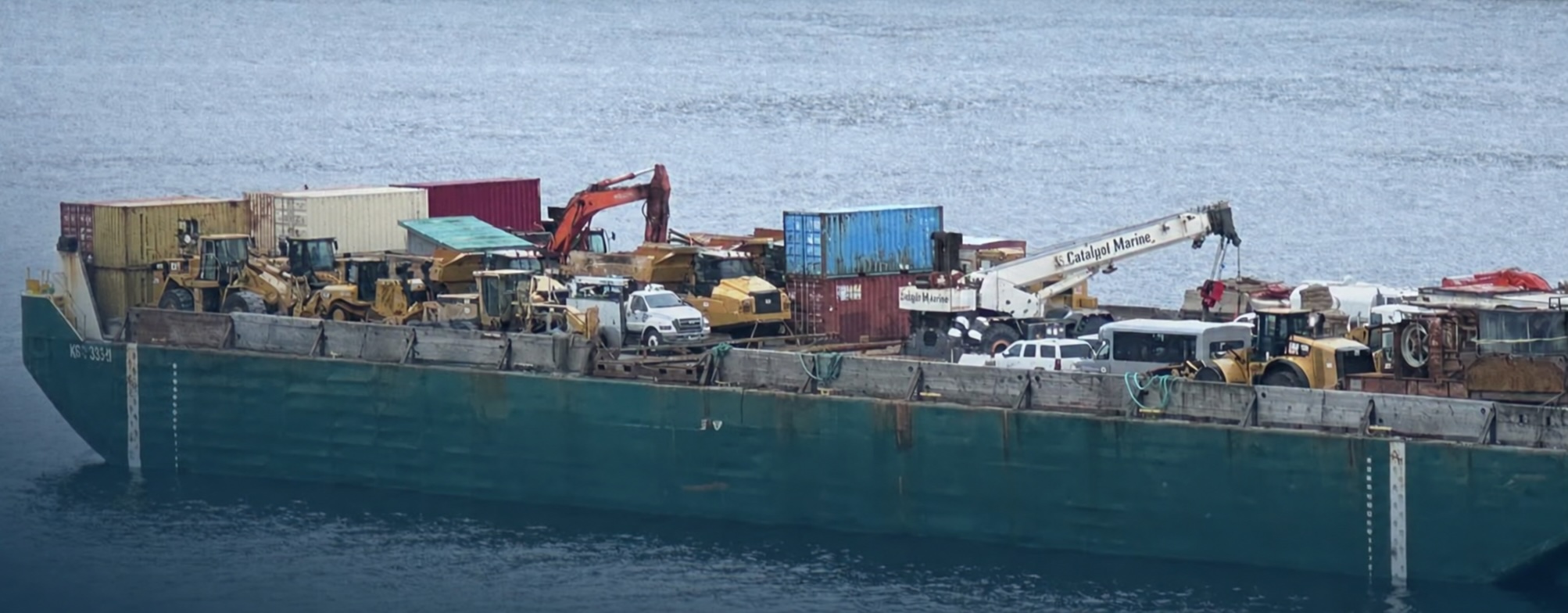
The State of Alaska began work in early September on a gravel road extending from the existing King Cove road toward Cold Bay. Heavy equipment and construction materials were barged into the community in August, and local workers received training ahead of the project.
The initial stretch is being built on land that King Cove Corporation owned before the 2025 land exchange with the federal government. It also includes the proposed road’s only bridge, an approximately 150-foot structure over an unnamed creek near mile 2.6.
That distinction is important: The first segment does not cross the federal land corridor transferred under the now-vacated exchange, and state officials maintain that the work can proceed independently of the U.S. Army Corps of Engineers wetlands permit that was later suspended.
The full road, however, remains far from assured.
The approximately 19-mile, single-lane gravel route would connect King Cove with Cold Bay, home to one of the longest paved runways in Alaska and a dependable airport capable of handling large aircraft in weather that frequently grounds smaller planes serving King Cove.
According to the state’s project description, the road would be about 13 feet wide with turnouts, 63 culvert or pipe-arch crossings and one bridge. Portions would follow existing roads and trails.
King Cove residents have sought the connection for generations, primarily as an emergency medical route. The isolated Alaska Peninsula community must now rely on small aircraft or marine transportation to reach Cold Bay, a potentially dangerous proposition during the region’s notorious wind, icing and poor visibility.
The Interior Department’s 2025 record found that between Dec. 23, 2013, and June 30, 2025, King Cove experienced 217 medical evacuations, most involving transport to Cold Bay. Thirty-two required rescue missions by the U.S. Coast Guard.
Interior concluded that a completed road would have “major beneficial effects” on public health, safety and transportation by providing reliable, year-round access to the Cold Bay airport.
President Donald Trump revived the project immediately after returning to office. His Jan. 20, 2025, executive order on Alaska resource development directed the Interior secretary to use all lawful authority to expedite a road corridor between King Cove and Cold Bay.
In October 2025, Interior Secretary Doug Burgum approved a land exchange between the federal government and King Cove Corporation. The deal conveyed approximately 490 federal acres, including about 336 acres within designated wilderness, to the corporation. In return, the federal government was to receive roughly 1,739 acres of corporation land selected for conservation purposes.
The exchange was intended to provide a 10.5-mile corridor through the Izembek National Wildlife Refuge for the 18.9-mile road.
On July 10, 2026, the Army Corps issued the state a Clean Water Act Section 404 permit, clearing what the Dunleavy administration called the last major federal permitting hurdle. The state immediately began mobilizing equipment and said construction would start within about 30 days.
But environmental organizations and somebWestern Alaska tribal governments continued their legal challenges.
On Aug. 18, US District Judge Sharon Gleason vacated the 2025 exchange, ruling that the Interior Department had not followed requirements of the Alaska National Interest Lands Conservation Act, the Endangered Species Act and the National Wildlife Refuge System Administration Act.
The ruling erased the land transfer needed for the central section through the refuge. The Army Corps subsequently suspended its wetlands permit while the legal status of the project is reviewed.
The Dunleavy administration plans to appeal Gleason’s decision. In the meantime, the state is moving forward with portions it believes remain legally available for construction.
No construction has begun on the connecting corridor created by the 2025 exchange, and the state previously told the court that it did not expect to authorize work on those exchanged lands until 2027.
Environmental groups are now attempting to stop even the 2.8-mile initial segment.
Defenders of Wildlife has filed a separate lawsuit challenging a US Fish and Wildlife Service compatibility determination that allowed construction and operation of the first segment. Although the surface land was already owned by King Cove Corporation, it lies within the external boundaries of the Izembek refuge. The organization has said it will seek an injunction to halt the work.
Road opponents argue the larger project would damage wetlands, designated wilderness and internationally important habitat used by Pacific black brant, emperor geese, tundra swans and other migratory birds. Tribal plaintiffs from the Yukon-Kuskokwim Delta say disruption at Izembek could affect bird populations important to their subsistence harvests hundreds of miles away.
King Cove residents and their supporters counter that the road is a narrow, restricted-access public-safety route—not a major commercial highway—and that successive federal administrations have placed environmental objections ahead of the health and safety of an Alaska Native community.
The battle has lasted half a century. King Cove adopted its first formal resolution supporting a road connection in 1976. Congress authorized consideration of a land exchange in 2009, but Obama administration Interior Secretary Sally Jewell rejected it in 2013. The first Trump administration approved exchanges in 2018 and 2019, only to encounter litigation. Biden administration Interior Secretary Deb Haaland withdrew from the 2019 agreement in 2023.
Trump’s return to office brought another land exchange and, briefly, the clearest path to construction the community had seen.
For now, the road still stops short of the refuge corridor, but for the first time in years, the end of the existing King Cove road is moving several miles closer to Cold Bay.
Labor Day lift: US hiring surges, while Alaska’s job market sends mixed signals
Red tape rollback: Trump administration moves to slash years of review for Alaska oil projects
Pretty Rocks Bridge complete, setting stage for return to Denali Park Road’s west end
5 thoughts on “Alaska begins first 2.8 miles of King Cove road as legal battle continues”
The US military operated at Cold Bay and surrounding area during all of WWII and for a while after. They built roads all over the place and tore up the tundra. If any entity can destroy the environment, military operations can, but go ahead and show me lasting destruction anywhere out there. Bottom line: A road isn’t going to hurt anything except in the minds of myopic people.
Great news! Start it and take it to the US Supreme Court if need be. Just get it done! This is waaay long overdue. The rights and welfare of endangered humans should reasonably take precedence, but it’s not being opposed by reasonable people.
Thanks to the current administration, President Donald Trump, Interior Secretary Doug Burgum, and the fortitude and leadership of our Governor Mike Dunleavy, this important project is finally going to be completed, and the ducks and geese won’t care.
I believe “judge” Gleason and ilk stand on their head to take a dump and think it’s natural. They say a man wearing a dress is a woman while supreme court member Jackson could not define a woman.
In Massachusetts a lady who murdered her three young children is called a hero to be worshipped.
So a road from King Cove to save human lives that will affect fewer birds than a windmill farm kills in a week must be prevented.
Saving human lives over wildlife is more important. NUTS! to the past “idiots” who valued human life for less.. Your last statement hits “the” TRUE nail on the head”. thank you.. It’s surprising wildlife after a few years will regrow and abound like nothing was ever plowed..(yes, I know the upkeep of the road will leave it’s mark.)
[…] Alaska begins first 2.8 miles of King Cove road as legal battle continues […]