

By THE ALASKA STORY
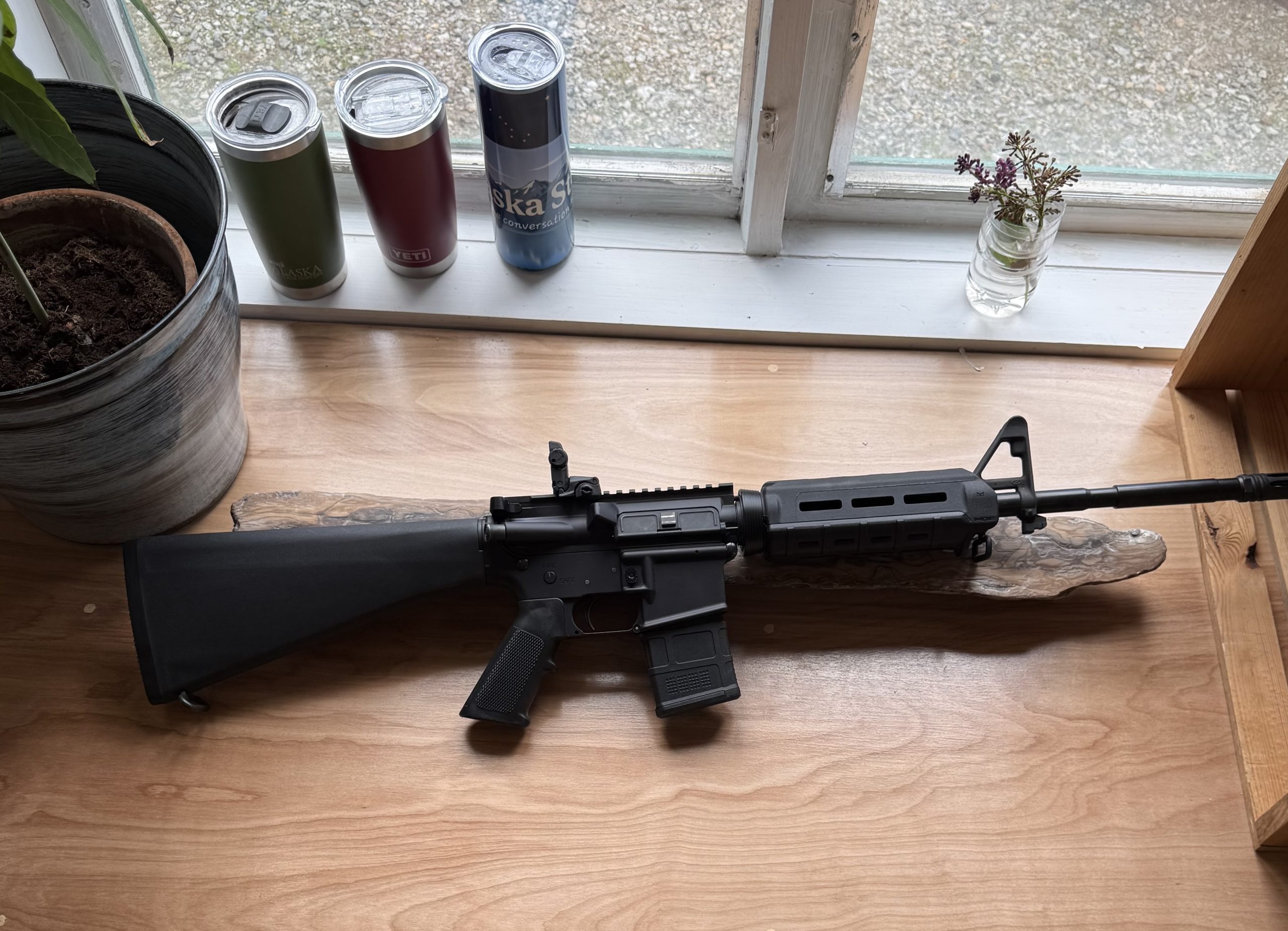
June 30, 2026 – The US Supreme Court has agreed to hear what could become the most consequential Second Amendment case since its landmark 2022 ruling in New York State Rifle & Pistol Association v. Bruen, setting the stage for a decision that could determine whether governments may ban the nation’s most popular rifle, the AR-15.
The justices announced Tuesday that they will hear the consolidated cases Viramontes v. Cook County and Grant v. Higgins, both of which challenge state and local bans on what gun-control advocates like to call “assault weapons.” The cases arise from Illinois and Connecticut, where lower federal courts upheld laws prohibiting the sale and possession of many AR-15-style semi-automatic rifles.
At the heart of the cases is a straightforward constitutional question: Whether the Second and Fourteenth Amendments protect the right to own AR-15 platform rifles and similar semi-automatic firearms.
The Court will hear arguments during its next term, likely this fall, with a ruling expected by the end of June 2027.
The decision has nationwide implications: A dozen states and the District of Columbia currently ban at least the sale of AR-15-style rifles, generally defining the firearms by their detachable magazines and certain external features. A ruling striking down those bans would reshape gun laws across much of the country.
For Alaska, where firearm ownership is widespread and protected by both the US Constitution and the Alaska Constitution, the case will be closely watched, even though the state has no ban on AR-15-style rifles. Alaskans are decidedly pro-Second Amendment and the state has the third-most guns per capita after Montana and Wyoming.
The Court’s decision to take the cases signals that a majority of the justices believe it is time to answer a question they have repeatedly postponed since their 2022 Bruen decision established a new historical test for evaluating firearm regulations.
Gun-rights advocates have made overturning AR-15 bans their highest legal priority since Bruen. Although the Supreme Court declined several earlier opportunities to hear similar cases, Justice Brett Kavanaugh hinted last year that the Court was simply waiting for more appellate decisions before stepping in.
“Opinions from other Courts of Appeals should assist this Court’s ultimate decision making on the AR-15 issue,” Kavanaugh wrote at the time. “Additional petitions for certiorari will likely be before this Court shortly and, in my view, this Court should and presumably will address the AR-15 issue soon.”
Tuesday’s announcement fulfilled that expectation.
“The Supreme Court’s decision to hear these pivotal cases will finally provide the courts the necessary guidance as it relates to the types of arms protected by the Second Amendment,” said Adam Kraut, executive director of the Second Amendment Foundation, which is a plaintiff in both cases. “The modern semi-automatic rifles banned in Cook County, Connecticut and elsewhere are among the most commonly owned firearms in the country, placing them well within the scope of the Second Amendment.”
Gun-control organizations believe invalidating assault weapon bans would undermine public safety.
“Assault weapons cause massive devastation. They are the weapons of choice for mass shooters,” said Janet Carter, managing director of Second Amendment litigation at Everytown Law. “These laws are critical public safety measures, and they are consistent with the Second Amendment,” she alleged.
The Court’s review comes after every federal appeals court to consider statewide assault weapon bans has upheld them. Those courts concluded that governments may prohibit certain semi-automatic rifles without violating the Second Amendment, despite the Supreme Court’s earlier decisions recognizing an individual right to possess firearms for lawful purposes such as self-defense.
The justices will now determine whether those lower courts correctly applied the Constitution or whether AR-15-style rifles deserve the same constitutional protection the Court extended to handguns in its 2008 District of Columbia v. Hellerdecision.
While agreeing to hear the AR-15 cases, the Court declined to take up several other closely related Second Amendment disputes, including challenges to state restrictions on high-capacity magazines and cases involving firearm rights for adults ages 18 to 20. Those issues are likely to remain unresolved until after the Court decides the AR-15 question.
The Court has now heard multiple Second Amendment cases in consecutive terms, an indication that the justices intend to continue defining the boundaries of firearm rights following the sweeping changes introduced by Bruen. The upcoming decision could become the most significant gun-rights ruling in nearly two decades and establish a nationwide standard for whether governments may prohibit one of the most commonly owned rifles in America.
Second Amendment battles heat up as Supreme Court enters fall term on Monday
Supreme Court strikes down Hawaii’s ‘vampire rule,’ expands Second Amendment protections
Justice, ATF roll back regulations in reform initiative that is pro-Second Amendment
DC Court of Appeals strikes down city’s ban on magazines holding more than 10 rounds





12 thoughts on “AR-15 showdown: Supreme Court to decide whether states can ban America’s most popular rifle”
We need AR-15s in case we go to Civil War.
It’s the Republican long-arm of the law.
Large mags too, with mountains of ammo.
Peace-keeper of choice for constitutionalists. (Night vision and laser mount recommended).
U.S. v Miller, 1939https://supreme.justia.com/cases/federal/us/307/174/?__cf_chl_f_tk=eGIK0D_kuAX4KCGR0mbfYOyAfNf.9r3C_d71xny.cuw-1782857559-1.0.1.1-LVqlyors.ECotKGFGNotAlrJAkiaVBWrnAhA4DDF.5k
“……..The signification attributed to the term Militia appears from the debates in the Convention, the history and legislation of Colonies and States, and the writings of approved commentators. These show plainly enough that the Militia comprised all males physically capable of acting in concert for the common defense. “A body of citizens enrolled for military discipline.” And further, that ordinarily, when called for service these men were expected to appear bearing arms supplied by themselves and of the kind in common use at the time………..”
We do NOT get our right to keep and bear arms from the 2nd Amendment. The right to self-defense comes from the Almighty God, so whatever the court decides, is totally irrelevant. Or whatever a particular state decides, or municipality. They can pass laws. We can think for ourselves. The government does not own you. Since they are smuggling abortion pills into a state, we can smuggle in an AR-15.
Mr Bird, you step close to the line that separates conservatives from far flung wacko right wing pterodactyls. You’re really close. You do your side a disservice. We, on the critical thinking side, see you as evidence that religion and far right Trumpian values are poison and must be chelated.
Actually, Mr. Bird is Constitutionally correct in his statement where the Declaration of Independence uses the term “Creator” after referencing “Laws of Nature” and “Nature’s God”. For Mr. Bird, “Creator” has as its meaning his “Almighty God”; for the Jewish people it is Yahweh, the God of Abraham, Isaac, and Jacob; for Buddhists it is temporal and spatial cosmology driven by cause and effect (actual meaning of Karma); for Hindus this may be different entities depending upon the particular Hindu tradition which represents the universe as a projection of divine consciousness and a continuous process of cyclical differentiation and reintegration (Brahman or the state of Brahman for many); for atheists “Creator” represents the organically coalesced natural order of the universe; we could keep going. Regardless of an individual’s concept of “Creator”, or Mr. Bird’s particular concept, Mr. Bird is correct that the right to self-defense falls under the category of “unalienable Rights”. Only a “far flung wacko” (your disparaging term) would fail to recognize what our nation’s founding Document codifies. Grow up.
As an atheist, I feel more qualified to define atheism than your cut and paste. Atheists don’t believe in a god.
Don’t get your hopes up, the Supreme Court has shown they’re a weathervane.
This will greatly affect the citizens of Virginia, whose legislature and governor passed a law outlawing “assault” weapons and “high capacity” magazines, due to go into effect tomorrow. However, both measures are now subject to an injunctive stay until Dec 31, 26.
Take aways:
1. Never trust “moderate” democrats to govern moderately. They lie.
2. There are no moderate democrats.
“They are the weapons of choice for mass shooters,” said Janet Carter…”. That is 100% false.
JenL. You might checkout the database on this site (https://smokinggun.org/guns-used-in-the-deadliest-u-s-mass-shooting/). It doesn’t have a pie chart showing percentages of particular weapons used in mass murders. It is stunning, though, to see how many people have been shot by folks with easy access to lots of guns. Remember that Las Vegas massacre on October 1, 2017? 417 people were shot by the right bestowed to Americans by the Second Amendment.
Incorrect!!!! The right didn’t shoot those people. Someone misusing iit did, just as those using the freedom to travel kill others in vehicle collisions in far larger numbers