


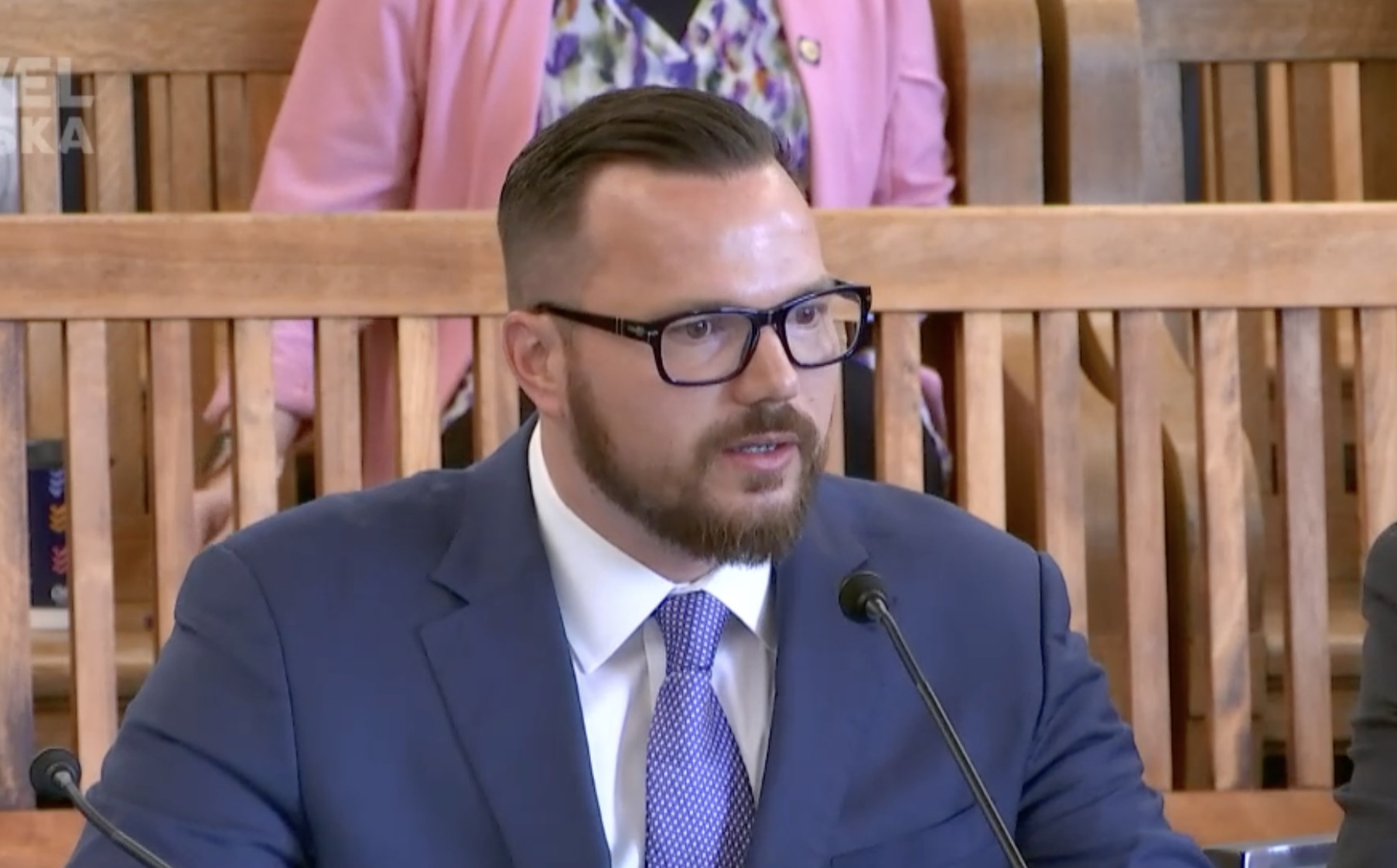
By THE ALASKA STORY
June 7, 2026 – The estimated cost of the Alaska LNG Project has climbed into the $44.5 billion to $54.5 billion range, a more than 22% increase from earlier projections and a reminder that delay carries a price tag of its own.
The updated construction estimates, presented to the Senate Finance Committee by Glenfarne Alaska President Adam Prestidge, pictured above, are the figures lawmakers have been demanding since the start of the special session and throughout much of the regular session.
The numbers underscore a reality facing Alaska’s long-discussed natural gas megaproject: Inflation, financing costs, labor expenses, and construction risks continue to push costs upward, and investors are closely watching whether the Legislature will enact tax reforms that Glenfarne says are necessary to move the project forward.
“The best way to present cost construction estimates for the project was as an estimated range reflecting our best expectation of what it will cost to construct the Alaska LNG project,” Prestidge told senators.
The total project estimate now ranges from $44.5 billion on the low end to $54.5 billion on the high end.
The largest share of that cost belongs to the liquefied natural gas export facility, estimated at between $23.6 billion and $28.4 billion. The gas treatment plant is estimated at between $7.7 billion and $9.2 billion.
The 807-mile pipeline itself — the portion of the project that would first deliver North Slope gas to Southcentral Alaska — carries an estimated construction cost of between $13.2 billion and $16.9 billion.
Prestidge said the pipeline estimate is based on a more advanced Class II cost estimate completed through front-end engineering and design work performed by engineering firm Worley. That work concluded in December.
The estimates for the LNG plant and gas treatment facility remain Class IV estimates, based on prior studies, industry inputs, and Glenfarne’s experience developing LNG projects elsewhere in the United States, including Texas LNG and Magnolia LNG.
The updated cost estimates arrive as lawmakers debate legislation that would replace traditional property taxes on the project with a volumetric tax structure tied to gas flowing through the system.
Supporters argue the change is necessary to make the project financeable and competitive in global markets. Opponents have doubted the plan while providing no reasonable alternative.
Prestidge told lawmakers the tax reform is a critical component of the project’s financing structure. It would provide certainty for investors while reducing the risk of valuation disputes that have plagued other large energy projects.
Prestidge noted that potential investors who recently attended an Alaska LNG conference in Anchorage are waiting to see what the Legislature does before making major commitments.
The stakes are significant for Southcentral Alaska, which faces looming natural gas shortages as Cook Inlet production continues to decline.
During testimony before both House and Senate committees, legislators expressed concerns that if only the first phase of the project is built, which is a pipeline bringing North Slope gas to Southcentral Alaska, consumers could ultimately face high energy prices if construction costs escalate.
Prestidge sought to reassure lawmakers that cost overruns would not be passed on to Alaska consumers.
Under the framework currently being negotiated with Enstar Natural Gas Co., the proposed gas transportation rate would be fixed at approximately $16 per thousand cubic feet and would not be reopened if construction costs exceed estimates.
Prestidge said Glenfarne supports statutory language specifically prohibiting cost overruns from being borne by the State of Alaska or by regulated utility customers.
Enstar President John Sims told the House Finance Committee that the utility has spent roughly 10 months negotiating with Glenfarne and is working toward a final agreement that would govern the transition from imported liquefied natural gas to North Slope gas delivered through the Alaska LNG pipeline.
The proposed gas supply agreement would extend for 30 years and ultimately be reviewed by the Regulatory Commission of Alaska.
Sims said Enstar will not take an ownership stake in either imported LNG facilities or the pipeline project itself.
For imported LNG expected before pipeline completion, pricing is tied to the Japan-Korea Marker benchmark, known as JKM, plus shipping and terminal costs. JKM prices have fluctuated dramatically in recent years, ranging from roughly $8 per thousand cubic feet to more than $18 today.
As a result, Enstar expects delivered gas costs between $16 and $22 per thousand cubic feet by 2033, replacing the current average gas cost of approximately $10.80.
Once Phase 1 of Alaska LNG is operational, Sims said, Enstar would pay the fixed $16 rate negotiated with Glenfarne.
As additional volumes move through the pipeline and later phases of the project are completed, that transportation cost is expected to decline.
For Alaska lawmakers, the June 3 presentation highlighted the consequences of continued delay.
The Alaska LNG project has been under discussion for more than two decades. Every year spent debating rather than building has brought higher labor costs, higher material costs, higher financing costs, and a larger overall price tag.
The latest estimates suggest that trend has not changed.
The question now before the Legislature is whether Alaska will create the tax framework Glenfarne says is necessary to secure financing and begin construction, or whether lawmakers will continue debating while the cost of the project keeps climbing. Special session ends June 19.



9 thoughts on “Alaska LNG price tag climbs as lawmakers delay”
Senator Myers piece in the Alaska Story today reported that the Alaska Oil Pipeline cost estimate was 900 million but the cost after completion was 8 billion back in the mid 1970s, then the proposed Alaska LNG line likely will be about 324 Billion comparatively.
Delisted middleman Glenfarne who is not a pipeline builder exaggerates on a lower number in order to get the commitments by the investors and the state to get the proposed LNG project over the line.
Summarize; A 42 inch diameter pipeline 700 plus miles and a LNG plant is a larger project than the state and Glenfarne realizes.
3rd Generation says: “Delisted middleman Glenfarne who is not a pipeline builder … ”
For the 10th time, Glenfarne is not listed because it is privately held. At least you could get something (anything?) right. That being said, on to your regularly scheduled rant. Cheers –
If the pipe is $12-$13 billion, and the LNG export facility is double that, then an LNG import facility will be double the pipeline cost, too. So, then, just the pipe is a better deal for our own gas usage than either additional offshore rigs in the inlet or importing LNG from Canada.
Once again, this entire brouhaha is demonstrated to be just a huge shakedown.
Let it all go to Hell. As soon as the money is gone, so the sharks will leave, and the discomfort will be well worth ridding ourselves of the parasites.
Yeah. The do-nothing liberals (luke-warm type of people who are liberal) they likely will leave IF Alaska hits rock bottom. What they’ll leave in their wake is moral society decay, disorder, corruption, thievery, rampant addiction and hobos, poorly educated children and adults, and even lesser of a Chuch community because of liberals resistance to “religion” since its the liberals leading Alaska churches. Alaska would be even worse than what we live around today.
The risk of hitting rock bottom is you don’t know if Alaska will die like other civilizations or if it’ll rise up from its ashes which depends sorely on God and His plan and love. He did show he cared about Nineveh to send Jonah and they repented for a short time which he spared them in those years; or his promise to Abraham if there are an amount of Righteous people living in Sodom He’ll spare for their sake. Still There are lots of civilizations that do not exist today after hitting rock bottom.
There is no just wishing and hoping the liberals (or parasites 🦠 ) will leave. They’ll leave but Alaska will not return to when Alaskans were Alaskans in 1967. There be Massive destruction, expense, and loss immorality everywhere
And destruction, immorality, and ruin Always bring new “sharks” who are profiting off the peoples vulnerabilities, weaknesses, and isolation.
The shorter the line, the cheaper the project. The Kotz option is half the length. The Prudhoe option is zero pipe. Just sayin’. Cheers –
Any % of nothing…is nothing. For dipstick progs, that’s, X% x 0 = 0.
.
Stupid mfisbahfh. 🤬🤬🤬🤯🤯
.
I don’t know either; it made sense while I typed it out…
The only profit in the LNG line is the Carbon Credits. Any excess credits not used by the recipent can be sold for 90 cents on the dollar to others who need more carbon credits. Guess who gets that cash. Spoiler, it aint the State of Alaska. This is a giant grift disguised as a boon for the little people.
Respectfully disagree, Madam Editor, with Glenfarme’s adolescent blackmail that time spent in legislative deliberations necessarily increases construction cost.
.
Take-aways are that: (a) Glenfarme may see Alaska, with its 25% stake in the project, as a cash cow to cover cost overruns and rate increases, (b) inevitable overruns and increases may be already baked into “increased” project cost, and (c) the legislature, justifiably seen as the cause of most of Alaska’s troubles, can be conveniently blamed if “incresed” cost turns out to be problematic.
.
There’s a reason the questions we’ve asked so many times, questions you’ve been gracious to print so many times, haven’t been asked, or answered in formal settings.
.
Alaskans have a 25% stake in the outcome, but no one’s asking on their behalf, why?
.
Nothing proves Cook Inlet gas reserves are bouncing on empty, nothing proves the two other options to the project are unworkable and should not be allowed to happen.
.
And the last bit (for now): their promise of price controls on customer rates seems unrealistic, at best. At worst, their promise is disturbingly amnesic. What we learned about the effect of price controls on supply during the 1970’s oil crisis seems forgotten, and Alaskans today may be forced into re-learning it.
.
Does this ring a bell, are they doing anything differently now? “We economists don’t know much, but we do know how to create a shortage. If you want to create a shortage of tomatoes, for example, just pass a law that retailers can’t sell tomatoes for more than two cents per pound. Instantly you’ll have a tomato shortage. It’s the same with oil or gas.”
(“Friedman Blames Mess on Federal ‘Helpers’,” Los Angeles Times, February 10, 1977)
.
Maybe there’s an ulterior motive, lowballing, setting prices artificially, temporarily low to discourage investment in the other two options.
.
Who knows? We damn sure don’t. But for our 25% stake, maybe we should find out.