By SUZANNE DOWNING
If you’ve followed the Iditarod for any length of time, you’ve seen Jeff Schultz’s work, even if you didn’t know his name. For more than four decades, his photographs have defined how the world sees the Iditarod Trail Sled Dog Race: the grit, the exhaustion, the quiet determination, and the bond between humans and dogs stretched across 1,049 miles of Alaska.
But Schultz’s most personal and ambitious work isn’t hanging on a wall or printed in a book. It lives online.
It’s called Faces of the Iditarod, and it may be one of the most important historical preservation projects ever undertaken for the race.
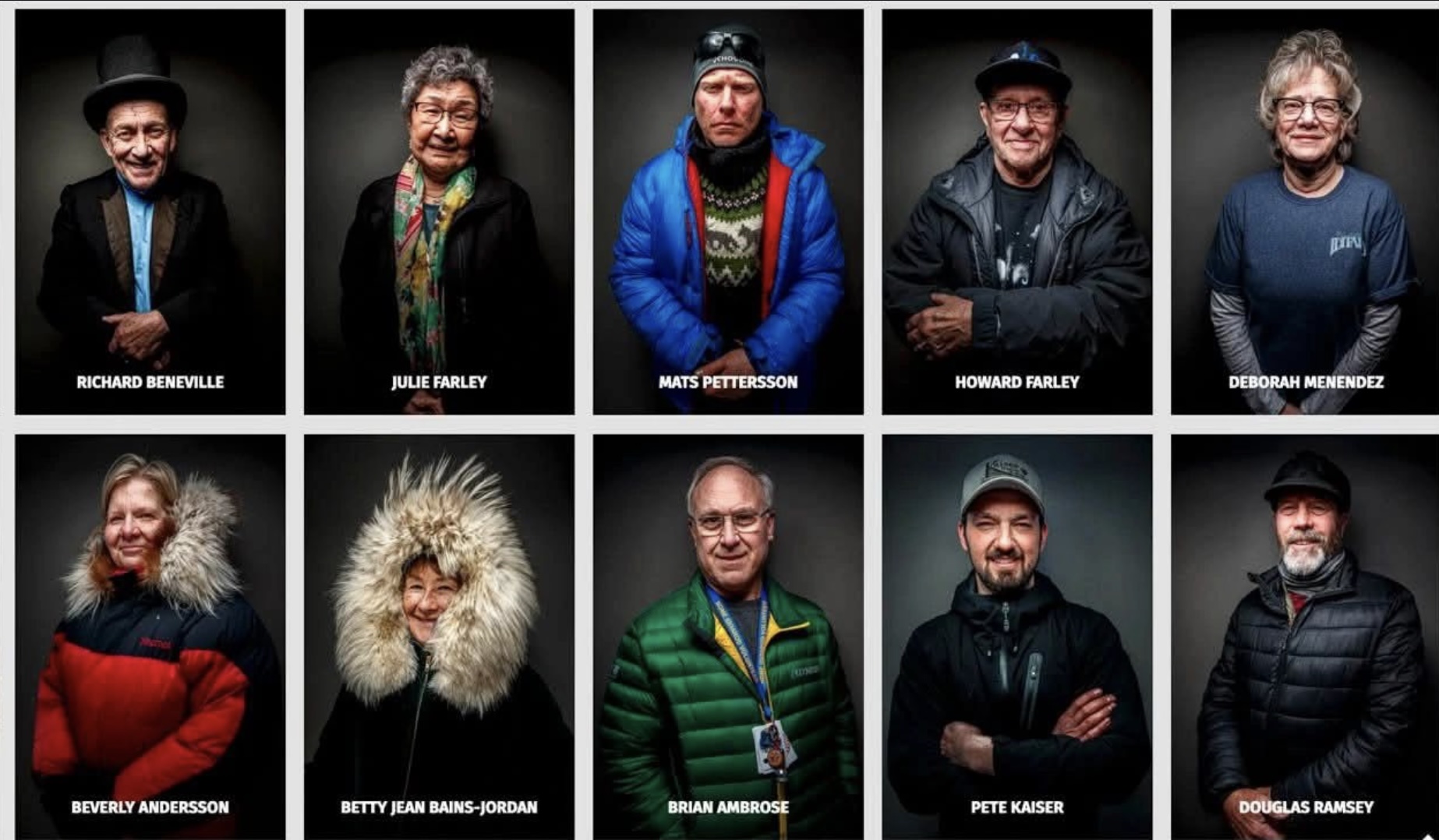
Launched in 2019, Faces of the Iditarod now includes more than 1,100 portraits of Iditarod mushers, volunteers, village residents, spectators, and canine athletes. Each portrait is paired with audio, real voices answering the same four questions, along with written context and personal details. The result is a living, breathing oral history of the Last Great Race on Earth.
“You can search for a specific person,” Schultz says, “but you really need to listen to the audio. That’s where the story lives.”
The project can be viewed at faces.iditarod.com, where every participant, whether a champion musher, a trail volunteer, or a local resident, appears on equal footing. No bib numbers. No finish positions. Just people.
Schultz deliberately photographs each subject with the same background and lighting, removing them from the chaos of the trail and the drama of the race. Combined with their own words and voices, the portraits reveal something deeper: what the Iditarod truly is, beyond headlines and controversies.
“Our hope,” Schultz explains, “is that these images and stories show what this thing we call the Iditarod really is – an Alaska event of real-life humans and superstar canines that is simply like no other event in the world.”
The idea for the project traces back decades. When Schultz first began photographing the Iditarod in the 1980s, he was encouraged by Bill Devine, an artist, close friend of Iditarod founder Joe Redington Sr., and creator of the Iditarod logo.
“He told me, ‘Your photos will preserve Iditarod history,’” Schultz recalls. “That stuck with me.”
Faces of the Iditarod is Schultz’s way of fulfilling that charge.
There is no commercial angle. It can’t be turned into a traditional book because the project is dynamic, constantly updated, and deeply tied to audio. Schultz supports the work largely out of pocket, with some help from voluntary donations through Patreon.
“There’s no money to be made in this,” he says. “I’m doing it to honor and preserve the founders, mushers, volunteers – everyone who made this race what it is. I only wish I had started it many years earlier.”
Now, Schultz is expanding the project.
He is on a mission to add every possible past Iditarod finisher, going all the way back to the first race in 1973. It’s a massive undertaking and a race against time, but he’s determined to do it.
This Saturday, Dec. 27, from 11 am to 2 pm, Schultz will be set up in Anchorage to photograph and interview finishers who are not yet part of the Faces collection. The effort is focused for now on Anchorage-area mushers, with continuing plans to expand statewide in the future.
Schultz is asking for help locating finishers who may no longer be active in racing circles or online. Among those believed to be in or near Anchorage are Robert Nelson, Tony Willis, Bob Hickel, Karin Schmidt, Ron Brennan, Greg Tibbits, Macgill Adams, Frank Bettine, Shannon Brockman, Wes McIntyre, Phil Morgan, Larry Williams, Peter Sapin, and Ben Jacobson, along with others.
Finishers who can attend Saturday’s session are asked to send Schultz a private message with their phone number and email address to receive specific details. Friends, family members, and longtime fans are encouraged to help make connections.
Schultz has planned trips to places like Montana, where 15 or more finishers live, Minnesota, Arizona, New Mexico, and multiple hub cities across Alaska. For mushers who live overseas, Schultz is even developing a system to hire photographers locally, using identical lighting and setup, while conducting interviews via Zoom or WhatsApp.
“The hardest part,” he says, “is simply finding people – where they live now and how to contact them.”
That’s where the public comes in.
Schultz is asking past Iditarod finishers, and anyone who knows one, to help spread the word. If you are a finisher, or know a finisher who is not yet part of Faces of the Iditarod, Schultz wants to hear from you.
He is asking for basic contact information- email, phone number, and current city, state, or country – so he can coordinate portraits and interviews as he travels.
Contact Jeff Schultz at: facesofiditarod@gmail.com