

By SUZANNE DOWNING
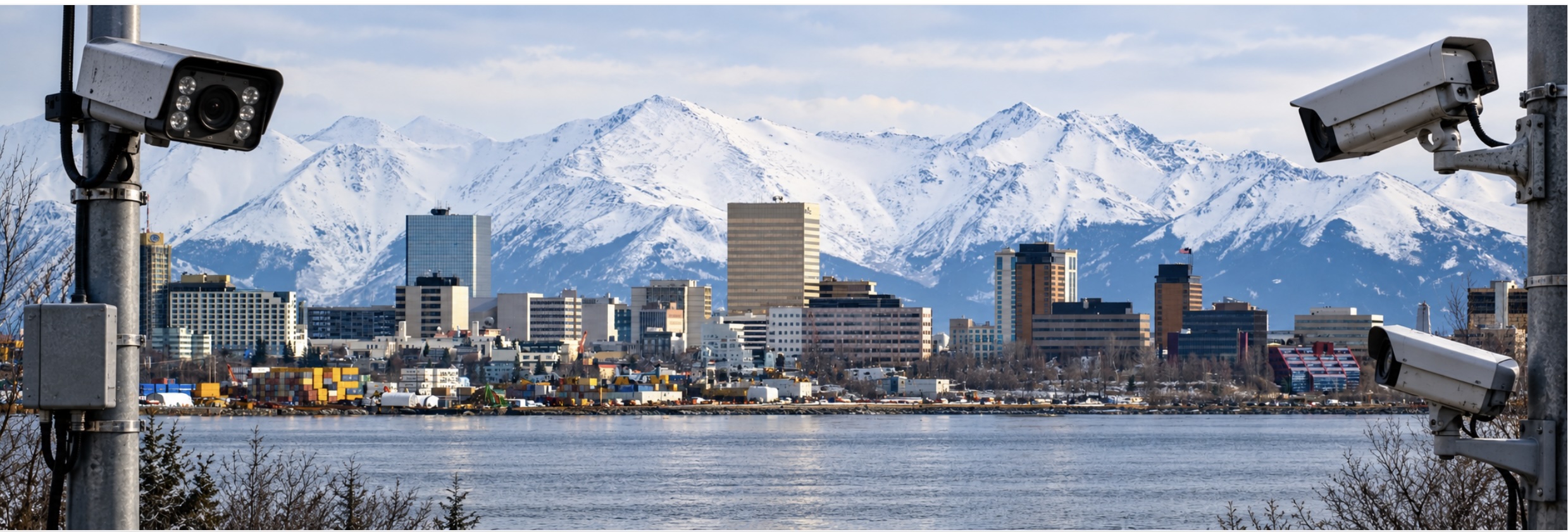
Sept. 13, 2026 — The Anchorage Assembly will continue a public hearing Tuesday on a controversial proposal that would place new limits and reporting requirements on the Anchorage Police Department’s use of license plate readers, live camera feeds and its developing Real-Time Crime Center.
Ordinance AO 2026-108 is sponsored by Assembly members Keith McCormick and Sydney Scout and Assembly Vice Chair Daniel Volland. The public hearing began Sept. 1 and was continued to the Assembly’s Sept. 15 meeting.
The ordinance originally put strong restrictions on municipal surveillance of Alaskans, including limits on how long data could be stored, prohibitions on coordinating with outside surveillance-data networks, and requiring approval from the Assembly prior to obtaining certain technology.
After feedback from the sponsors of the measure, a substitute version, AO 2026-108(S), was drafted by the municipal Department of Law. It rewrites and narrows portions of the original proposal but retains the Assembly oversight portion.
The Anchorage municipality is planning to spend approximately $600,000 on equipment and technical support for APD’s Real-Time Crime Center at the department’s Elmore Road headquarters. The contract with ThunderCat Technology is being paid through collection of fines from federal and state agencies.
The center is designed to connect together some 750 camera feeds, including Anchorage’s more than existing 250 traffic cameras, police body cameras, cameras on drones and privately owned security systems whose owners have agreed to provide access.
Automated license plate readers can scan passing plates, and then compare them with lists of stolen vehicles or vehicles associated with wanted persons, and preserve information that may later assist an investigation. APD currently uses license plate-reading functions installed in some patrol-car dashboard cameras.
Crime has risen dramatically in Anchorage under the LaFrance Administration. Reported offenses to the Anchorage Police Department rose 14.6% from 2024 to 2025, according to Alaska’s official 2025 “Crime in Alaska” report released in late August. Property crime went up 19.4%, violent crime rose 1.2%. A total of 17,280 total offenses were recorded in Anchorage in 2025.
Police Chief Sean Case has defended the use of technology as an extension of tools officers have already been using for years. A license plate displayed on a vehicle moving or parked on a public road is already visible to an officer and officers routinely run plates to determine the vehicle’s registration status and whether its registered owner has an outstanding warrant.
The difference is scale.
An officer may observe and check one plate. A network of automated readers can scan thousands of vehicles, record where and when each was seen, and potentially reconstruct a driver’s movements over days or weeks. When information is shared with other police agencies or placed in a national network that uses artificial intelligence, the reach can actually extend far beyond the municipality. It can go national.
The original Anchorage proposal would have generally required camera footage to be deleted after 14 days unless it was connected to an active investigation. It also sought to restrict license plate reader searches to defined law-enforcement purposes, including locating stolen vehicles and missing people, and would have limited the sharing of information with federal agencies without legal authority such as a warrant.
Some have suggested that rules controlling access, retention, and sharing should be in municipal code, rather than left entirely to the discretion of the police, which could change from administration to administration.
There is also the matter of the Alaska Constitution and its right-to-privacy provisions.
The substitute ordinance reflects some of those concerns. Rather than replacing the municipality’s surveillance chapter wholesale, it amends existing code and emphasizes written policies for specified technologies, Assembly review of contracts and acquisitions, regular public reports, and a process for reporting and investigating alleged violations.
The debate in Anchorage mirrors a rapidly growing national dispute over automated license plate readers and interconnected police camera systems, and mass surveillance of Americans through publicly placed cameras, often called Flock cameras.
The continued public hearing is scheduled during the regular Assembly meeting beginning at 6 pm on Sept. 15, in the Assembly Chambers at the Z.J. Loussac Library, 3600 Denali Street. Members of the public may testify in person, by telephone or through written comments.
The municipality’s agenda materials here include the original ordinance, the substitute version, the accompanying memoranda and supporting documents.


One thought on “Anchorage Assembly to weigh limits on police surveillance as privacy, public-safety debate intensifies”
Big Sister is Watching You