


By SUZANNE DOWNING
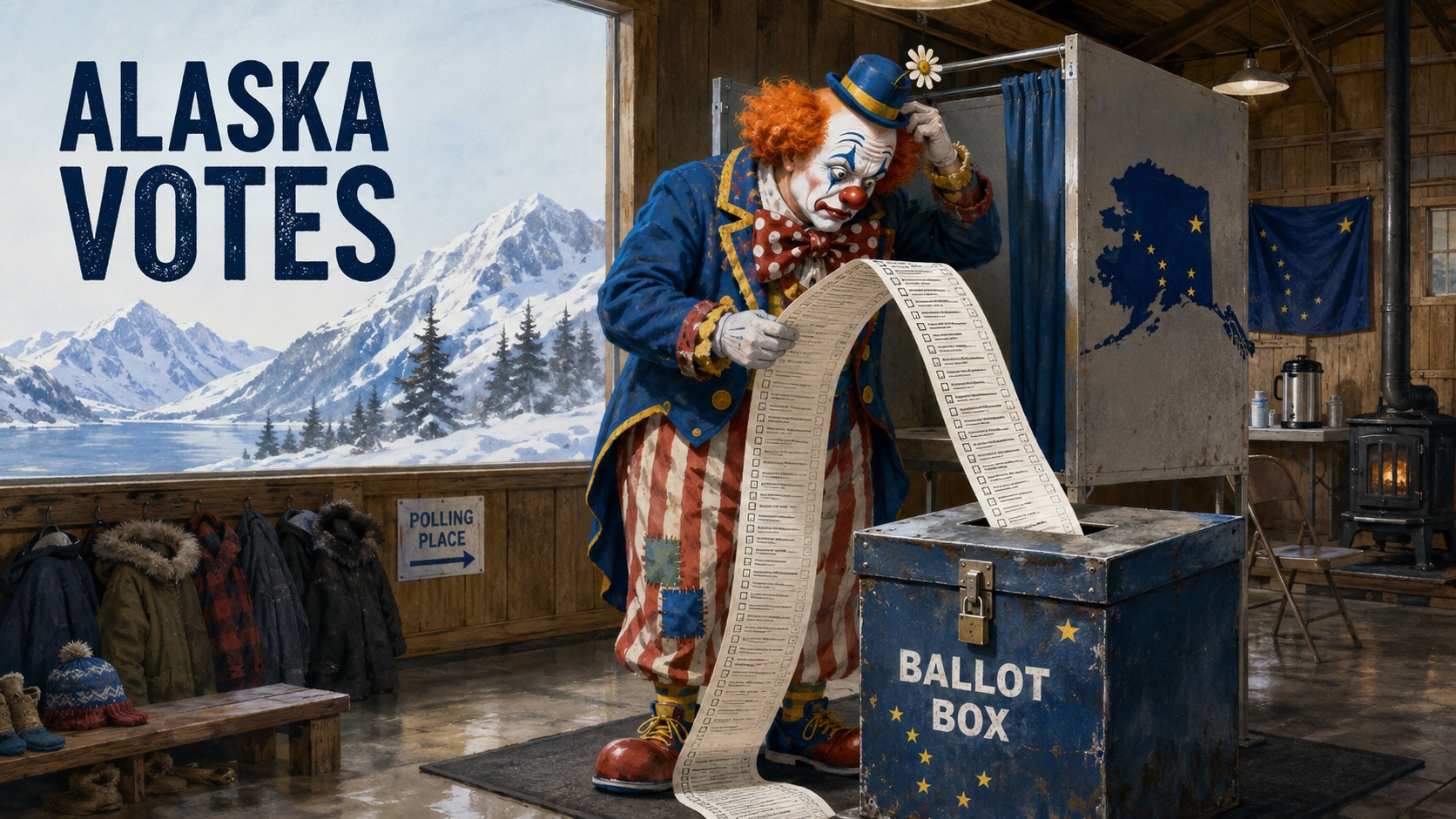
Sept. 1, 2026 – Alaska’s experiment with ranked-choice voting has progressed from a source of confusion and delayed results to a system that political operatives can manipulate, according to a blistering assessment in The Wall Street Journal.
In her Aug. 20 column, “Alaska’s Ranked-Choice Voting Travesty,” Kimberley A. Strassel argued that Alaska’s first two ranked-choice election cycles were embarrassing enough. This year, she wrote, campaigns and political operatives discovered just how many ways the system could be gamed.
Strassel described Alaska as a national “poster child” for political dirty tricks, with voters treated less like citizens choosing their representatives and more like pieces moved around a campaign strategist’s chessboard.
Her critique began with Alaska’s two-stage election system: a nonpartisan primary in which every candidate appears on the same ballot, followed by a general election in which the top four finishers compete through ranked-choice voting.
The system is complicated further by Alaska’s remarkably low threshold for becoming a candidate. There is no petition requirement, and filing for statewide office costs only $100.
The result this year was a primary ballot featuring 17 candidates for governor, 16 for U.S. Senate and 15 for Alaska’s lone seat in the U.S. House. Candidates can make the “final four” with just 1% of the vote, as has Gerald Heikes in the US Senate race.
Strassel argued that the crowded fields invite frivolous candidacies, strategic filings and candidates with no serious intention of serving. The ballot included attention-seekers, perennial candidates, people living outside Alaska and even a federal prisoner.
One congressional candidate openly acknowledged that he was running “for fun,” supported Democrat Mary Peltola for Senate, and would withdraw if he unexpectedly reached the final four.
Such candidates are not merely harmless curiosities under Alaska’s system. A candidate who advances and then withdraws can elevate the fifth-place finisher, potentially changing the ideological and partisan composition of the November ballot after voters have already cast their primary ballots.
That is precisely what has now happened in the U.S. Senate race.
Democrat-socialist David Leslie finished fourth with about 1.1% of the vote, narrowly ahead of perennial Republican candidate Gerald Heikes. Leslie withdrew Monday, moving Heikes onto the November ballot alongside Peltola, incumbent Republican Sen. Dan Sullivan and Daniel J. Sullivan Jr.
The last of those candidates is the centerpiece of the controversy.
Decoy Daniel J. Sullivan Jr., a retired teacher who had previously supported Democratic candidates, filed for the Senate shortly before the deadline. A Democratic consultant handled his filing. His original campaign logo closely resembled the incumbent senator’s branding, and the two Sullivans appeared next to each other on the primary ballot, with the lesser-known candidate listed first.
The Division of Elections initially removed Decoy Dan from the ballot after concluding his candidacy was not made in good faith. A Superior Court judge reversed that decision, and the Alaska Supreme Court allowed him to remain. The courts concluded that state law did not give election officials adequate legal grounds to disqualify him merely because his candidacy might confuse voters.
The result was predictable.
Despite conducting almost no visible campaign, Decoy Dan received 4,107 votes and finished third. The senator, listed as Dan S. Sullivan, received 68,726 votes, while Peltola received more than 82,000, according to the state’s official primary results.
No one can determine how many of those 4,107 voters intended to support the incumbent. Strassel’s point was that Alaska has constructed an election system in which campaigns have an incentive to manufacture precisely that uncertainty.
The Wall Street Journal editorial board returned to the issue after more ballots were counted. In an Aug. 26 editorial titled “Alaska Voters, Seeing Double Dan Sullivan,” the newspaper called the election another fiasco produced by Alaska’s top-four system.
The editorial noted that the lesser-known Sullivan performed disproportionately well in Democratic areas. Daniel J. Sullivan has denied running as a decoy, describing himself as a moderate Republican who has voted for Peltola twice and has never supported the incumbent senator. Peltola’s campaign and the Alaska Democratic Party have also denied involvement in recruiting him.
But intent is only part of the problem. The larger issue is that the system makes such tactics potentially effective.
A conventional party primary would allow Republicans to select their Republican nominee and Democrats to select theirs. Alaska’s jungle primary instead throws serious candidates, marginal candidates, strategic candidates and nearly identical names onto one ballot. The four highest finishers then advance, regardless of party or percentage received.
The maneuvering does not stop after the primary. Candidates can withdraw and alter the final four. Parties and special-interest groups can encourage marginal candidates to remain in the race, drop out or position themselves to siphon votes from someone else. In November, voters must distinguish between those candidates and decide not only whom they support, but how many candidates to rank and in what order.
Supporters of ranked-choice voting contend that it gives voters more choices, rewards candidates with broader appeal and prevents someone from winning without majority support. Research cited by RCV advocates also disputes claims that ballot exhaustion or complex manipulation routinely changes outcomes.
Strassel’s argument, however, is that Alaska’s 2026 election demonstrates the gulf between that theory and political reality. When ballot access is nearly effortless, four candidates advance regardless of support, withdrawals can rearrange the field and candidates with nearly identical names can appear together, the system offers political operatives a toolbox for mischief.
Alaska is now nationally known for elections that take weeks to resolve, candidates who advance with barely 1% of the vote, and a Senate ballot featuring two men named Dan Sullivan.
What was sold as election reform is, in actuality, political theater at the expense of voters.
Democrat David Leslie’s last-minute withdrawal puts three Republican-identified candidates against Peltola — and exposes the flaw in ‘rank the red’


20 thoughts on “Wall Street Journal: Ranked-choice voting has made Alaska a national laughingstock”
Leftists ruin everything they touch. And they are trying to touch Alaska.
Repealling rcv will be the most important vote I’ll cast this fall.
Get used to RCV. Even after Nov, the voters by narrow majority again will keep it in play.
Alaskans haven’t changed that much since its first run to be repealed.
You and your crystal ball Tina?
Engineered by Democrats. Just like LGBTQ, DEI, BLM, wokeism, race baiting, climate action……etc. This all has to be fought, head on by Conservatives. Otherwise, the lefty communists will rule and destroy our country. It is their objective intent.
“Despite conducting almost no visible campaign, Decoy Dan received 4,107 votes and finished third.”
Perhaps the news outlets reporting on his every move gave him all the publicity he needed?
Aaannndddd…perhaps everything reported on in this piece will give us the edge we need to vote YES ON 2 and return RCV to the festering dung pile from whence it emerged.
Well it seems that now the Republicans will have 3 choices for who they want to lead us towards higher fuel costs and ridiculous tariffs. They all seem capable. “Eggs expensive under Biden” was a story for months. “Trump made everything expensive on purpose” is apparently just a Trump personality quirk we’re all supposed to get used to.
Continue to think that the dems have any solutions. Americans reject dei, the alphabet mafia, “green” energy and open borders- all of which is an albatross around any candidate who tries to run as a D. If the dems do win back some power and try to implement their policies they will get blow back as hard as the repubs are getting now.
Like Great Britain is going through with the Tories and Labour, both major old school parties here have failed and voters are seeking new solutions. I would be interested in a party where the only platform is the end of constant war which means the end of empire. Empire has cost us so much. And those costs are rising.
Speaking of war- where are all the anti war protests from the left? I guess your donors want war. Just like the repub donors.
It’s just made AKRepublicans a laughingstock.
Because the group leaders don’t know how to play it.
Even in Ranking the Governor we are being forced to Rank the red candidates and only God knows what order the R voters will choose. However just like a Normal ballot whether or not RVC is used UNITY still is just as important.
Now I know for sure Why AKGOP top leaders told So many Republican leaders to enter the Governor’s race after Bernedette. Their strategy was to out Rank the Democrats by having so many Republicans. So the AkDemocrats decided to play the Unity game choose candidates whom their voters Will unify behind.
And I’m tired of being in the cool down corner having all my comments go through moderation. Put everybody else on comment moderation too. Some of them need to be moderated like Bot Evan Singh to which he doesn’t even contribute Ideas he communicates just like Kamala Harris in Word salads.
Ms Downing your acting like my passive aggressive supervisor
We love you, Tina! Give ’em hell!
If you thought it worked in your favor, you’d be all for it.
If Democrats thought it worked to their detriment, it would be gone lickety split.
Nailed it.
You are right that’s why Democrats are unifying behind One candidate. RCV and closed primaries was not made for political parties. RCV was designed by people to choose their candidates for a One world governance. It’s crazy but the key for Republicans and Democrats for beating RCV (and the right to have a differing opinion) is the same thing as a regular election Is using Unity.
The Republican leaders were wrong to think if they can have many gubnatorial republicans that they would be so many that Democrats wouldn’t make the top four All awhile Democrats unified behind JKT or Tom Begich while Republicans were so split that their top two just narrowly made the top three and fourth slot.
Ranked choice voting didn’t make Alaska a national laughing stock. Alaskans have made Alaska a national laughing stock, and they can’t seem to help themselves.
A reminder: all of this chaos is happening under Mike Dunleavy! He owns this crap! 💩 Remember his friend Mike porcarro got rich off this scheme by the funneling of murkowski money into his coffers! The credit for all of this costly dumpster fire 🔥 lays at the feet of Mike Dunleavy!
Alaska has, all along, been just too big and too sparsely populated. Because of this, our Alaskan culture has no harmony nor consensus. We had it in the push for statehood, but no longer. What does the Road System, where most of us live, have in common with Southeastern, whose focus and politics is all Seattle? For that matter, after 65 years of partial statehood, how many new roads have been built? And how many Alaskan communities even WANT them? Or, what do we have in common with the Third World standard of living in the Bush, where even our language divides us, and native corporations and Democrats hold total sway? Where snowmachines and four-wheelers are the only reasonable transportation to the nearest village, perhaps 30 miles away? Remember BARROW? How many people there actually call it Utqiaġvik, anyway? How many Alaskans are imported Greenies, who never want Pebble Mine to open, and every proven mining prospect is somehow controversial? Every “alternative energy source” is glommed onto by Democrats, who secure federal funding? How many former AIP members raced to re-register with the new Alaskan Party, which is eager to promote the old “Can Do!” spirit, after the AIP was single-handedly dissolved? How much of our land is held in private property? — about 1% ! Does our congressional delegation try to correct these handicaps, or do they merely seek to mitigate them? All these questions tell us that we are more of an American colony than we were BEFORE statehood. We were controlled by Outside corporations then, and we are (and it’s not even arguable) NOW.
Nineteen states have enacted legislation banning RCV. Where in hell are the utterly useless, worthless, self-serving RINO clowns in Alaska’s legislature????? The best budget cut we could make to help Alaskans would be to shut down every single state building in Juneau, and tell the people who work there to go home and not come back.
[…] Wall Street Journal: Ranked-choice voting has made Alaska a national laughingstock […]
[…] Wall Street Journal: Ranked-choice voting has made Alaska a national laughingstock […]