


By SUZANNE DOWNING
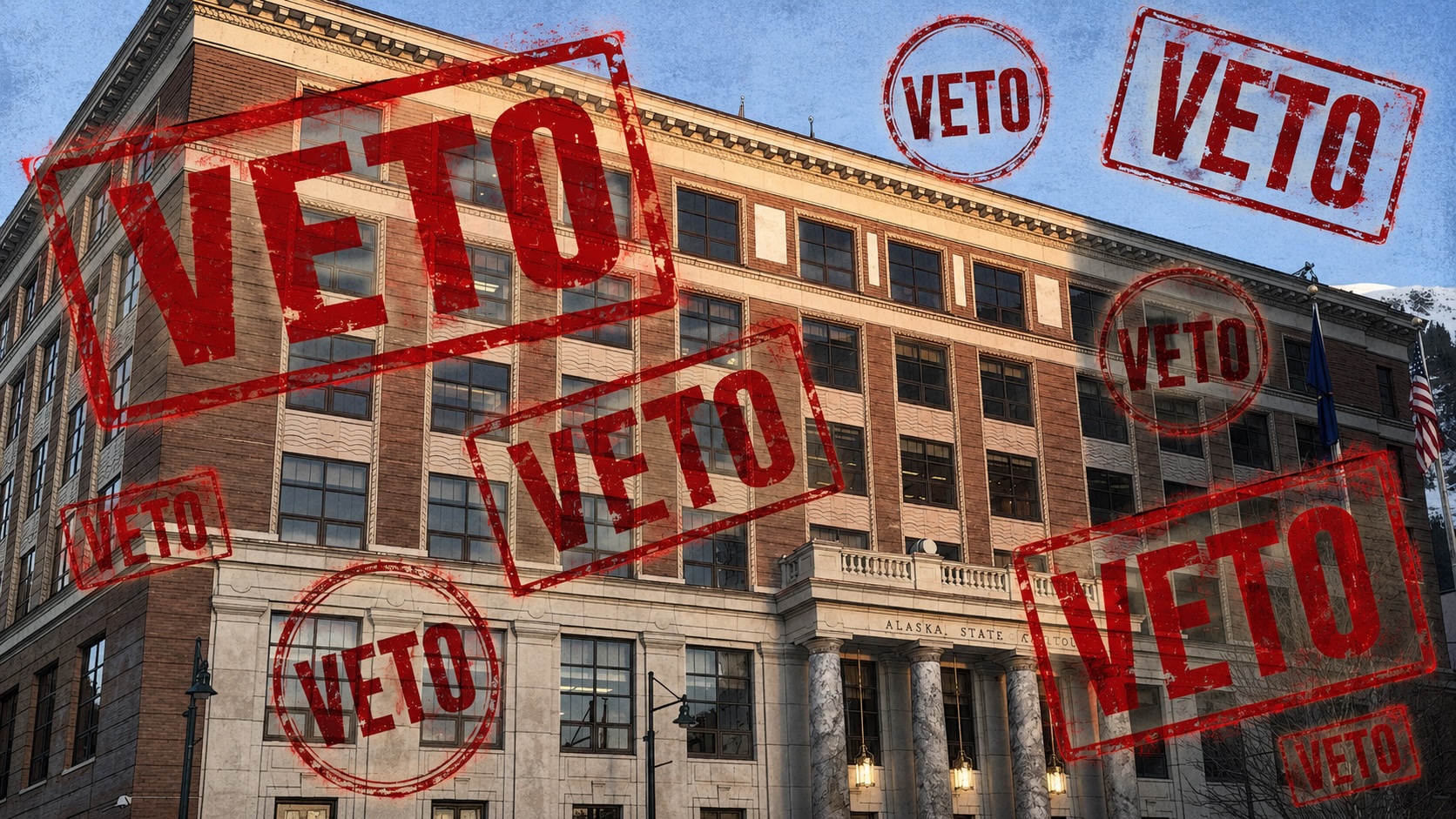
June 18, 2026 – As Alaska lawmakers race toward Friday’s special session deadline on the Alaska LNG tax legislation, another major deadline looms just hours earlier: Veto Day.
By midnight Thursday, Gov. Mike Dunleavy must either sign, veto, or allow nearly two dozen bills passed during the regular legislative session to become law without his signature. The Legislature and governor remain locked in a high-stakes struggle over the future of the Alaska LNG project, and the vetoes factor right into the equation.
Whatever happens with the governor’s veto pen could ripple directly into the final hours of negotiations over House Bill 381, the centerpiece gasline legislation that would replace construction-phase property taxes with a lower volumetric tax structure designed to improve the project’s economics and attract financing.
The governor has made passage of the gasline tax package his top legislative priority this year. When lawmakers failed to adopt the proposal during the regular session, Dunleavy responded by vetoing a defined-benefit pension bill last month, demonstrating his willingness to use his executive powers to advance his policy goals.
That history is not lost on legislators.
“People tend to get attached to their bills, and there’s some important bills in there,” Sen. Bill Wielechowski said this week to reporters. “I think it’s got the potential to create some ill will and create some more friction that you probably don’t need at this point.”
In other words, it’s a Mexican standoff.
The concern is straightforward: If Dunleavy vetoes one or more high-profile bills Thursday evening, lawmakers who support those measures could become less inclined to cooperate on the governor’s gasline priorities during the final hours of the special session.
Conversely, if the governor allows most or all of the legislation to become law, it could help maintain a more cooperative atmosphere as the Senate decides whether to advance the gasline measure before Friday’s deadline.
The governor’s office has not publicly indicated whether any of the bills are targeted for vetoes.
A veto could also trigger another legislative battle. If lawmakers decide to challenge a gubernatorial veto, legislative leaders could call a joint session as early as Friday to attempt an override. Such efforts require substantial support: 45 votes for revenue-related bills and 40 votes for most other legislation.
That prospect creates an unusual dynamic. Lawmakers may find themselves simultaneously debating whether to override gubernatorial vetoes while also deciding the fate of Alaska’s energy future.
The list of bills awaiting action covers a broad range of issues.
Among the highest-profile measures is House Bill 28, which would provide additional support for public schools by establishing a framework for the state to absorb certain heating costs.
Senate Bill 146 would revise funding formulas for Mt. Edgecumbe High School and direct more money toward rural school maintenance projects. Dunleavy vetoed a similar measure last year.
House Bill 280 would update Alaska’s corporate income tax system and extend tax obligations to some out-of-state companies conducting online business with Alaskans, generating tens of millions of dollars in additional annual revenue.
House Bill 239 would make significant changes to Alaska criminal statutes, including raising the state’s age of consent to 18.
Several health-care measures are also awaiting action, including House Bill 195 and Senate Bill 89, which update laws governing physician associates and physician assistants. Senate Bill 178 would increase funding for early-intervention services for children experiencing developmental delays.
Other bills range from civic education requirements and mental health instruction in schools to electronic cigarette taxation, retirement savings programs, commercial fishing regulations, workforce housing financing, food dye restrictions in school meals, and updates to state technology and health information laws.
Under ordinary circumstances, Veto Day would be one of the most significant political events of the summer.
This year, however, it arrives in the shadow of the Alaska LNG debate, and the two are all tangled up.
By Friday evening, Alaskans may know not only which bills became law, but whether the state’s decades-long effort to commercialize North Slope natural gas has cleared one of its final legislative hurdles.

4 thoughts on “Veto Day arrives as gasline showdown reaches its climax”
In a nutshell Alaska has elected a crowd adult children who hadn’t outgrown disappointments not getting their way and resort to pouting, complaining, and bitter resentments and foolish retaliation
A walkaway for all. Sorry folks. We’ll try again for a NGP in 2051. Everyone here should be pretty much dead by then. Sort of like leaving a nice sized estate behind without a will. The testator won’t be around to see what happens anyway, so why do they care? And according to the climate change wackos, it won’t matter because everyone in Alaska will be wearing bathing suits in January, running their air conditioners.
The Governor could rise above the fray and address each bill that comes across his desk by simply signing it if the bill is good for Alaska and don’t sign if it is not. These bills are separate, not a part of an omnibus appropriation bill.
Also, the Governor is on his way out, so he gets to define his leadership legacy. He is in the driver’s seat of his legacy. I don’t really care one way or the other; just an observation.