


By SUZANNE DOWNING
May 2, 2026 – Gubernatorial candidate Dave Bronson has thrust himself into the contentious debate over Alaska’s trawling industry and is making it a centerpiece of his campaign. He issued a sharply worded call for state and federal action that drew immediate and forceful pushback from seafood groups.
In a campaign press release, Bronson accused foreign-flagged refrigerated cargo vessels, commonly known as “reefers,” of operating in Alaska waters without proper federal permits and siphoning off millions of pounds of fish bound for overseas markets.
The former Anchorage mayor said his campaign documented Panama-flagged vessels anchoring in Dutch Harbor and receiving offloads from American trawlers. He said that publicly available records from the National Marine Fisheries Service show no evidence those vessels hold required transshipment permits under federal law, raising concerns about potential violations of the Magnuson-Stevens Fishery Conservation and Management Act.
Beyond legality, Bronson framed the issue as economic.
“When these fish never land in Alaska, the state receives no landing tax revenue, no shoreside processing jobs, and far less economic benefit for our coastal communities,” he said.
Bronson pledged that, if elected, he would act immediately by issuing an executive order to ban foreign reefers and at-sea transshipment within state waters, which extend three miles offshore. He also said the state could pursue additional restrictions through the Alaska Board of Fisheries and the Legislature, while imposing higher port fees on out-of-state and foreign vessels.
Recenty, the Board of Fisheries demurred when presented with a proposal to end trawling.
In March (during its Statewide Finfish and Supplemental Issues meeting), the Alaska Board of Fisheries took no action on the main proposals aimed at restricting or adding requirements to pelagic (midwater) trawling for pollock and other groundfish in state waters.
Key proposals that were voted down included:
- Proposal 163: Defining all trawl gear in state waters as non-pelagic (effectively treating it as bottom trawl) unless operators could prove no seafloor contact.
- Proposal 164: Requiring bottom contact sensors/monitoring for pelagic trawl gear.
- Proposal 165: Requiring salmon excluder devices in Gulf of Alaska pollock fisheries in state waters.
- A related proposal (e.g., Proposal 11) to close state waters to commercial groundfish trawling west of 170° W. longitude.
The board voted 7-0 (no action) on these, effectively deferring/punting decisions on trawl gear standards, monitoring, and bycatch mitigation to a joint state-federal process (involving the North Pacific Fishery Management Council). Board members cited concerns about acting without full coordination or risking unintended consequences.
Yet the Bronson campaign said both the National Oceanic and Atmospheric Administration and the United States Coast Guard have been notified of his concerns.
The response from Alaska’s commercial seafood sector was swift and blunt.
The Alaska Pollock Fishery Alliance accused Bronson of misrepresenting how one of the state’s largest fisheries operates, calling his claims inaccurate and inflammatory.
Seafood Processors Association CEO Matt Tinning went further, saying Bronson’s central economic argument does not hold up under federal law.
Citing the American Fisheries Act, Tinning said pollock harvested off Alaska’s coast is subject to state landing taxes regardless of whether it is processed in Alaska or shipped elsewhere.
“Cargo vessels transport this pollock to markets around the world, just as they do for salmon, crab, cod and other Alaska seafood,” Tinning said, adding that the fishery operates under strict federal oversight and is widely recognized for sustainability.
He warned that rhetoric targeting the industry risks undermining a major economic driver.
“The Alaska pollock fishery… supports tens of thousands of jobs,” Tinning said. “Alaska’s fishing industry deserves serious leadership, not campaign theater.”
On Facebook, Rick Whitbeck of the CDQ Alaska Coastal Villages Region Fund, wrote a stinging response to Bronson’s attack on the communities that depend on this fishery:
“Oh, Dave Bronson, you are an incredible leader, aren’t you? You try to put out a ‘gotcha’ press release and TOTALLY WHIFF on reviewing regulations as part of your ‘thorough researching’??!!??” he wrote.
Whitbeck commented further: “Anyone wanna talk about your ‘thoroughly researched’ press release from last night, and how you TOTALLY overlooked the regs in your ‘gotcha’ moment? No? Not at all? You should be embarrassed. Actually, you should be putting out an apology press release for denigrating the Alaska pollock fishery, and all the good it does for Alaska. But you won’t, because you’ve chosen to believe George Soros and SalmonState over science. #LazyCandidate #doyourresearch #incompetencepersonified.”
The clash highlights how trawling, and the broader pollock industry, has become a defining issue in the governor’s race, with candidates staking out positions.
Supporters of the current system point to longstanding federal management, stable harvest levels, and economic benefits flowing to dozens coastal communities and thousands of Alaskans through programs like the Community Development Quota system.
In a recent op-ed, Alaska Coastal Villages Region Fund official Adam Trombley argued that Bronson’s approach could harm dozens of Western Alaska communities that rely on the fishery for jobs and infrastructure funding.
Trombley wrote that the pollock industry has provided tens of millions of dollars annually to CDQ communities and operates within scientifically managed harvest limits, calling it “a proven, sustainable engine for Western Alaska.”
He also pushed back on claims that trawling is driving salmon declines, arguing that long-term data show fluctuating salmon returns even as pollock harvest levels have remained relatively consistent.
Adam Trombley: Dave Bronson is wrong
Bronson’s proposal to restrict transshipment in state waters would test the limits between state authority and federally managed fisheries, which is a complex jurisdictional boundary that could invite legal challenges.
With the governor’s race heating up, the trawling industry has been cast as a villain by candidates like Democrat Mary Peltola (for Senate) and now Republican Dave Bronson (for governor).
Trawling in Alaska is a highly regulated commercial fishery in Alaska, primarily targeting pollock, cod, and flatfish. It accounts for 80% of Alaska’s seafood harvest. Learn more about the bycatch complexity at this North Pacific Fishery Management Council web page.
10 thoughts on “Trawling groups push back on Bronson’s anti-trawling campaign”
I think we can trawl – with procedural changes to minimize bycatch – and have salmon too.
However, I must ask Mr. Whitbeck and friends, “show me the science.” NO ONE is citing published science – and there are no links. The one paper showing actual bycatch numbers shown on social media came from a suspect source – reporting from the trawlers – and lacked the context to show what impact those numbers are having. Trying to link Dave Bronson and soros is just vile lying – and totally counter-productive.
What I know first hand, is that once robust chum and king runs in the Koyukuk are gone – there are simply no fish. Why? – that is a question that must be answered, and very soon. Candidates that ignore the salmon failure of the last six years turn their backs on 100,000 votes. Suzanne, you can do us all a great favor and research these subjects more broadly and write an accurate report, avoiding the ad hominem and inflammatory rhetoric. This is a problem to solve, not a bomb to throw.
Some of us anyway, value truth.
Why are the runs gone? Same reason they are disappearing in PWS, Cook Inlet and Southeast – too many pink fry in the salt. In the west, those pinks are from Russian hatcheries. In the rest of the state, they are from Alaska hatcheries. Pinks out compete the longer lived salmon species for available food in the North Pacific. Result are smaller fish returning and crashing runs first of kings and then of other fish (coho, chum and reds in that order). The other variable is changes in water temperature that favor finfish.
Want to solve the problem? Get the maximum number of commfish nets out of the salt. Move commercial hatchery production to fish farming (either offshore in pens or onshore in RAS systems). Cheers –
Rich – Check out TheTruthAK.com for the citations you desire (or The Truth Alaska on FB). You can also read Adam Trombley’s piece on The Alaska Story from last week, where he cites publicly-available data from NOAA and ADF&G throughout his piece.
Dave has said – privately and publicly – that David Bayes and Stop Alaska Trawler Bycatch is “the authority” for bycatch and “Alaska’s sentiment” on trawling. SalmonState is a backer of Bayes and co, and SalmonState is a project of New Venture Fund (ie, Soros, Wyss, Packard, etc). Easy to see the connection…and it is direct.
So, I’d stand by my statement: Dave Bronson is wrong. He is co-opted by an insidious group of anti-Alaskan, anti-development billionaires.
His plan to shut down trawl – without ANY alternative economic plan for Coastal Alaska – shows he is unfit to govern this state. 80% of the tonnage of seafood caught in the Bering Sea and Gulf of Alaska is trawl-caught. There are always ways to improve bycatch numbers (and industry continues to lower them through investment in science and technology), but Bronson doesn’t care to listen to that. He is pandering for votes, and believes Soros-backed talking points will get him there. That’s sickening.
The Trawl Fleet has been getting away with bloody murder for too long. They have successfully manipulated the politics, made entire political careers with their ‘generosity”, hidden the total destruction they are doing, downplayed their impact on the entire ecology, and had the gall to call the genocide they are committing sustainable. Everything they say is the smoke and mirrors. Their lies about how many “Alaskans” actually work for them are hilarious.
A condescending comment doesn’t help the case of Whitbeck, it just gives further evidence of the evil behind a small group making millions while facing a threat that will reduce their wealth made by trawling practices like no difference of a response of public unions against any restructuring and reducing state government and expenditures
Alaska is corrupt at its core
Leaders of good character don’t use condescending tone language even when they are being questioned by people concerned; they bring out all the receipts carefully explaining instead of immediate attack on the defense because Defense and Condescending communication that has been shown by the last writers for trawlers had shown a guilty industry on the defense because people are demanding receipts and accountability.
You know who did a good example of bringing out receipts in his rebuttal to Mister Ruedich’s public criticism of Buaer in Alaska Watchman. Paul Buaer came out with a letter not in defensive language using condemnation and condescending in defending himself as we see what Trawler leadership are doing, but receipts he had carried with himself about past experiences and calmly explained what the public wouldn’t known so they can take the two and between the two make their own judgement.
This isn’t a liberal vs conservative argument. The big problem I have with the trawler’s position is that this is a public resource that they get to profit on without the cost of making/producing the product. Granted there was a permit which may have been purchase but what gives a certain few the right to profit off a public resource and don’t even have to pay an income tax to the state for it. I understand there are some fees they pay but very few of these trawlers are owned by Alaskans and Alaskans pay a lot of infrastructure cost to let these out of state owners benefit some large incomes.
I wonder (sarcastically) if mushrooms were harvested via the trawl method. i.e. dragging a weighted chain link fence through the forest. How many mushrooms would be able the following year.
I’m wondering for a friend.
Mr. Bronson hit somebody’s secret ammo dump.
.
The hysteria seems all about stopping Governor Bronson from doing some unspecified evil, plus stopping public chatter before non-experts mess up something.
.
For example, this January 2026 article suggests questions which non-experts might ask:
.
“Analysis Shows Huge Gaps in Pollock Industry-Funded Research, Points to Underreported Economic and Environmental Damages”
.
“The Alaska Marine Community Coalition and Ocean Conservancy released an analysis today that highlights gaps in two 2025 studies commissioned by the pollock fishing industry. Their analysis shows that the pollock industry’s research failed to account for the fishery’s negative environmental impacts while overstating the economic benefit of the fishery for everyday Alaskans. Indeed, the industry’s own research indicates that 71% of labor income, 62% of jobs and roughly two thirds of economic output actually leave Alaska.”
.
Anyone calculate how much of Alaska’s fish landing tax payments might be leaving with them?
.
“The pollock industry has caught more than 6.3 million chum salmon and 1 million Chinook salmon as bycatch since 1991, and scientists are increasingly concerned about mounting ecosystem and community impacts, including links to the long-term decline of crab, salmon, northern fur seals in the Pribilof Islands, and other species.”
.
This is false and therefore of no concern to industry leaders since 1991?
.
“The new analysis additionally finds that the industry-funded research:
.
1. Treats industrial pollock vessels as the backbone of Alaska’s maritime economy, without considering the vital economic contributions of sovereign Tribal nations, other fisheries, mixed-species harvesting, and other players that may be impacted by large-scale pollock harvests.
2. Omits the role of government support to the pollock fleet, including $50 million in recently announced seafood purchases and hundreds of millions in historic subsidies, thereby overstating the fleet’s economic strength.
3. Does not examine whether the shared infrastructure in Alaska that the pollock fleet relies on can be reliably accessed by independent fishermen and small processors.
4. Overstates potential economic impacts by considering only the effect of a full closure of the fishery, ignoring other scenarios that include a measured reduction.”
(https://oceanconservancy.org/newsroom/press-release/2026/01/23/pollock-industry-research-analysis/)
.
Is all this wrong? Bronson’s wrong for mentioning it, public’s wrong for talking about it?
.
Last but not least, remind again why fish farming seems to be an absolute no-no, apparently never to be discussed in polite Alaskan company?
.
Could this whole thing actually be less about preserving pollock fishing and more about preserving the $285M Alaska Coastal Villages Region Fund, in which 17 employees make over $200k per year, which may go away if fish farming works out better?
.
Sure and we’ve nothing against the fishing industry, our Macfish budget proves it, but this adolescent outrage …can’t help but wonder if Bronson accidentally dredged up something folks outside the industry were never supposed to see, much less talk about.
.
We thank Mr. Bronson for his attention to this matter.
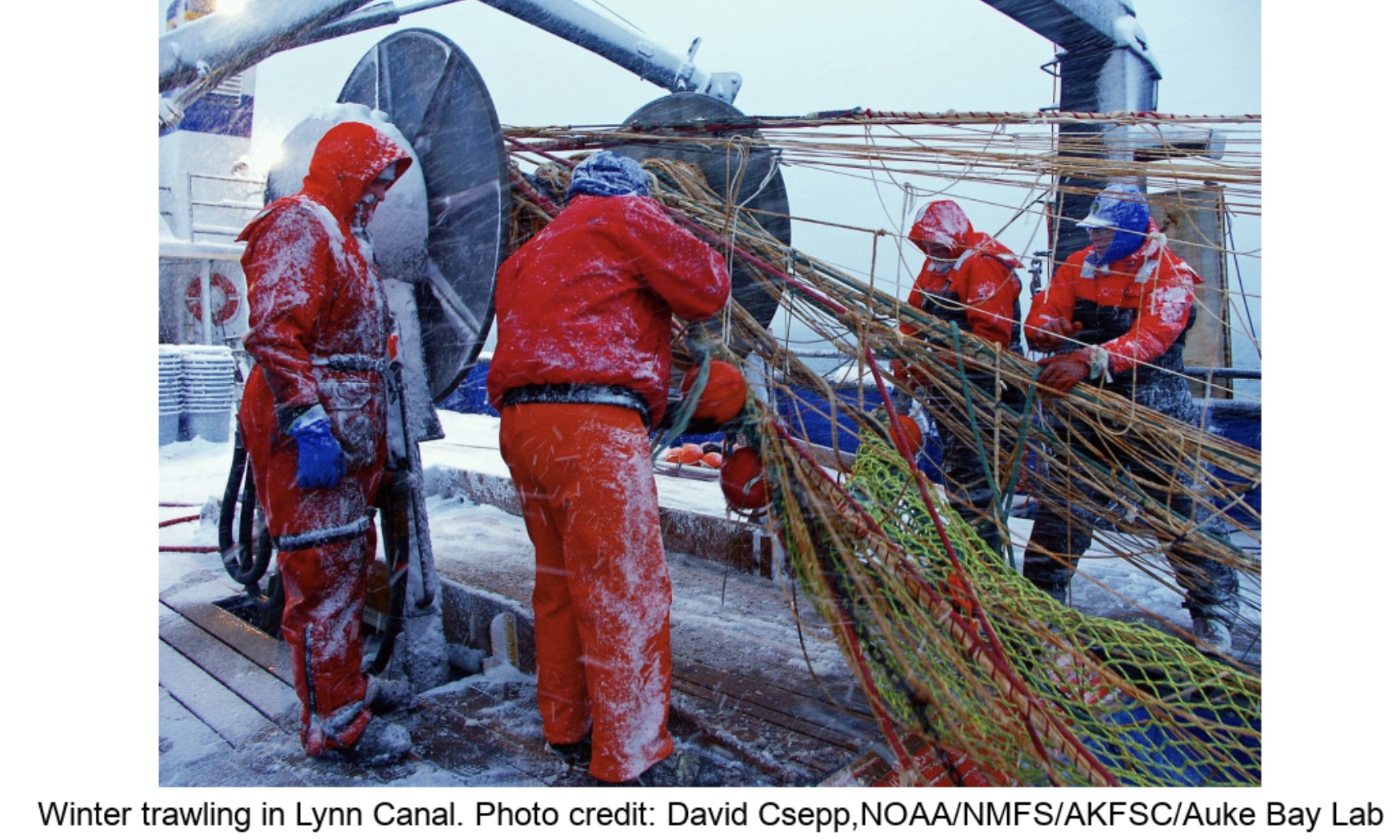
The picture that accompanied this article is NOT a commercial trawl fishing vessel. In fact, large scale factory trawling is banned in Southeast Alaska!