



By SUZANNE DOWNING
June 29, 2026 – The Alaska Supreme Court’s decision to allow Daniel J. Sullivan—better known as “Decoy Dan”—to remain on the ballot may frustrate many Alaskans who see his candidacy as an obvious attempt to confuse voters. It certainly frustrates me. But the ruling also reflects something much larger happening in American jurisprudence.
In many ways, this decision resembles the reasoning behind the US Supreme Court’s landmark 2024 ruling in Loper Bright Enterprises v. Raimondo, the case that overturned four decades of Chevron deference. Different courts. Different facts. Different areas of law. But the same judicial instinct.
That instinct is simple: Courts are claiming their constitutional role of interpreting the law, rather than allowing executive agencies to fill in statutory gaps with standards, when the law is not clear.
For years, the federal Chevron doctrine instructed judges to defer to federal agencies whenever Congress had left ambiguity in a statute. If an agency’s interpretation was merely “reasonable,” courts generally upheld it. In Loper Bright, the Supreme Court rejected that approach, holding that judges—not agencies—must independently determine what statutes mean. The Administrative Procedure Act requires courts to decide questions of law, not outsource those questions to bureaucrats.
The Alaska Supreme Court’s ruling follows a remarkably similar path.
The Division of Elections concluded that Decoy Dan (Daniel J. Sullivan) was attempting to deceive voters by, first trying to game the voters by using the senator’s middle initial rather than his own, and suddenly switching to the Republican Party shortly before filing. Then he modeling the look and feel of his campaign after incumbent Sen. Dan Sullivan’s. Looking strictly at the facts, it is difficult to argue anything but he is pulling a big scam.
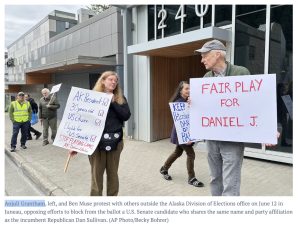
Further proof: Those protesting in front of the Division of Elections last week, holding signs favoring the Petersburg Poser Dan Sullivan, have a solid track record of donating to Mary Peltola. We looked them up at the FEC:

The legal question was a bit different.
The question before the Alaska Supreme Court was whether Alaska law authorizes the Division of Elections to deny ballot access because election officials believe a candidate is acting in bad faith.
The answer, according to both the Superior Court and now the Alaska Supreme Court, is no.
There is no statute requiring candidates to file in “good faith.” There is no regulation authorizing election officials to examine subjective motives. There is no constitutional provision allowing the Division to become the referee of candidate truth in filing. Without that legal authority, the agency cannot resort to common sense.
Courts are increasingly signaling that agencies cannot improvise rules that legislatures never granted them. If lawmakers want election officials to reject sham candidacies based on deceptive intent, they will have to write such a law. Until then, Alaska judges will not permit agencies to create sensible standards.
Legislatures write the laws. Agencies enforce them. Courts are supposed to interpret them.
When any branch crosses into another’s lane, the constitutional balance begins to erode.
None of this means Alaska’s election laws are adequate. Quite the opposite. They are wholly inadequate for the shenanigans being wrought by Democrats in this day and age.
The Decoy Dan episode exposed a glaring weakness in Alaska’s elections. Anyone can change their name and run under their new name. Joe Blow could change his name to Ted Stevens or Wally Hickel, file as a Republican, and clean up at the ballot box. If lawmakers believe intentional name-confusion campaigns undermine election integrity, they will need to amend the election code before another candidate exploits the same loophole. But this Legislature will not do that because it is now run by the very team that is attempting to fool the voters.
The Legislature has every authority to establish objective standards that prohibit fraudulent or intentionally deceptive candidacies while protecting legitimate ballot access.
The Alaska Supreme Court concluded that under the law as currently written, the Division of Elections lacked the authority to disqualify one.
For those of us who believe Decoy Dan’s candidacy was designed to mislead voters, it is an unsatisfying outcome. Now, the senator will need to expend vast sums of campaign resources just to distinguish himself from the poser from Petersburg. That gives Mary Peltola a glide path to November, not having to take part in the fray that she created.
Democrats have poured poison into Alaska’s election system. It can only get worse from here as they look for more loopholes to exploit. These are dark times for our state.
Suzanne Downing is founder and editor of The Alaska Story and is a longtime Alaskan.



21 thoughts on “Suzanne Downing: What does the Supreme Court’s Decoy Dan decision mean for Alaska elections in the future?”
I wonder how many Lisa Murkowski’s will be on the 2028 ballot, assuming SCOTUS doesn’t intervene.
It will be interesting to see if the AK Supreme Court sidesteps the obvious Article I, Section 4 argument.
This only matters if RCV still exists in 2028. Hopefully, it will be repealed in November, making the Decoy Dan gambit irrelevant. Cheers –
I rather doubt that Mary Peltola is on any “glide path” to victory. Not all of us are quite that stupid. Decoy Dan has made enough stink that people will be on the lookout for his name, and vote accordingly. Mary’s lying ads notwithstanding, I doubt the real Senator will be defeated. This does, however, expose the leftists for the slimy greasy grifting jerks they generally are. They know they can’t win fairly, or honorably, so they cheat, scheme and steal. Good luck with that when you meet your Maker.
Alaska’s always been a Sh#% show
It’s just mankind is closer to when Christ returns on the spot where he ascended SO everything is being revealed just as in the days of his crucifixion. There was a lot of madness and corruption to think about that Rome crucified an innocent man (Jesus) instead of Barabus by the will of the courts and people.
By the way
Alaska has always been living in spiritual darkness
People didn’t come to Alaska because of the gospel of Jesus Christ. They came to Alaska for money and personal satisfaction.
Boomers, GenXers, Millennials.GenZ, and now GenAlpha and GenBeta have been living through the shenanigans, schemes, confusion, and crimes, and abuse of the every previous generation before each one.
Maybe in our lifetimes (IF God wills this) we will learn how to live correctly putting behind us the idolatry and schemes of our ancestors behind us
Or Republicans today could just try to win playing just as dirty as the Democrats. Both learning how to win by out smarting the other.
We can do that. But that only goes so far until one day being like the snake who was so greedy it ate its own tail and destroyed itself
Still just as 1970. Very Alaskans really know who Jesus Christ is and what Salvation and peace really means. No thanks to our churches and pastors who only came up here for money.
I was listening Jerry Prevo 89.3fm Anchorage morning radio talk he mentioned when after the oil rush was over, a lot of pastors who came during the pipeline days were packing up to leave. They never came to save souls living on Alaska through the sixties. Seventies. Eighties, nineties. They and their institutions just planted churches just to cash in on the new money from Prudoe bay in tithes and offerings. Churches today are still living the same way.
Just pointing out Alaska has always lived in dark times. 2026 is no different no darker than any year since 1900. Just read our history books and what people have recorded about us or oral family stories shared and past through family members.
Honey, how in the world would the Gospel motivate people to move to Alaska?? Maybe to the Holy Land where it all supposedly happened, but the cold, frozen North? Wake up, Tina.
“……..Honey, how in the world would the Gospel motivate people to move to Alaska??………”
Matthew 13: 14-18
“……… “When you see the desolating abomination standing where he should not, then those in Judea must flee to the mountains, A person on a housetop must not go down or enter to get anything out of his house, and a person in a field must not return to get his cloak. Woe to pregnant women and nursing mothers in those days. Pray that this does not happen in winter……….”
“……..Honey, how in the world would the Gospel motivate people to move to Alaska?? Maybe to the Holy Land where it all supposedly happened, but the cold, frozen North?………”
The Holy Land is a busy, violent region, and people tend to flee to places with few people and a history of peace.
Without RCV and the jungle primary this entire scam would be far less feasible. The system we have now does nothing but enable deception and manipulation.
Senator Sullivan can distinguish himself from the other candidate by pointing out it was he who supported President Trump’s tariffs and the Iran war. Senator Sullivan never put up any resistance to these actions and voted with Trump on the majority of issues. So the decoy from Petersburg gets no credit for our insane grocery and gasoline prices. If the imposter from Southeast wants to sink our economy as well he will have to beat Peltola to earn that right.
Given the leftist nature of the partisans posing as judges on the AK Supreme Court, they should agree that I’m allowed to “identify as” a person named Mary Peltola. And, I should be allowed to run for US Senate against perhaps a dozen other Mary Peltolas doing the same. Let’s just take the leftists game to the next level.
INDEED! … These radical progressive Judges will regret setting ‘errant’ legal precedence, as the opposition uniquely leverage opportunity. Ultimately, they will get so frustrated as the opposition lashes out and overwhelms.
I knew it was going to come to this just when Decoy Dan filed to run, that if the election dudes would let the dude doing time in a federal prison on the ballot, how in the world can they keep the Decoy Dan off of the ballot. We just gotta figure out how to game them at their own gaming operation.
Democrats are very odd creatures. Eventually they all start looking alike and sounding alike. Even the way they walk. Sort of aimless zombies looking for each other, conducting an interesting smell test on each other to see if it’s another Democrat. They are like flies circling around a wool blanket looking for a pile of dung to land on When they land it’s like a convention to see who gets the bigger bite, flexing their antennas to show off their intelligence. And Democrats love a good spoof, as long as they aren’t being spoofed back. If that happens, they get real nasty and start swarming, looking for more dung to chew on.
Yes, Democrats are very odd creatures.
Snuffy,
You should copyright that description and send it to Websters.
If Santa Claus can run in Alaska, then so can Daniel J. Sullivan.
If Santa Claus or Dan J. Sullivan can run in Alaska, so can Bozo the Clown. But only one Santa Claus, Dan Sullivan, or Bozo the Clown on the ballot at a time, please. I’d hate to vote for the wrong clown in confusion…………………
Similar outcome to the birthright citizenship case (today) and the election day ballot case (yesterday). In each case, the legislature (former) and congress (latter) did not set the statutory rules. Legislation, rather than additional lawsuits will solve both problems.
How to get the legislature off the dime? Pull the same stunt next election cycle for every single house and senate member up for election, Our Side or not. Won’t be an instant fix, though it would most certainly get their attention. Have fun with this. Ridicule is an effective tool for our opponents whether they are democrats, RINOs or black-robed legislators. Cheers –
As I’ve said before, I cannot believe democrats made such a stupid move. If Petersburg Sullivan actually makes it onto the ballot, democrats are clearly, unequivocally admitting that the reason they wanted RCV so badly is so they could use it to cheat in our elections. Everyone around the country will look at this and see RCV for the democrat cheating scam it was designed to be.