


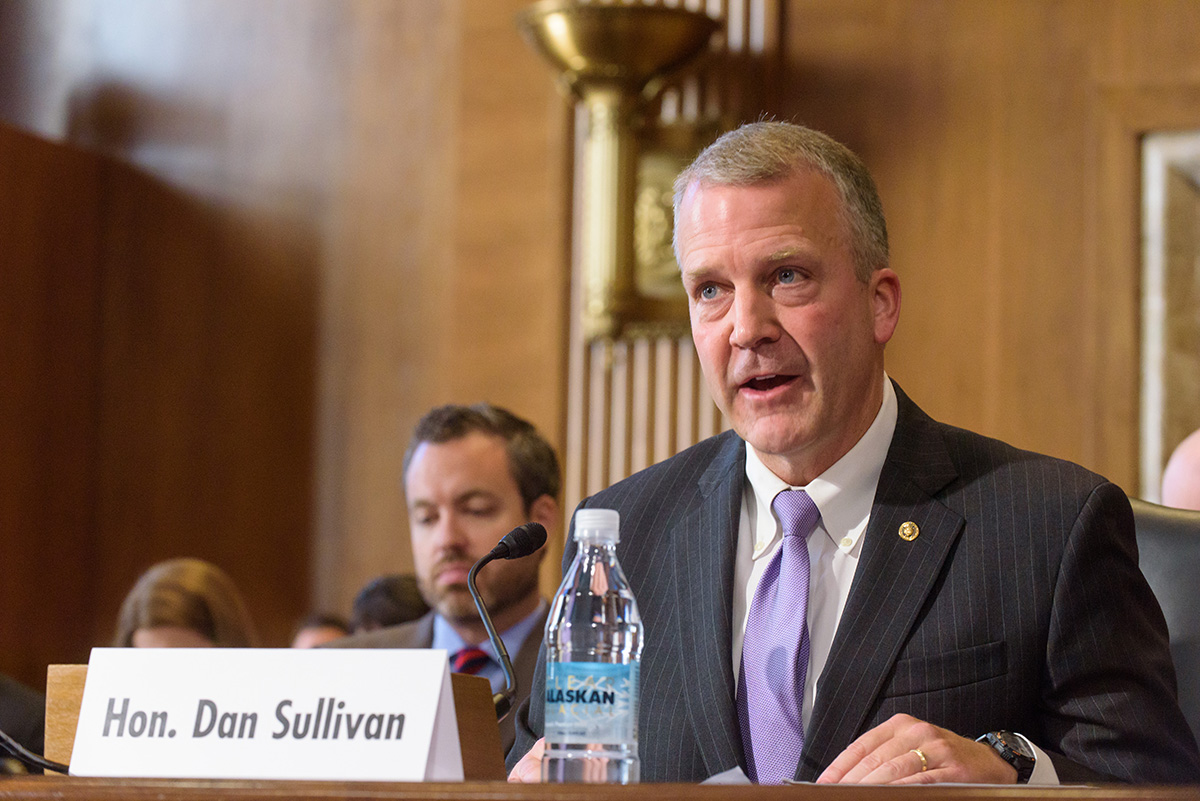
US Sen. Dan Sullivan, who is a member of the Senate Armed Services Committee, announced passage of the Fiscal Year 2026 National Defense Authorization Act (NDAA), a $890 billion defense policy bill that authorizes national defense programs and military construction for the coming year. The legislation represents nearly a $12 billion increase over the baseline and now heads to the president’s desk.
According to Sullivan’s office, the FY 2026 NDAA includes 19 provisions and amendments authored or led by the Alaska senator, incorporates a majority of his Golden Dome missile defense legislation, strongly supports US service members and their families, and authorizes more than $292 million in military construction projects across Alaska.
Sullivan said his work on the Armed Services Committee is guided by three priorities: support for service members, advancing a policy of “peace through strength,” and continued investment in Alaska’s military infrastructure. He emphasized Alaska’s strategic location amid increased Russian and Chinese activity in the Arctic and North Pacific.
The military construction authorizations for Alaska total more than $292 million and include:
• $82 million for the Air Force Joint Integrated Test & Training Center at Joint Base Elmendorf-Richardson
• $80 million for upgraded Army barracks at Fort Wainwright
• $46 million for an Army Reserve Base Supply Complex at Joint Base Elmendorf-Richardson
• $46 million for an Army Reserve Maintenance Facility at Joint Base Elmendorf-Richardson
• $15 million for a Base Civil Engineering Pavements and Grounds Facility for the Alaska Air National Guard at Eielson Air Force Base
• $13.2 million for the design of an Air Force Consolidated Munitions Complex at Eielson
• $8 million for the design of an Army dining facility at Fort Wainwright
• $1.75 million for the design of an Air Force Coal Thaw Shed addition at Eielson
Sullivan noted that this authorization is separate from the $441 million in Alaska military construction funding secured through the military construction appropriations bill passed in November, which represents the largest single-year military construction investment in Alaska in eight years.
The FY 2026 NDAA also includes provisions supporting US service members and their families. These provisions authorize funding for a 3.8% military pay raise, following the 14.5% raise enacted in the FY 2025 NDAA. The bill also authorizes an additional pay raise for service members stationed in Alaska.
Other service-member provisions include annual travel reimbursement for those stationed in remote locations such as Alaska, more frequent Department of Defense reviews of housing allowances to better reflect inflation and cost-of-living changes, and requirements that DOD provide clear explanations of pay tables and allowances. The legislation also directs DOD to establish an ongoing financial education campaign for service members and to improve staffing and services for special education programs at Department of Defense schools.
Several Alaska-specific provisions included in the NDAA stem from Sullivan’s Golden Dome Act, which he introduced in June 2025 with Sen. Kevin Cramer of North Dakota. The legislation supports development of a layered homeland missile defense system and aligns with a January 2025 executive order from President Donald Trump.
Golden Dome-related provisions in the NDAA authorize multi-year procurement of 10 missiles, including low-cost cruise missiles and hypersonic strike systems, and establish seven-year authorizations for PAC-3, THAAD, and Tomahawk missiles. The bill removes statutory caps on testing of kinetic and non-kinetic missile defense systems and directs the US Space Force to identify alternate launch sites, likely increasing testing activity at the Pacific Spaceport Complex on Kodiak Island.
Additional Alaska-related provisions prohibit military dining facilities and commissaries from purchasing seafood originating or processed in the People’s Republic of China, require quarterly Defense Department briefings on $115 million allocated for Arctic infrastructure exploration and development, and direct long-term sustainment planning for the COBRA Dane radar system at Eareckson Air Station on Shemya Island.
The NDAA also includes measures supporting domestic production of critical minerals and magnet processing, with an emphasis on reducing reliance on China and strengthening the defense industrial base. These are resources that Sullivan has repeatedly said are abundant in Alaska.
Beyond Alaska-specific items, the bill establishes a pilot program for automated shipbuilding technologies, directs the Pentagon to consider NATO allies’ defense spending commitments when making basing decisions in Europe, and creates a new Assistant Secretary of Defense for International Armaments Cooperation. It also includes provisions to accelerate foreign military sales, reform defense acquisition processes, and extend elements of the US-Israel Defense Partnership related to missile defense, counter-drone efforts, and anti-tunneling cooperation.
The legislation incorporates the Fight China Act, which restricts US investment in certain Chinese technologies, including artificial intelligence, quantum computing, and hypersonic systems.
As chairman of the Senate Commerce Subcommittee on Coast Guard, Maritime, and Fisheries, Sullivan also highlighted inclusion of the Coast Guard Authorization Act of 2026 within the NDAA. The Coast Guard authorization provides $15.5 billion for FY 2026 and $17.2 billion for FY 2027.
Sullivan said this funding, combined with nearly $25 billion for the Coast Guard secured through the budget reconciliation bill signed into law in July, represents the largest investment in Coast Guard history. He emphasized that Alaska will be the primary beneficiary due to its Arctic location and extensive coastline.
The Coast Guard authorization includes accountability measures requiring annual reporting on cutter homeporting projects in Alaska, including Fast Response Cutters, Offshore Patrol Cutters, and the icebreaker Storis, which will be homeported in Juneau. It also requires updates on plans for a forward operating base in St. Paul.
Personnel provisions allow Coast Guard members stationed in Dutch Harbor to bring dependents, expand travel benefits for Alaska-based members, require studies on ferry travel impacts, and authorize recruitment and retention incentives for civilian firefighters at remote Coast Guard facilities.
Maritime safety provisions direct studies of vessel traffic in the Bering Strait and evaluate port readiness in Point Spencer, Nome, and Kotzebue. The bill continues satellite tracking authorization for fishing gear, supports fisheries safety training, and authorizes towing operations linked to Alaska salmon hatchery management.
Provisions related to Alaska Natives and natural resources preserve oil spill response capabilities, advance Exxon Valdez restoration efforts through 2031, establish the Coast Guard’s first tribal advisor position, require collaboration with tribes on Arctic research, and add an Alaska Native seat to the North Pacific Research Board.
Through reconciliation legislation earlier this year, Sullivan also secured funding for 16 new icebreakers, 22 new cutters, expanded Coast Guard aviation assets, $300 million for homeporting the Storis in Juneau, and more than $4.3 billion for shore infrastructure repairs nationwide, including projects in Sitka, Seward, Kodiak, and St. Paul.
Sullivan said the combined defense and Coast Guard investments exceed $1 billion for Alaska and will strengthen national security while creating hundreds or thousands of jobs in the state.
7 thoughts on “Sen. Sullivan secures hundreds of millions for Alaska in 2026 National Defense Authorization Act”
We are now over 37 trillion in debt. The deficit is close to 2 trillion a year. We needed massive cuts across the board to the federal government. Radical surgery to save a dying patient. Instead we are whistling past the graveyard playing the politics of old. The Pentagon budget needed to be cut in half. Instead we have deep institutional warfare over shifting the focus from Europe and the middle east to the Caribbean and Asia. We are a deeply unserious people and consequently we will go bankrupt. We already spend more in interest payments then the whole of defense spending. More for bankers and bonds then war. And every day that ratio gets worse and we all get poorer.
Did anyone else notice the sums designated for “Design” of some of the listed facilities
EXAMPLE:
$8 million for the design of an Army dining facility at Fort Wainwright
How long have we been “Designing” cafeterias?
What do you think any corporate entity in America spends to “Design” one of their Restaurants?
I can tell you being in private facility development over the decades, its no where close to the numbers reported here!
Maybe the work involves more than design. But if reported correctly this is another example of Gross Government excess
Well, if nothing else, this (very expensive) expansion of military facilities and support in Alaska counters much in the overproduced, glossy ads from Outside Dark Money against Senator Sullivan. The money is going to create an incredible amount of jobs for Alaskans. Problem – we don’t have enough workers with trade skills; as Mike Rowe says, “They’re in the 8th grade.” I hope Seward’s AVTECH is able to accelerate their enrollment, course instruction, and graduation rates . . .
Bringing thousands of jobs, and new families to Alaska.
The rush is on to claim the Artic. That is why Alaska needs more fortification. It is a coastal state and 1st in the line of defense against both China and Russia. China is very hawkish right now.
The Golden Dome is going up and Alaska is a major part of this.
In addition, 16 new icebreakers, 22 new cutters, expanded Coast Guard aviation assets, $300 million for homeporting the Storis in Juneau, and more than $4.3 billion for shore infrastructure repairs nationwide, including projects in Sitka, Seward, Kodiak, and St. Paul.
Plus- extension of Exxon-Valdez clean up and all of the Native positions and adding Research boards.
These are BIG items. @SenDanSullivan YOU DID GOOD FOR ALASKA – Thank You.
I agree. Except it is all borrowed money that our grandkids will pay off at high interest rates. Look at the famous graph that Charle Kirk often touted of 30 year olds that are married and own a house by 30. The numbers are quite high- except for the last 25 years whe deficits exploded and the value of our currency plunged as the fed printed more. And then the inflation…
Still worth it?
With gold over $4000/ounce those billions are worth less and less.
This is how a REAL Senator operates. Not benefits for just one community(i.e. native), but for our entire State and more importantly our Nation. Dan is a REAL Senator! Thank you, Sir!