


By SEN. ROBERT MYERS
On paper, Alaska is in an enviable position. We have been drilling from some of the largest oil reserves in North America since 1977 with the Department of Energy still estimating that we have 22 billion barrels of recoverable oil on the North Slope. We have at least 35 trillion cubic feet of proven natural gas reserves on the Slope, enough to power the US for about 390 years.
We have known deposits of coal, gold, silver, copper, and many other critical and rare earth minerals. We have enough fish to provide more than half the seafood harvested in the United States each year.
On the other side of the ledger, we have no broad-based state tax. We have an $85 billion savings account that spins off nearly $4 billion a year to the state. That pays for most of the undesignated general fund $6 billion state budget.
Despite all of that, most of us feel that we’re not doing well. We have talked for decades about our lack of infrastructure. We’re still having the same conversation after 50 years of oil income from the North Slope, and we struggle to take care of the infrastructure we have. We have a state-owned railroad, but it hasn’t laid any mainline track since the late 1940s when it was owned by the federal government.
We had over 60% of our health care spending being paid for by government in 2010, and that’s before Medicaid expansion. But we have the highest health care costs in the nation with no end in sight to cost increases while losing providers and care at the same time.
We’ve been adding more to the budgets of departments like Public Safety and Corrections to address our crime rates, but only about 5-6% of charges actually go to trial, and those trials take years to conclude, because of our dysfunctional court system. Our state has the second-highest percentage of our economy spent on K-12 education, but our results have been among the worst in the nation for a decade.
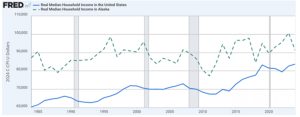
As for our economy, we aren’t doing any better. While median household income in the state is still above national levels, the gap has narrowed considerably. The median income nationally has grown nearly 40% over the last 40 years while ours has stayed largely stagnant after accounting for inflation.
We’re looking at finally building the gas line after decades of discussions, but we’re going to have to import workers because so many have left the state in the last decade. We have thousands of acres of forest, but we have hardly any logging. Since 2005, our economy has been effectively flat outside of oil, government, and a couple of related industries.
I was first elected to office in 2020, and I still get a lot of the same questions about why our government and economy are in such trouble. I get questions about state spending, the PFD, our state services, and the low quality of our infrastructure. In this series, I want to answer some of those questions of why things in Alaska work the way they do.
What these questions and answers will illuminate is that most of our problems are natural extensions of the incentives of the structures that we set up in the 1970s. Human nature makes us more worried about what we would lose than what we could gain.
The result in Alaska is that we’ve set up a system to make both residents and politicians averse to cutting spending or being friendly to the private sector. Human nature will draw us to pay attention to and cultivate where our money comes from, and for our government that is not the private sector as a whole.
Instead, Alaska has hidden the true cost of government from the private sector, and it is clear that many of our politicians are intent on keeping it hidden because they are worried about pushback on spending.
One of the downsides of politics is that it encourages short-term thinking because of the election cycles. Individuals and businesses may think in terms of decades, but most politicians are encouraged to think in terms of two or four years. But we’ve engrained our government in so much of our economy that it’s hard to get our economy to look further down the line than that cycle any more.
Going into a wide-open governor’s race and some critical legislative races, we need to fully understand why we’re in this mess if we’re going to make good decisions going forward.
If other questions come up from messages or comments related to this series, I may add those in. Please join me on this journey.
Senator Robert Myers was born in Fairbanks and spent much of his young childhood at the Salchaket Roadhouse, owned by his parents. He attended the University of Alaska Fairbanks, where he studied philosophy, political science, and history. While in college, he drove for a tour company, sharing Alaska with countless visitors. He currently drives truck and travels the Dalton Highway (Haul Road) frequently. He ran for office because he wants an Alaska his children will choose to make their home down the road. When not working for his Senate District B, North Pole, he enjoys reading, history, board games, and spending time with his wife Dawna and his five kids.
5 thoughts on “Sen. Robert Myers: Why does Alaska look so good on paper, but perform so badly?”
Asking the hard questions that beg for public accountability is a step in the Right direction
Alaska won’t move forward in the Right direction without the peoples consent and with that they’ll find their independence when Alaskans (most of them like the 60% who don’t vote and the 25% percent voting Right) seek God first, we are state who do not Know God just to be honest. Government grows when people give up their sovereignty.
Protests and annoying current legislators and assembly members with endless phone messages and emails or protests won’t get the Right anywhere like them putting their energy starting their political careers serving first on their neighborhood community councils.
The GOP members were wrong to ignore their own involvement in their community councils all these decades while putting so much effort in state races which still needs attention but members cant ignore their neighborhood community councils. The community council keeps political leaders in touch with the people and right now Alaska is very government dependent and any cuts to government and services sends them into meltdowns as we saw in Feb 2019. So any one on the right especially the far right (conservatives) has to be understanding. Gentle, and firmly reminding what is at stake if we are continue our government dependency because not everyone would be able to handle if Ak leadership made the draconian cuts necessary which doesn’t mean Akbudget loses money just means money is redirected from whom was receiving taxpayer money and placed where it is needed for infrastructure, development, better education directives, and financial security. But, Alaskans seeking God First comes first before Alaskans hearts can change that they don’t want soft on crime politicians, big government politicians and bureaucrats, and money senselessly wasted while infrastructure continues to decline or businesses are squeezed out of Alaska, or children growing up into adults with very little education and very little sense to protect themselves against drugs, prostitution, or taking their own lives.
Seriously, Robert, you have to ask why Alaska looks so good on paper, but performs so badly, knowing as you do that: (a) her judicial branch of government is so corrupted, (b) her election system is so easily corruptible, and (c) the legislative half of her lobbyist-legislator team is outnumbered nearly 8 to 1 by registered special interests?
.
How can you not know this? If you do know it, what’ve you done to fix the problem?
.
Is it just a coincidence that the very things making government officials accountable to “we” happen to be FUBAR’d?
.
Can you stop using “we” until you fix these things that protect government officials from the wrath of “we” the voters?
.
Weren’t you, Robert, hired for your ability and motivation to fix these problems?
.
One more favor, Robert, can you stop using “broad based tax” like it means something, like it’s a not-so-subtle hint that a “broad based tax” is all it takes to make Alaska not perform so badly? Surely your BFF Keithley’s obsession with “broad based tax” doesn’t mean you fell for that lie too?
.
There’s your answer, Robert. Now, what’s your plan?
Spoken by someone who is part of the problem. You’re an elected official in the heart of the problem. You’re part of the problem, get busy fixing it!!
This is one of the most honest and important pieces I’ve read about Alaska in a long time. You’re putting words to what so many of us feel but rarely see laid out clearly and without spin. On paper, we should be absolutely thriving, and yet anyone running a business, raising a family, or trying to build something long-term here knows the reality doesn’t match the balance sheet.
I especially appreciate you calling out incentives and human nature instead of defaulting to partisan blame. The way we’ve structured government, spending, and risk over the last 50 years has consequences and pretending otherwise hasn’t helped anyone. Hiding the true cost of government from the private sector may feel politically safe in the short term, but it’s clearly hollowing out the long-term health of the state.
As someone deeply invested in Alaska’s future, economically, personally, and generationally; I’m grateful to see a sitting senator willing to ask why things function the way they do, not just argue over symptoms. If we want our kids to choose Alaska, we have to be honest about what’s broken and courageous enough to rethink systems that no longer serve us.
Looking forward to the rest of this series. Alaska needs more conversations like this; grounded in reality, history, and a genuine desire to do better.
Crime, duh. Along with the constant betrayal of “small government conservatives” as soon as they get elected