




By SEN. ROBERT MYERS
Why do so many Republican legislators support higher spending?
I’ve talked a lot about the political reasons that led to Alaska’s Legislature spending than it could normally justify or support. The odd part for a lot of people is that our state has elected a majority of Republicans to the Legislature for roughly three decades now.
Aren’t Republicans supposed to stand for lower spending?
We have to remember that Alaska started out as a Democrat state. Our constitution is one of the most liberal in the country. Our first federal delegation was all Democrats. The State House was solidly Democrat for the first 30 years of statehood, with the exceptions of the 1966 fluke election that briefly brought Republicans control of the governor’s office and both chambers of the legislature for the first time in state history, a situation that didn’t repeat until 1994, and the House coup in 1981, which gave Republicans control of the chamber from mid-1981 to 1984.
Control of the Senate was closer, but it was still primarily Democrat-controlled until Republicans took both chambers after the 1992 election.
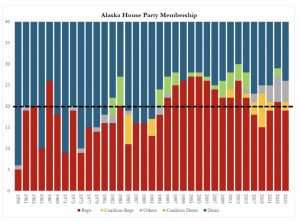
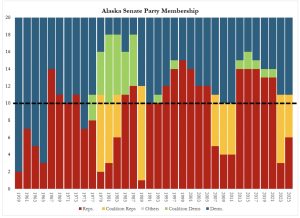
Please note in the charts that we have accurate numbers for party affiliation, but we don’t have an accurate account of who was in the governing majorities of either chamber before 1975. The formative events that created our fiscal structure happened when we were still a largely Democrat state. Oil money began flowing in overwhelming amounts. Spending rose with it. The income tax was abolished.
The resulting structure was simple: Collect money from the oil, disburse it out through the state budget. In theory, that money would support the economy. Eventually, that budget was considered to be the economy (or at least the most important part of it) by at least a portion of the Legislature. That structure led to a bigger, more deeply embedded government.
New people learned that they could use state spending to buy votes for reelection, regardless of party. That’s not exactly conducive to the limited government philosophy that Republicans have stood for since the 1970s.
One incident in particular helps illustrate the whole problem. In 1981, the House had a leadership coup near the end of the first session of the Legislature. Republicans joined with rural Democrats and two Libertarians to replace the Speaker of the House and form a different governing majority coalition.
But the argument driving the reorganization was about how money in the budget was allocated between districts, particularly the capital budget. That’s not exactly a strong conservative message.
The 1980s and ’90s saw growth and change within the Republican party in the state, generally matching national trends. The rank and file of the party generally agreed that government should be smaller. But the underlying fiscal structure of our state government did not change. The incentives for how to get elected in Alaska did not change. So the views of the people at the top of the power structures didn’t change.
And honestly, why would they? If people can use a system to get reelected, why would they want to change that system? The structure and incentives didn’t change. Why would we expect behavior to change, even if party control did?
When the Republican Party initially took control of the legislature in 1992, there wasn’t much warning that there was a problem. The first decade of Republican control saw flat or declining oil prices, imposing some fiscal constraint from outside the system. To the average conservative voter, it appeared that all was well because government spending was flat or shrinking on a per-person basis after accounting for inflation. We were still spending much more than we were in the 1960s, but three decades of inflation and population growth would mask that.
The first clue that we had a problem was in the mid-2000s when oil prices started to rise and spending rose with them. We then saw our savings quickly depleted when oil prices crashed in the mid- 2010s. That was followed by first cutting then spending the PFD.
But even with all of the budget chaos created first by the drop in oil prices and production and then the political chaos created by cutting the PFD, spending has continued to follow that rough per-person, inflation-adjusted rate we’ve followed since the late 70s.
It’ s easy to say that we need to vote for a different group of people to fix the problem. But we’ve already tried that. We’ve been in the current crisis since roughly 2015. If we look at the 60 people in the legislature that year, we only have 15 members who are still in office, including representatives who have moved to the Senate (add one if we count the governor). We’ve largely
elected different people who have the same views and vote the same way.
That tells me that the problem is systemic, not personal. We won’t get out of this situation until we change the underlying fiscal structure and the incentives that it creates, regardless of which people or party is in charge.
Senator Robert Myers was born in Fairbanks and spent much of his young childhood at the Salchaket Roadhouse, owned by his parents. He attended the University of Alaska Fairbanks, where he studied philosophy, political science, and history. While in college, he drove for a tour company, sharing Alaska with countless visitors. He currently drives truck and travels the Dalton Highway (Haul Road) frequently. He ran for office because he wants an Alaska his children will choose to make their home down the road. When not working for his Senate District B, North Pole, he enjoys reading, history, board games, and spending time with his wife Dawna and his five kids.
Sen. Robert Myers: Why do we spend so much money but have such poor quality services?



11 thoughts on “Sen. Robert Myers: Why do so many Republican legislators support higher spending?”
Rep. Myers, the last several articles you have submitted have provided much insight into Alaska’s government spending problem. Will the next article discuss some possible solutions?
I’m heading that direction. Most of us can list our problems. I’m trying to illuminate why those problems exist rather than just list them. I have a few other things to say before I start talking about solutions.
Because the legislative half of Alaska’s lobbyist-legislator team is outnumbered 5 to 1 by registered special interests, none of whom represent the average working stiff, more than a few of whom pay for certain legislators’ questionable extracurricular activities, and therefore own legislators and their votes.
.
Because the election system’s corrupt, the grand jury system’s corrupt, Co-Governor & Finance Minister Giessel controls the purse strings, all of which adds up to the dismal reality that voters have no recourse against the racketeers who turned the legislature into the lobbyist-legislator racket it is today.
.
How the hell can you not know this, Robert? Did you not read Art Chance’s “”Red on Blue, Establishing a Republican Governance”, which would have answered your question before you asked it?
Because much of the AKGOP members and leadership are just as much of a government dependent as a Democrat member and their leadership.
I’d suggest your party members and leaders if they don’t want to be a government dependent change your personal employments to private sector management positions and raise your children and grandchildren to work in the private sector versus the public sector.
Districts need to sponsor candidates who do not come out of a public sector employment like law enforcement, education, state and local government, health care, courts. They’d be too sympathetic to maintaining government spending levels because of its all they know.
Now you can’t blame Eastman.
Sucks huh?
I think Sen Myers is just trying to keep the topic going so new readers hear it and old readers keep it circulating because we can’t keep spending what we don’t have. Takes a decade to get a new pipeline built before new revenue is flowing through the Alaska economy that would pay for the government we didn’t reduce before the pipeline.
Problem we got too many government dependents dependent on government paid employment and they don’t want to have to go find another state or another job because of being layed off. So the legislature keeps them employed increasing our states future deficit hoping for a new a gas pipeline to pay for their government employed dependents
You know that today’s 11 year olds would be 21 years old. And today’s 21 year olds would be 31 years old. Today’s 31 year olds would be 41 years old. That’s ten years later. You can’t count on have a gas pipeline built between today and ten-15 years later? The state of Alaska NEEDS to rightsize state government, not increasing departments not adding new departments, not adding pensions, not adding new employees, and reduce what it spends on itself.
While 25% of Alaska’s best minds who graduated from a high school on Alaska will leave Alaska because they are smart enough not to wait on a state that refuses to get its act together.
In spite of some problems listed in the article. We in Alaska also have some wonderful blessings. One is the Permanent Fund which perpetually produces earnings for state services for us Alaskans, and the free cash of the PFD.
The 2nd blessing is that we have no state sales tax or state income tax. That is a mighty barrier to prevent runaway government spending.
Yes, there are those who recently proposed creating a state sales tax. That is like someone in the Netherlands proposing to create a breach in the sea wall, so that the North Sea can rush in. But as long as the Dutch stand strong for their barrier, and we stay strong for our barrier (no state sales/income tax) then we will continue to prevent the flood of waves and taxes.
Actually, Alaska started out Republican when President Eisenhower appointed Mike Stepovich of Fairbanks as the first governor in 1959. Dan Eagan, raised in Cordova, had the connections statewide that Stepovich didn’t have, and he also had JFK backing. But to examine the post pipeline era in the 80’s and onward, one only has to look at the way big $$$ came to Juneau. It doesn’t matter which party was at the helm, big oil and the money that flows from it doesn’t discriminate by political affiliation. Greed, graft, and glee is pursued universally.
Why do so many Republican legislators support higher spending? The answer is blatantly obvious – because they are not actually Republicans. They may be registered as Republicans, but they are actually Democrats in disguise. We see it in every legislative session. They campaign as conservative Republicans and as soon as they are elected immediately start caucusing with the leftist Democrats.
If you go by just their registered political affiliation the Alaska State Legislature has had a Republican majority for decades. However, the reality is that the Democratic Party has had the majority voting block during all that time because registered Republicans caucus with the Democrats. Republicans have not been in control of the Alaska State Legislature since Wally Hickel was Governor.
I am the last standing Republican from the Valley that flipped the legislature Red in 1995. (I say standing because two are dead, Green and Kohring, and Masek is MIA somewhere.) I produced a list of new programs created since big oil $ flowed. I proudly walked into my “conservative” caucus of 27 republicans, with my list and said let’s repeal some of these! They looked at me like deer in headlights, and responded, “we can’t cut government, our constituents WANT those programs!” This was right after Newt Gingrich implemented his Contract with America. We cut a few percent off existing program funding over a 5 year period, guess what? The 6th year after meeting our goal, all those cuts were restored in one session.
It’s hard when too many legislators, both R & D, think that real economic development is creating another government job. Now the union backed RINOs and D’s want to bring back the defined benefits. Kind of ironic that Steadman was the main driver of that effort to eliminate it. His own beloved coalition caucus that he has empowered with his wind vane political compass, is rolling him. If it was not so tragic for the state’s bottom line, it would be fun to watch his arrogant suit vest get rolled.
Gov Dunleavy tried, his DOGE was Donna Ardwin. He tried too much too fast, and almost got recalled. Shower had a real plan, constitutional spending limit, constitutional protection for the PFD, and (gasp) once those were in place some new taxes. Government always grows in direct proportion to the amount of money there is to spend. With $80+ billion on the table in the Permanent Fund, better guard your wallet.