By JOE GELDHOF
Editor’s note: “Reality” shows having made a significant impact on American life, we assigned occasional columnist and long-time political hack Joe Geldhof to complete a “reality show” interview with Juneau Mayor Beth Weldon. Here’s his satirical take:
Joe Geldhof: Good day to you Mayor Weldon. Thank you for taking the time to discuss some of the important issues Juneau is facing.
Mayor Weldon: Yeah, well I’m not so sure this is a good idea but all of the communications staff at City Hall were busy, so you got stuck with me.
JG: Glad to have you. Let’s start with the issue of affordability. That’s a timely topic in Juneau.
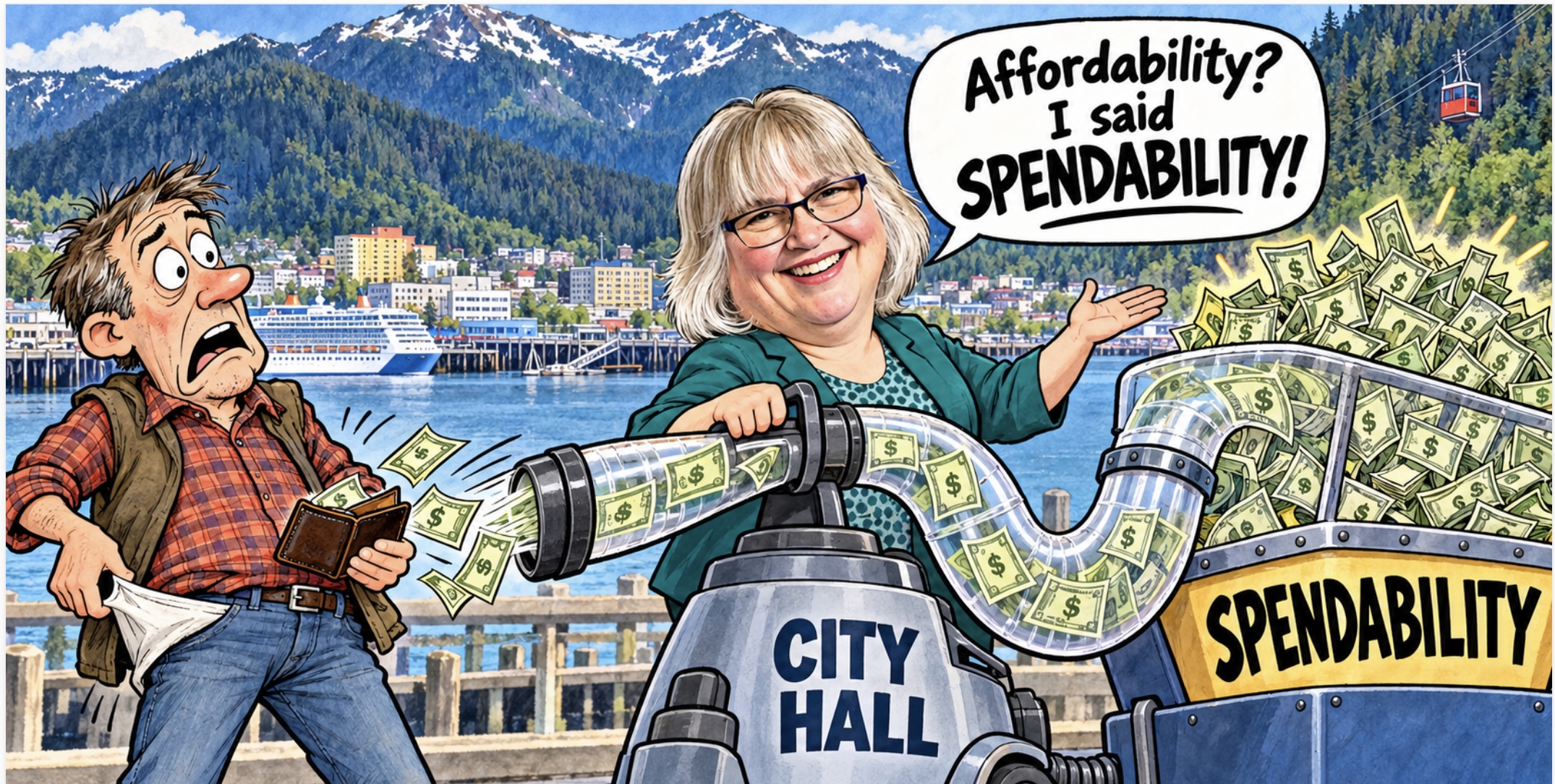
MW: Not really. You and that mob of miserable misanthropes’ you hang around are always yammering on about affordability. The real issue Juneau is facing is all about spendability.
JG: Really! Can you explain this idea about spendability?
MW: Sure, you know, it’s like easy to understand. More revenue, more spending. Juneau has a revenue problem and it’s led to a spending crisis. We just need more money.
JG: When you say “we,” what do you mean?
MW: Look, I mean, the CBJ Assembly and the staff. Isn’t that obvious?
JG: Of course. When you put it that way, it is rather obvious. Perhaps we should move on. Tell us about some of your spending priorities.
MW: First off, we have to have a new City Hall. The average voter in Juneau just doesn’t get how serious the problem is down at City Hall. The place is a dump. It’s like worse than a mobile home. Our staff can’t do their work. The Assembly Chambers are old and the break room we use during our meetings needs to be expanded and include a better snack area for us to use when we do our business.
JG: How do you respond to the citizens who rejected the efforts to build a new city hall two times?
MW: They need to get over it. It’s like they don’t even care if the old building was a horrible place to work. Our staff found a new place with plenty of room where we can work, right? The voters don’t realize how much better it will be for us on the Assembly and staff in the new building after we finish refurbishing the place.
JG: The move to the new City Hall appears to have cost more than anticipated, is that a problem?
MW: Not really. Look, you have to understand that moving was a very high priority for me and the other Assembly members after the voters turned down a new city hall. You know, the voters don’t really have a clue about what is important. That’s where we come in as Assembly members. Staff tells us what’s important and we get the job done.
JG: If I follow your drift, your saying the move will be better for community?
MW: Precisely. Even though there are a few issues to work out with the move to the new location, the public just has to trust us that we know what we are doing with this move.
JG: You mentioned some issues that need to be worked out with the move to a new City Hall. What would those be?
MW: Well, we thought we would be consolidating everyone in the new building but it turns out that can’t happen. We shoved the Assessors Office into the old dairy building but that’s close to the new City Hall. So, call that good enough. We’ll probably have to keep some office space downtown for some of our staff based on their needs. And, we still have to get some more parking.
JG: How are you going to solve the parking issue at the new City Hall?
MW: We’re working on it. Parking is, for sure, critical. I and my colleagues on the Assembly and all the staff need parking. We don’t have time to drive around looking for a place to park when we are doing our work. We might have to buy some more property for parking or maybe tear down the old middle-school next to Harbor View Elementary School to build a parking lot. Staff’s working hard on getting more parking, for sure. That, and ordering the new furniture for the new offices, is something that they are addressing.
JG: Is the move to the new City Hall and the refurbishment of offices coming in on time and according to budget?
MW: Probably not but it’ll be worth it.
JG: Madame Mayor, what else is staff working on?
MW: Well, some of them are working on figuring out what to do with Telephone Hill. That’s been a big issue.
JG: How so?
MW: For starters, nobody believed us when we said we needed to build high-density housing on Telephone Hill. Uhm, look, we spent over $600,000 on a consulting firm in Portland, Oregon that told us that the housing on the hill needed to be high-density and probably some sort of high rise. You have to trust the experts when it comes to this kind of thing.
JG: What went wrong with Telephone Hill?
MW: First off, I resent your characterization that anything went wrong with our approach to developing Telephone Hill. We tried and we’ll keep trying to do something but these things take time. What happened, and this is just my opinion, is that a small group of social activists who don’t know anything about real development — these people cooked up a clever campaign based on hysteria and the supposed history of Telephone Hill. Most people in Juneau just don’t know what’s needed like we do.
JG: Did the decision to halt work by the CBJ on Telephone after evicting the residents have anything to do with finances?
MW: People say that but I’m not sure that’s true. Here’s the thing – if we just had more money down at City Hall, we can do anything we want, including building high-density housing on Telephone Hill. We know we need to develop Telephone Hill. Actually, it will be redevelopment. Staff is working on plans for this project. We know what we are doing and people just need to stop all this second-guessing of what we are doing. Look, it’s hard work being on CBJ Assembly. We have to go to meetings. The pay is totally inadequate. We have to listen to what staff wants us to do and that takes time. It’s not a fun job and all the criticism directed at us is unfair. Think about it. For years we’ve adopted a very conservative budget for Juneau. We have built up large reserve funds. We have a lot of partners that count on us for their budgets. We’re doing the best we can to make Juneau affordable, including making more affordable housing but that takes money and we need more of it.
JG: I think I understand what you are saying. Are there other areas where the CBJ has increased spending to provide affordable housing?
MW: There sure are. We worked hard to get affordable housing built on Pedersen Hill. It turned out to be pretty expensive. After we used public funds to build the infrastructure, we turned the whole project to some of our partners, who we are hoping will do something with the property to make Juneau more affordable. The CBJ Assembly has discussed lowering regulations that slow down housing development and even making more local public land available to the public for construction of homes but most of us on the Assembly want to be very careful about unleashing a housing boom. We have spent a lot of funds on a comprehensive review of the ordinances and regulations related to development, which reminds me that I need to check on how that review is coming along. It seems like it got stalled somewhere along the line. But the public shouldn’t worry, we’ll have staff look into the delay on this topic.
JG: What do you see as bright spots for development in Juneau?
MW: Well first off, the tremendous growth in cruise ship tourism in the past four decades has brought growth but also challenges. We’re very lucky the citizens of Juneau and Alaska adopted initiatives that bring in a lot of tourism fees. The money we get from visitors from Ohio and other places has been great, although we never seem to get enough to do everything staff says we should. But tourists bring big challenges and we had to hire someone to get them under control, which is what most of us on the CBJ Assembly want to do. You just can’t let the tourists run wild in a place like Juneau. We should probably look at increasing the taxes on tourists even more so we have more money to spend.
JG: This is what you mean by spendability, I take it.
MW: Exactly!
JG: Juneau is community that has aged and continues to age. The number of citizens who live here on a full-time basis has dropped below 30,000 residents. Our schools are experiencing decreasing enrollment. Our all-in budget for the CBJ exceeds a half-billion dollars. Is our spending sustainable without some new growth?
MW: I love the idea of sustainability. The CBJ Assembly is totally supportive of sustainability. It’s right up there with diversity and fairness as being important.
JG: Is economic growth compatible with sustainability?
MW: Look, you know, umm, I’m not an expert on economics but it seems to me that growth in spendability will support sustainability and eventually make Juneau more affordable. The more funds we have at City Hall to spend will make Juneau a better place to live and that will increase growth, which is something I support. I do have to say that growth worries some of my colleagues on the CBJ Assembly. I grew up and have always lived in Juneau so I’ve seen a lot of growth.
JG: Are there limits to growth?
MW: Well, of course there are. That’s why we were very, very careful about permitting a new cruise dock downtown. Juneau is already facing a crisis in tourism management. Allowing more tourists has to be done with extreme caution or the genie will get out-of-the-bottle, if you know what I mean. I mean, a lot of locals think the genie is already out.
JG: How about the development proposal for development on the back side of Douglas? Wouldn’t that alleviate some of the congestion in downtown Juneau?
MW: I don’t even want to talk about that development. The advocates for that project didn’t talk to me and staff first before they started promoting the idea that they could build something out there on the west side of Douglas Island. They disrespected me and the CBJ staff, which is something I haven’t forgotten.
JG: But isn’t that proposed development on private property?
BW: I’m not sure that really matters. We were not included in the planning of the project. We try to help but we can’t if there isn’t communication.
JG: Does the CBJ do an adequate job working with developers?
BW: We do a great job working with developers. All they have to do is address the concerns we have and everything works out nicely. But we have to be careful about greenlighting development, especially when it comes to mining and tourism.
JG: Juneau was essentially founded as a mining community. What’s the problem with mining:
BW: Well, for one thing, they don’t pay the CBJ as much as they should. It’s like cruise tourism. These industries don’t pay us as much as they should. Tourism, for sure, is out of control. I can’t even find a place to park if I want to get a meal downtown during the cruise season.
JG: If the tourist genie is already out of bottle, the one you mentioned before, suddenly appeared before you and the genie gave you three wishes, what would you ask for?
MW: More revenue, more money and additional funds to spend.
JG: Speaking of spending, the current ballot in the upcoming local election has three propositions. What are your thoughts on these propositions?
BW: It’s simple, right? Look, you have to know you’re A, B, Cs in this world to get along. Proposition A keeps the current “temporary” sales at 3%. That’s a no brainer. Down at City Hall, we need that revenue or we would have to make cuts that our partners wouldn’t like. All Proposition B will do is allow the CBJ Assembly to raise property tax millage rate without a vote of the citizens by 25%. The current cap on the millage rate for property taxation is way too low and has a negative impact on spendability. That cap has to go. Proposition C simply increases the Juneau sales tax on a seasonal basis. This seasonal sales tax increase is designed to get tourists visiting to Juneau to pay more for us to spend. It’s true that all of us who live here will have to pay the increase but it’ll be worth it so we can keep on spending and not have to make any cuts to our current budget. It’s as simple as knowing your A, B, C’s.
JG: Are there no cuts that can be made to the current CBJ budget?
MW: Here’s the thing – sure, our all-in budget for the CBJ is north of a half-billion dollars but that doesn’t tell the whole story. A lot of the budget takes into account the hospital and school district. When you take away those big financial drivers, the remaining budget is only about $150 million. That money goes for snow plowing, street maintenance and other local government activities. We also have a responsibility to fund our partners and important obligations to fund the Juneau Economic Development Council and a bunch of other organizations. You have to ask what these organizations would do without CBJ funding. They’d be devastated.
JG: What will happen if some or all of these ballot propositions are not approved by the voters?
BW: The voters asking for trouble if they don’t pass all the Propositions.
JG.: What do you mean?
BW: If the ballot measures don’t pass, the citizens can say bye-bye to recreation and grants.
JG: Mayor Weldon, that seems rather draconian. Does it really come down to more taxes or no swimming, skiing or skating?
MW: Don’t forget soccer, that field house is on the chopping block if the voters don’t get in line and pass all the measures. Like I said, this is about spendability.
JG: Surely, there must be some programs or spending items that could be reduced or eliminated besides taking an axe to recreation?
BW: Don’t call me Shirley.
JG: My apologies Madame Mayor. Are there not some cuts or reductions to the CBJ budget that could be enacted to save recreation facilities from closing?
BW: Like where? Me and the other members of the CBJ Assembly have gone over the CBJ budget. There isn’t any fat anywhere. We need to keep spending or some of the spending will stop.
JG: A lot of your constituents think there is too much tourism in Juneau already, is that correct:
BW: Well, yeah, we get pounded all the time by folks upset about tourists. Anyone knows that.
JG: Did you or anyone on the CBJ Assembly consider reducing funds for the Travel Juneau Office before cutting recreation?
BW: Hey, I’m not going there. Every allocation we make during the budget process is carefully considered. There is no waste or excessive spending down at City Hall.
JG: Not an ounce of fat anywhere in the CBJ budget?
BW: You’re trying to trick me. If you haven’t figured it out by now, every dime we spend has a constituent who wants the money. Where would we be in terms of development if we didn’t have the JDEC? We need those new communication positions in the Manager’s Office so the public knows what we are doing with their money. I could go on but I don’t think you care.
JG: It sort of seems like you and some of the other CBJ Assembly members are holding recreation hostage to get more money to spend.
BW: You’re wrong. Every item in the CBJ Budget is important. Believe it or not, we have a lean budget and spend public funds efficiently.
JG: Mayor Weldon, thank you for sitting with me for this interview. I appreciate your candid responses. I have one final question ……..
BW: Not for me. I am done with you. Besides, it’s time for lunch.
Joe Geldhof is a Juneau attorney and occasional satirist. Supposedly this interview took place at Louie’s in Douglas. (It is satire.)