


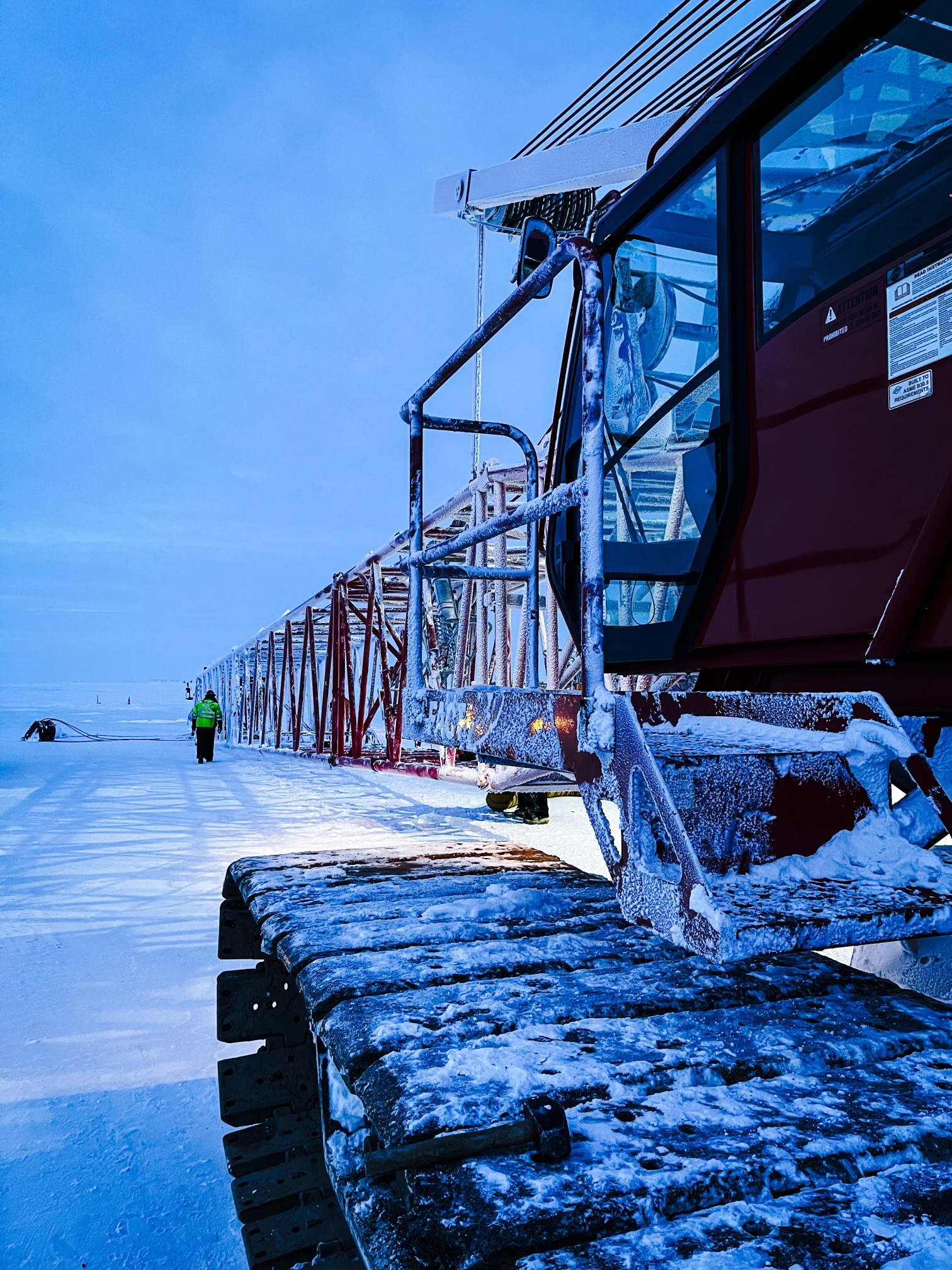
By ROBERT SEITZ
April 17, 2026 – Various Alaskans have provided their take on the “evil oil companies” which “exist only to take advantage of Alaska citizens” and “make money while taxes are low.”
What these Alaskans are missing is that the oil companies want to make money while taxes are low so they can have enough money to invest in future projects in Alaska, to make more money by growing the production of oil and gas.
As long as the taxes are low enough there will be a continuous stream of investment capital to allow them to invest in more projects, which will benefit Alaskans with more jobs and more opportunities for service company contractors. It is good for Alaska and our economy. I was pleased to see that the Alaska State House actually voted against applying corporate tax to LLC corporations. This is a move that will encourage investment. Oil and gas companies are key to Alaska’s growth and survival.
Survival, the basis of life in Alaska, it is what defines our existence. Surviving the cold is the primary goal. Since it can be very cold for many months, in Alaska, it is important to have easy and efficient ways to stay warm. An individual or a family can survive by foraging for fuel and food, but a large population requires the flow of natural gas through a pipe and electricity through wires to provide easy and efficient means to survive. If everyone burned wood for heat the smoke becomes unbearable. Fairbanks is an example of a city in need of the flow of natural gas as they have pollution problems every winter.
Alaska owes to the oil companies and the mining companies, a business climate that has reasonable permitting processes, reasonable regulations and reasonable taxes, so they can afford to develop facilities and operate facilities and in exchange they will feed our revenue stream from the product they produce and sell.
We have had periods during my engineering career that there were many years of successive increase of design projects for the North Slope oil and gas fields. During those years the local engineering companies were fully staffed and each with a good number of projects to work. We had engineers and construction workers in this state as we designed and built projects for Enhanced Oil Recovery and some greenfield facilities to increase the flow of crude oil and have more natural gas on hand. Then we got hit with growing ESG (Environment, Social and Government) policies which were used to halt investment in oil and gas production projects or fossil fuel projects in the effort to make us green. As projects dried up, engineers and construction workers have retired or moved on to where there are projects.
The best way to have a workforce is to have enough projects in place in Alaska to attract the workers. Then ensure enough development activity to retain enough engineers, technicians, construction personnel and other workers to be available for any future projects.
We ran out of workers for the workforce because there wasn’t enough work to keep them around. If we are to get to 1 million barrels of crude oil per day through the trans-Alaska pipeline, we still need to be promoting and encouraging additional oil production projects on the North Slope so we are adding to our revenue each and every year. Twice the crude oil flow that we have now is better than hoping for high crude oil prices.
The engineers must be knowledgeable in things Arctic, they must have an understanding of just how remote some of the work locations are to ensure they can maintain a supply chain and they must understand what is takes to work in the cold and wind and snow and frozen ground. When the experienced people go away it takes a lot to get that experience of the Arctic back into the workforce.
The best way to have a steady stream of projects is to keep the Alaska burden on investors low and provide incentives to attract investors to consider Alaska as a place for investment. We want investment in more North Slope oil and gas production projects; mining projects throughout Alaska; and investment in the Cook Inlet area petroleum projects. High on the list is Cook Inlet natural gas production. Let’s keep supporting John Hendrix and Furie to drill more wells and flow more gas.
I haven’t see where any one has asked “how much additional natural gas needs to be available to curb the concern for decreasing gas in Cook Inlet?” It is something we need to know, so we know how hard we need to work to reach that level. I’m sure we can get enough additional wells producing natural gas to get us to where those who care can be satisfied that we won’t or can’t run out of gas during a cold spell in winter. I would also hope that we can have enough gas capacity to provide power for the Johnston Tract Mine that might even allow refining at the mine site. That would remove a lot of pressure on those who are concerned with the Beluga whales in Tuxedni Bay. We need to encourage more mines to help get some economy into some of the places far from Anchorage. Even if someone thinks there is a problem with a mine, smart engineers and planners can find ways to make them acceptable neighbors.
The State of Alaska needs to find ways to provide incentives for Furie and Hilcorp to drill more wells more quickly so that Cook Inlet gas can power mines, data centers and whatever other profitable businesses might come along. ADEA (Alaska’s Development Finance Authority) has been doing a good job of helping increase the production level of Cook Inlet gas. Even with the AKLNG project in place, we will be better off with high natural gas production in Cook Inlet. The Alaska Revenue stream will be depending on the LNG that is to be exported. One way to get lower electrical rates is to have enough large customers. We can’t have large customers until we have plentiful supply of energy, then everyone’s rates can be lower.
I sat through the “Alternative and Synthetic Fuels for Energy and Transportation Systems” virtual workshop that was held recently and have some renewed hope for hydrogen as a fuel source in the future. A methanol plant is being built in Kuparuk by Alyeschem. Part of the discussion dealt with diesel engines that could be used with methanol. There is some difficulty at this time to get EPA approval of methanol fueled engines.
If we can get this problem solved I see this as a way to allow hydrogen to become a part of the fuel mix in Alaska. As I have stated in earlier commentaries I have be waiting since 1980 for hydrogen to become an economical product of electrolysis of water by one of the renewable resources (solar or wind). I think that the wind and solar generation in the remote communities of Alaska could be used to produce hydrogen and then convert it to methanol for easier storage for long term. This would be a way to store the summer solar energy for use during the winter months, and a way to have a liquid fuel for transportation.
The hydrogen to methanol could benefit the railbelt with utility scale solar farms to produce hydrogen by electrolysis of water and convert it to methanol to store until the cold months to provide relief for Cook Inlet natural gas.
In my first commentary a few years ago I claimed that the best way to make solar energy effective for Alaska was to store its energy from June to January to avoid curtailing the solar energy, and to have it available when it is really needed. I still think that is true and the hydrogen/methanol fuel would be a great enhancement to any wind or solar energy source. I used to think that the solar energy could be stored as pumped hydro, but I have long since abandoned any hope of that being achievable. The location of a solar farm with a good water supply for electrolysis to provide hydrogen, along with good sun exposure and room to build a solar farm and the H2 to methanol plant could be the location of a methanol fueled engine driven DER (Distributed Energy Source) along the Railbelt utility to provide microgrids throughout the Railbelt system.
To make a budget in Alaska we need to determine what Alaska needs to provide to its residents and what that cost would be. Then we can calculate how many barrels of oil, cubic ft. of gas, ounces of gold, board ft. of lumber and the number of fish we need to produce to reach that value. With this information we know what our targets are for each industry in Alaska and just need to ensure the right regulations are in place to guide the work; that the right incentives and financial motivations are in place to fund the efforts; that the permitting process and constraints are sufficient to allow the work proceed at a pace to keep us on track. Then it will be up to each industry to make sure they are developing for a quantity of product and the number of customers necessary to have good rates for heat, rates for electricity, food, timber and transportation.
When our revenue flow is optimum we will have an annual budget, a full PFD and an ability to plan for the future with some certainty. To work out a plan we need to work together. To work together we need a common goal.
The Future is ours if we can work this out. North to the Future!
Robert Seitz is a professional electrical engineer and longtime Alaskan.



13 thoughts on “Robert Seitz: What Alaska needs to do to have heat, electricity and adequate revenue”
It’s not just environmental misinformed crowd who are acting very much like the old testament teachers during Jesus days with us when there were religious leaders calling things unclean that was never meant to be unclean because everything God made is good and we are meant to use it. The scripture that reminded me of this fight between environmentalist and developers fighting over about same idea. Do we have a right to use what God created and given to man to steward over it?
You know why this legislature refuse to anger the people by not restructuring government and spending it’s because so many of the voters are government dependent.
Democrats have made it clear they are happy being government dependent. What the republicans can first take your children out of their public charter, neighborhood school, even a public homeschool and educate your children yourself. If you can get a job not dependent on taxpayers funding it. This state can’t make any moves forward until there are more voters not government dependent than there are. It starts with retraining and re educating your children because face it parents your aging but your kids will be tomorrows adults of Alaska, and they won’t learn how to be more independent and accountable unless you take them out of public funded schools including those state homeschools and educate your own children.
I think I agree with much of what you wrote. If we have the projects that it will take to double the flow of crude oil there will be enough jobs for everyone, so nobody needs assistance from the State. The State can take care of the infrastructure, fund schools and the PFD in addition to provide the incentives that will encourage investors to support mining, drilling and fishing. Even the kids will learn to work.
The author certainly appears to be credentialed. What is also evident is that he is not well versed in economic, risk or alternative analysis based therefrom. There’s a technical aspect and an agenda driven aspect to much of what’s proposed.
Take hydrogen, wind and solar for instance. The motive force behind these are not economically sound and are inflationary and debt creating. They depend on and are dependent upon the climate control and the carbon control industrial complex that exist of, for and by itself and for its growing, bottomless needs that amount to industrial and economic sabotage.
Alaska’s emission footprint is minuscule. Our energy needs are great. Our petrochemical revenues should not be extorted for this nonsense.
Lastly, Alaska needs cheap, dependable, local energy. Carbon control, net zero scams need to be shut out of the considerations, regardless of federal grift and those building it for their own profit and manipulations.
I primarily advise to use wind and solar in remote communities where diesel has to be shipped in. Displacing diesel gives some affordability to using wind and solar. They still need a diesel generator. The hydrogen addition I provide with the provision for it to be converted to a liquid fuel(methanol) for easier storage than would be for H2 in its gaseous state.
I am not suggesting that our petrochemical revenues should be extorted, just that petrochemical revenues should be increased through increased production and not increased added taxes.
To get cheap energy we need to produce enough of our energy source to a point where it will be cheaper for Alaskans to use. That is another prong of my message.
Good, concise work, Robert
.
Questions about this, if we may: “To make a budget in Alaska we need to determine what Alaska needs to provide to its residents and what that cost would be.”
.
In the engineering world, success depends on making things which must work in an environment controlled by immutable, constant, physical laws which, if violated, invariably create spectacular material for the “Engineering Catastrophes” series.
.
How is it possible to engineer a budget in a chaotic environment seemingly uncontrolled by legal, moral, practical, or ethical constraints?
.
“From each according to his ability, to each according to his needs” is a hundred-year-old Marxism.
.
How is “we need to determine what Alaska needs to provide to its residents” different?
.
In an age when the registered special-interest half of Alaska’s lobbyist-legislator team outnumber legislators by nearly 9 to 1, who is “we”?
.
“When our revenue flow is optimum” means what, exactly? Optimum for whom, Alaska’s education industry, the 5728 nonprofits registered in Alaska, for examples?
(https://www.irs.gov/charities-non-profits/exempt-organizations-business-master-file-extract-eo-bmf)
.
What’s likely to happen if, post Exodus, left-behinds can’t be taxed enough to reach “optimum revenue”?
(https://thealaskastory.com/is-alaskas-economy-in-slow-decline-or-is-it-on-the-brink-study-raises-concerns/)
.
Speaking of catastrophes, what’s likely to happen, Robert, when heat and electricity get turned off, rationed, or unaffordable for entirely preventable, predictable causes?
.
At that point, “adequate revenue” would seem like the least of peoples’ worries, no?
.
Good start, Robert, less lecture, more revision, you might be on to something.
If we have redundant and resilient and reliable energy sources we should survive catastrophes.
Alaska has being trying to have a balanced budget with no money in the bank. So the best way to get money in the bank is to sell more of whatever we have, which in our case is oil.
If we have enough good projects the Exodus will end and people will return for the jobs. Taxes won’t be the thing we depend on but royalties on each barrel of oil will flow into the State coffers. We can decide not to accept grant requests, and to build barley silos and decide to have good roads, bridges and airfields.
My “Optimum” is optimum for the State of Alaska, so that no state taxes are necessary. Sales taxes would all be by local communities.
The other integral component to this exercise includes constantly researching for “Waste – Fraud – Abuse” that need to be identified and eliminated quickly, driving efficiencies and integrity. I’m confident the Boyz that Elon pulled together at DOGE could automate the process, delivering useful – transparent information that decision makers could make reasonable policies and actions to serve Alaska and Alaskans better.
Waste-Fraud and Abuse should become less frequent when the citizens realize they don’t have easy access to revenue stream. We need to create a culture of integrity where reasonable policies and actions are the obvious choices.
“……..Various Alaskans have provided their take on the “evil oil companies” which “exist only to take advantage of Alaska citizens” and “make money while taxes are low.”
What these Alaskans are missing is………” ……..a brain.
Save gas, burn Giessel fuel
Hydrogen would seem to me to be an effort to insert a square peg in a round hole. H2 is notoriously difficult to work with as it requires extremely cold temperatures to liquefy, is almost invisible when it burns, and tends to react with metals it is stored in, embrittling them.
A good example of industrial use of H@ has been in the space business where it has been in operational use since the Saturn 1 (S-IVB upper stage). It was used on the shuttle. One of the most difficult problems has always been identifying leaks, with the space guys eventually using infrared sensors to look for them.
Yet Musk and SpaceX moved from H2 to methane (CH4) for Starship. Why? CH4 (natural gas) is much more available, widely used, liquefies at about half the temperature of H2, and most importantly understood. The infrastructure is already in place nationwide, even in Alaska, where it is used to provide heating, a full third of our daily energy use.
We here in Alaska can use CH4 with existing infrastructure for clean energy for centuries. The older I get, the more H2 starts looking like yet another expensive green bunny trail like wind and solar. Should I do a piece with the argument, Bob? Cheers –
Would appreciate a piece with the CH4 argument.
.
Hard not to conflate H2 with things like lowest bidder and Hindenburg.
I am not advocating for the H2 application where there is natural gas. My focus is for remote communities around Alaska and areas along the Railbelt where there is no natural gas nearby. I’m suggesting that if we can have an effective Solar or Wind source with an electrolyzer and H2 output, that the best way to store the energy would be in the liquid form as methanol.
I am also thinking that if we can find more large loads for our gas and electricity the eventual rate for each should decrease considerably.