


By SUZANNE DOWNING
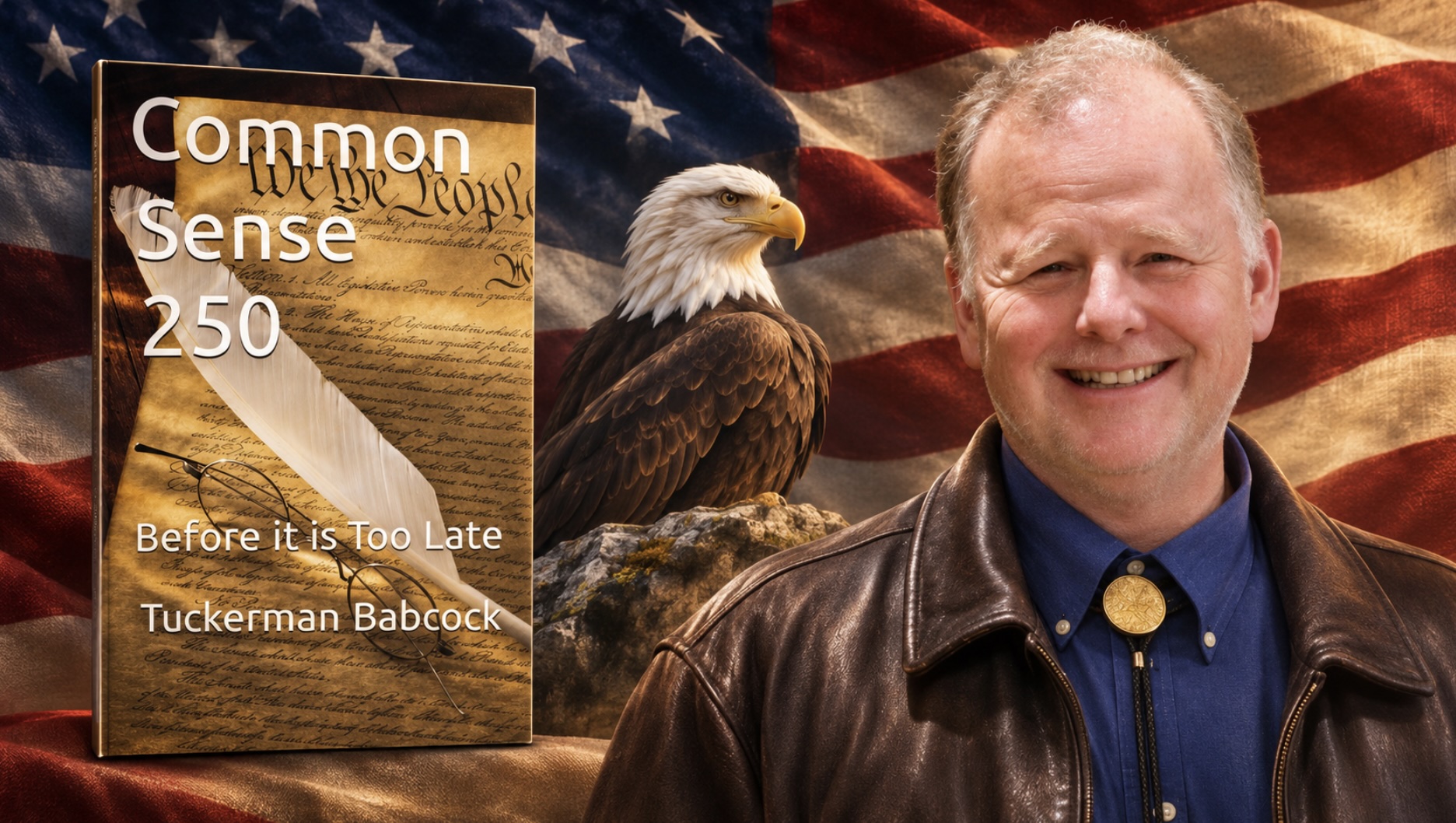
Nov. 8, 2026 – Tuckerman Babcock has spent years working both inside and outside the machinery of Alaska politics. In his newly published 36-page pamphlet, Common Sense 250: Before it is Too Late, the former Alaska Republican Party chairman steps back from the next campaign cycle to ask a more unsettling question: How much longer can Americans share a country when they no longer share an understanding of what the country is for?
It is a big question, and a looming one for many Americans. But the pamphlet form suits the material and makes it not an overwhelming investment of time for readers. Direct, urgent, and deliberately provocative, Babcock wants readers to stop treating the country’s political condition as another rough patch that the next election will fix.
The title unmistakably invokes Thomas Paine, and the revolutionary pamphlet tradition itself. At the nation’s 250-year mark, Babcock asks readers to consider the very durability of the republic.
“A fork in the road looms ahead. This vast Republic suffers from division, division so deep, so pervasive, and so fundamental, that the the two great factions are irreconcilable. Common Sense tells us a nation divided against itself cannot stand. A practical solution exists,” the summary at Amazon says.
His starting point is that America’s political conflict has moved beyond disagreements about tax rates or the size of an appropriation. In his telling, the country’s two principal factions hold incompatible beliefs about human nature, morality, liberty, national identity, and the relationship between citizens and government.
“Those are irreconcilable worldviews,” he writes. “What compromise is possible? Little to none.”
That is the premise driving these pages, and it is also the proposition on which readers will divide.
Babcock’s strongest observation concerns the transformation of political opponents into moral enemies. Once citizens become convinced that the other side is evil, losing an election becomes something more frightening than spending a few years out of power. It becomes an existential threat. Under those conditions, restraints on political conduct begin to look like obstacles to survival.
His discussion of civility is particularly pointed. Calls to lower the temperature offer little reassurance if the people making them believe their neighbors are fascists, communists, or traitors.
Politeness alone cannot settle a dispute over whether a right is fundamental or dangerous, whether parents or the state should direct a child’s education, or whether national loyalty is a virtue or a vice.
Conservative readers will recognize much of the terrain: gun rights, religious belief, taxation, immigration, and the meaning of America’s founding. Babcock writes from a plainly conservative perspective, and his descriptions of the competing positions leave little doubt about his convictions.
Yet he also assigns responsibility across factional lines. In these pages, he criticizes both camps for reliance on executive power and spending that increases deficits and debt. He describes the erosion of civic restraints as a problem extending beyond one party’s misconduct.
The pamphlet was written before the Nov. 3 election.
“The election just confirms the thesis that the division is strong, fierce and irreconcilable,” he told The Alaska Story.
Babcock describes a possible descent toward civil conflict as gradual: frustration giving way to hopelessness, fear, disorder, and violence. The warning gains force from its emphasis on accumulated failures. A country can travel a considerable distance down a dangerous road while its citizens continue assuming someone will eventually turn the wheel.
Babcock acknowledges there are many moderates, libertarians, smaller factions, and people who pay little attention to politics. But there is a growing trend toward two deeply opposing worldviews.
The tension makes the pamphlet worth sharing. Babcock puts a difficult question before readers:
What shared principles must survive for self-government to keep working?
As an opening argument, Common Sense 250 has a clear strength: It asks readers to think beyond the next election cycle and consider what will hold the country together afterward.
Babcock reminds us of something said by Arthur Schopenhauer that perfectly sums up much of what America is going through:
“All truth passes through three stages. First, it is ridiculed. Second, it is violently opposed. Third, it is accepted as being self-evident.”
Babcock is a longtime Alaska political strategist who served as executive director of the Governor’s Reapportionment Board during the 1991–1992 redistricting cycle, held constituent relations and appointments roles under Gov. Wally Hickel, and served on the Alaska Oil and Gas Conservation Commission from 1993 to 1996. His career also includes legislative staff work, management positions at Matanuska Electric Association, and decades of involvement in Republican campaigns and party leadership. He lives on the Kenai Peninsula with his wife Kristie.
Common Sense 250: Before it is Too Late, by Tuckerman Babcock, is available on Amazon.