

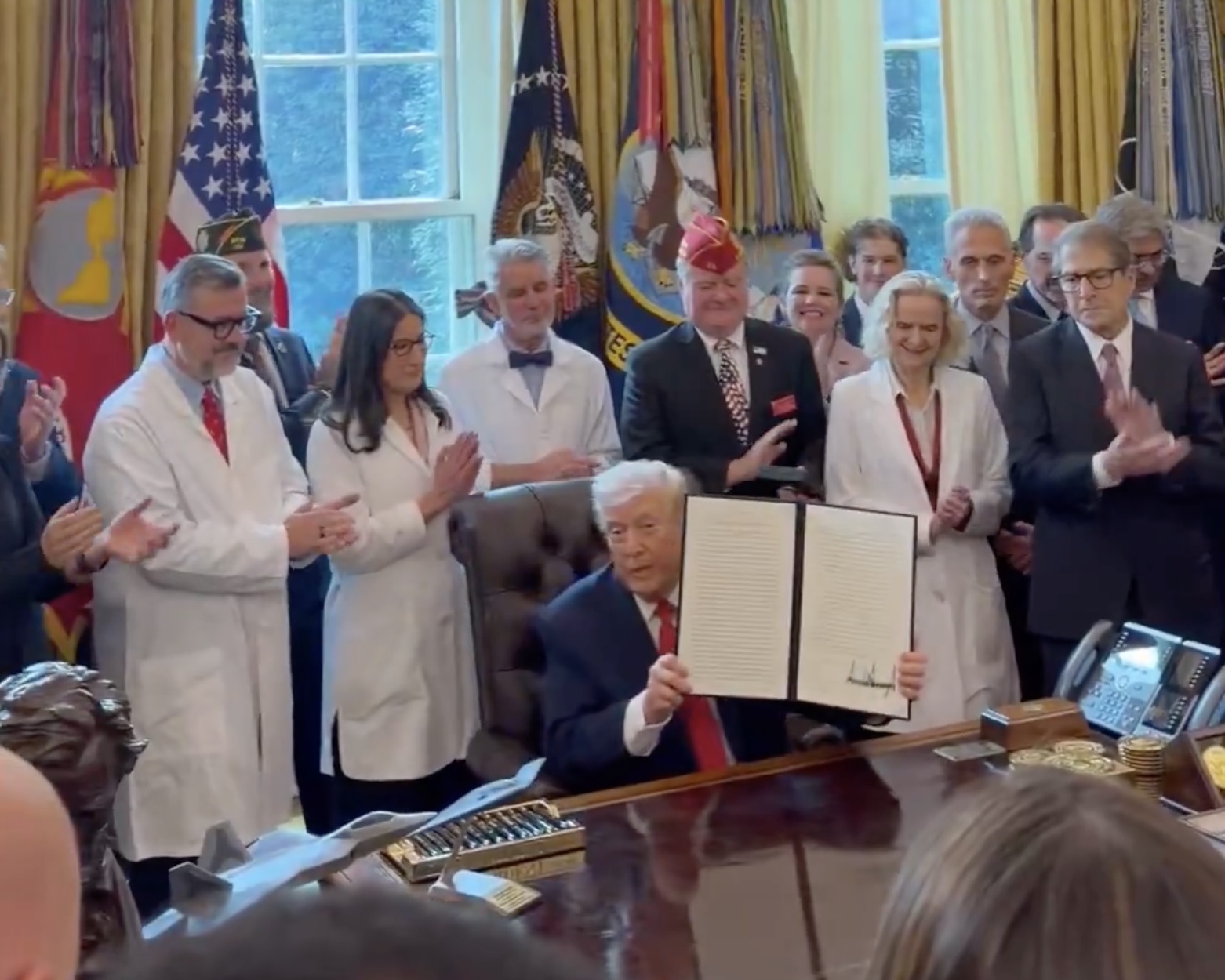
President Donald Trump signed an executive order directing the federal government to accelerate the long-delayed process of rescheduling marijuana under federal drug law and to expand research into medical marijuana and hemp-derived cannabidiol (CBD) products.
The order cites findings by federal health agencies that marijuana has accepted medical uses and that decades of federal drug policy have hindered research, manufacturing, and the development of clear medical guidance for doctors and patients.
Marijuana is currently classified as a Schedule I substance under the Controlled Substances Act, a category reserved for drugs deemed to have no accepted medical use and a high potential for abuse.
In 2023, the US Department of Health and Human Services formally recommended that marijuana be moved to Schedule III, a classification that recognizes accepted medical use and a lower potential for abuse. That recommendation was supported by the Food and Drug Administration and the National Institute on Drug Abuse.
According to the executive order, more than 30,000 licensed health care practitioners across 43 jurisdictions are authorized to recommend medical marijuana to more than 6 million registered patients for at least 15 medical conditions.
Federal agencies cited credible scientific evidence supporting marijuana’s use in treating chronic pain, nausea and vomiting associated with chemotherapy, and anorexia related to certain medical conditions.
Chronic pain affects nearly one in four adults and more than one in three seniors. Federal surveys referenced in the order show that six in ten people who use medical marijuana report doing so to manage pain. The order also notes research indicating that some veterans reported reduced opioid use after transitioning to medical marijuana.
Despite widespread state-level legalization, including 40 states and the District of Columbia that operate regulated medical marijuana programs, the federal Schedule I classification has limited large-scale clinical research and left doctors and patients without FDA-approved guidance.
Surveys cited in the order indicate that only about half of older Americans who use marijuana have discussed it with a health care provider, increasing the risk of drug interactions and adverse effects, particularly among seniors taking multiple medications.
The executive order directs the attorney general to complete the rulemaking process to move marijuana to Schedule III “in the most expeditious manner” permitted under federal law. The Justice Department proposed such a rule in May 2024, drawing nearly 43,000 public comments, and the matter remains pending an administrative law hearing.
The order also addresses the rapidly expanding market for hemp-derived cannabinoid products, including CBD. Federal data show that one in five US adults and nearly 15% of seniors reported using CBD in the past year. While hemp-derived cannabinoids are legal under federal law, the administration warned that inconsistent labeling, unclear THC limits, and overlapping statutes have left Americans without adequate safeguards.
Some full-spectrum CBD products may soon be reclassified as controlled substances when a provision of Public Law 119-37 takes effect, due to THC levels exceeding new per-container thresholds. A study cited in the order found that some commercially available CBD products were inaccurately labeled, raising concerns about safety and consumer protection.
Under the order, senior White House staff are instructed to work with Congress to update statutory definitions governing hemp-derived cannabinoid products. The stated goal is to preserve congressional intent to restrict unsafe products while maintaining access to regulated full-spectrum CBD. Federal agencies are tasked with developing guidance on THC limits per serving, container thresholds, and CBD-to-THC ratios.
The Department of Health and Human Services, the FDA, the Centers for Medicare and Medicaid Services, and the National Institutes of Health are also directed to expand research using real-world evidence.
The administration said the focus will include long-term health effects, particularly for vulnerable populations such as adolescents, young adults, and seniors, as well as the development of standards of care that reflect how marijuana and CBD are actually being used by patients.
Cannabis ‘scromiting’ is hurling onto the public health scene

12 thoughts on “President orders accelerated rescheduling of marijuana for medical uses”
I do not like marajuana around children and teens at all. Even the smoke in public places. Pot destroys too many young minds. A lot like pornography.
It should only be for private or gifted use. It should not be sold in stores. No advertising and no public use- or use of machinery under the influence. Employers should have the right to not hire or fire because of use.
You want to use it? Grow your own.
Trump really screws up sometimes. First giving civil servants who had two months off another two days and now helping legalize dope. It’s like a leftover hangover from being a democrat. No e of this helps the country and our Alaska Senators vote to allow more marajuana access. Next they will ask for teachers to get more time off.
They need to stick to what R’s want. Drill Baby Drill and defense.
So you finally regret your vote for Trump, along with many, many others.
Something I noticed about those smoking marajuana for a medical purpose such as pain relief for alleviating chronic pain. They don’t smoke it too much, the they are time structured at set times when they smoke it like bedtime so they can relax to get to sleep better. Unlike those users just doing it for an escape or getting High, they over consume smoking it all hours of a day and evening.
However I feel like there HAS to be better pain relief than marajuana for people I’ve met seldomly using just to alleviate pain or inflammation. There just Has to be. Because like Trump and health professionals I too am concerned about longterm negative health effects on adults using it even in smaller amounts for their chronic pain.
Please give Grammarly a try, Tina.
Marijuana might have more potential for medical use but it also is definilty has a high potential for abuse as well as addiction and that classification should not be lowered. It is most certainly being abused in Alaska and I smell it all the time in traffic, driving down the road, when I am out for a run, in parking lots, etc. – it is an insidious smoke that lingers and does not dissipate. I cannot stand the smell and it is concerning that those of us who do not want to use it are forced to breath other peoples smoke, which just like secondhand tobacco smoke, could have negative effects. I have seen lives ruined by marijuana addiction and just this past week I read an article about something called ‘scromiting’ Cannabinoid Hyperemesis Syndrome – a condition caused by chronic cannabis use that leads to uncontrollable vomiting.
This is long overdue. Classifying marijuana as a schedule I drug was ridiculous to begin with. This simply places it in a category that is more appropriate for the active compounds it contains.
From the DEA:
” Schedule III
Schedule III drugs, substances, or chemicals are defined as drugs with a moderate to low potential for physical and psychological dependence. Schedule III drugs abuse potential is less than Schedule I and Schedule II drugs but more than Schedule IV. Some examples of Schedule III drugs are: products containing less than 90 milligrams of codeine per dosage unit (Tylenol with codeine), ketamine, anabolic steroids, testosterone”
That you all do not have enough reading comprehension to realize that this does not make it a “free for all” is very sad. The recreational use authorization comes solely FROM THE INDIVIDUAL STATE alone and this does NOT federally support those. A schedule III drug requires a licensed medical professional’s prescription. This is a medical use authorization under the care of a doctor, which makes a lot more sense in light of the applied medical uses we have seen in years past.
This reclassification should also permit producers to conduct business within the established banking system and eliminate the need for cash transactions, reducing the risk of criminal activity.
I wonder how many people that supported the use of ivermectin for covid are opposed to even allowing the medical testing of a plant or the ability of a medical professional to prescribe a plant in the use of medical treatment.
Everyone should watch Tucker’s Nov. 17th’s podcast: “Big Pharma’s Most Dangerous Lie and the Dark Truth About Weed.” Legalized marijuana is one of the main things destroying Alaska right now. Whether it should be legalized or not for medical use, we all need to know what it’s doing to Americans, including their souls. Marijuana even interferes with people’s consciences, so they don’t feel guilty when they should — so they would get right with God and people to be right with God and fellow Alaskans — unlike Crash, on the ‘Mike Porcaro Show,’ who tells how he regularly consumes, and mentions how great it is, while Porcaro laughs — as Crash trashes Alaska! Why is he allowed to be on the public airwaves?
I don’t recall if Dr. Daniel Amen mentioned the conscience numbing factor, but he says A LOT!:
Chapters:
0:00 How Does Marijuana Affect the Brain?
3:03 The Connection Between Marijuana and Psychosis
12:35 Why Is Brain Damage on the Rise?
15:18 Psychosis and Schizophrenia
21:58 Does Obesity Decrease the Size of Your Brain?
24:45 What Does Marijuana Do to Testosterone Levels?
25:11 Is This Contributing to the Rise of Autism?
31:41 Don’t Believe Everything You Think
34:08 Is Marijuana a Medicine?
38:23 Should Marijuana Be Legal?
40:41 Is Marijuana Ruining Your Marriage?
44:51 Does Marijuana Increase Your Risk of Dementia?
55:00 Why Isn’t the Government Sounding the Alarm About Marijuana?
TO FIND THIS SHOW, “Big Pharma’s Most Dangerous Lie and the Dark Truth About Weed,” which is free to watch, do a search for: .
God bless!
Jeff, can you clarify your statement: ” Legalized marijuana is one of the main things destroying Alaska right now.” Seems a bit broad. What do you mean by destroy and how is marijuana a “main” thing?
The Democrats could never give up on the additional tax revenue on this enormous source of revenue.
Oregon’s number one “cash crop” has become the foundation for their economy even surpassing logging. They had to come up with something to offset the decimation of timber cutting thanks to the preservation of the spotted owl of which now it has been discovered the horned owl is the real killer. Most politicians will swear the benefits far outweigh the impact weed has on developing children. That is primarily the main reason Oregon is at the top of the heap when it comes to Heroin use per capita. Keeping the dangerous drug users on the street where they are “safe” is their goal.