


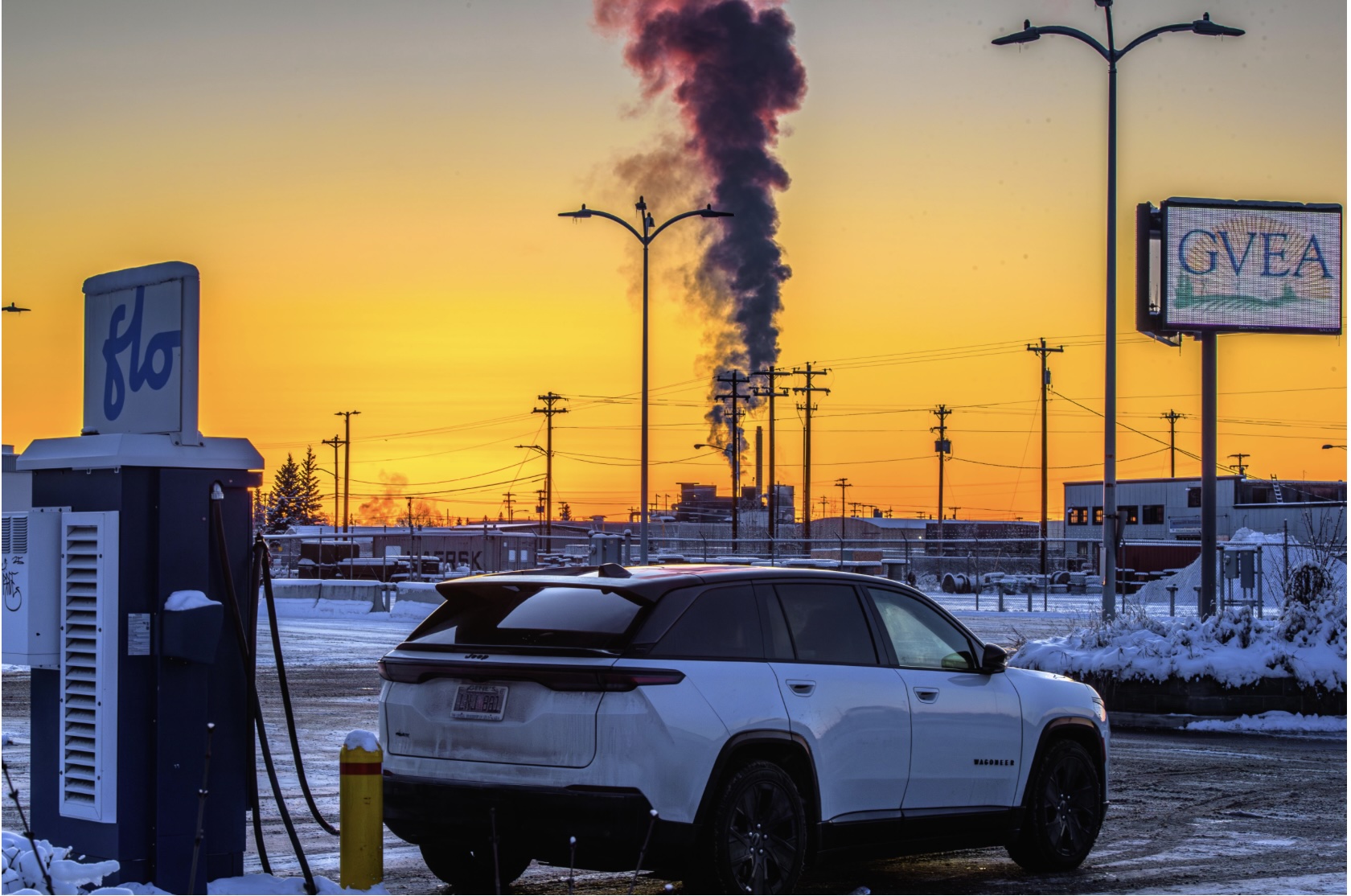
An electric Jeep Wagoneer charges up in Golden Valley Electric Association’s parking lot with the sun setting over the Power Plant. Poetic. GVEA gets its power from nine facilities that burn oil, coal, natural gas, and utilize smaller amounts of wind, solar, and hydro.
Robert Lype photo.

8 thoughts on “Poetic photo of the day: Charging up in Fairbanks”
Of the larger cities in Alaska, Fairbanks would be the last on my list in which to own an electric vehicle even if I had a heated garage for it at home and work. But wait, there’s more: Having to keep it warm and paying the corresponding energy bill would make its economics even worse.
My grandkids told me the same thing, not to buy, but I bought an older one anyway. I figure that if I spend more on electricity, and less at the pump, I’ll have more $$ to spend on cheap spirits and forget about the cold winters in Fairbanks. But I do need more donations to make it to December.
LOL. With that kind of logic, no wonder he gets only Democrat donations. And flimsy ones at that. Democrats are inherently cheap *sses. Maybe Derm The Mutt should do a piece on the UAF new $300 million coal-fired powerplant, with all the grad students and climate wackos choking on coal ash from their ring-side seats on campus. Lights out, everyone. Class is over for the day.😆
King Cole. Good for the ash heap.
That’s a Jeep? Anyone else remember when Jeeps were Jeeps and not big cars?
Just for reference, that power plant in the background is Aurora Energy’s Chena 5 coal-fired unit. That’s mostly steam coming off the stack, darkened by the shadow cast by the setting sun. It’s probably the least cost source of electrical energy in the interior. Or was; now that they are freed from a crazy long term commitment at the purchase of FMUS, they are likely charging market rates. Nice picture, in any case.
No solar panel, wind generator, or electric car has been manufactured in the USA without government subsidy or tax credit (same thing). In fairness, petroleum producers get occasional government allowances; but nowhere near the same degree and only in unique, purposeful, cases.
My friend Wayne Info for you to review : Alaska’s petroleum tax structure no longer includes a traditional percentage-based “depletion allowance” or “cashable” credits. Instead, it uses “per-taxable-barrel credits” as an integral part of the production tax calculation, which vary based on the price of oil and the type of production.
The primary per-barrel credit amounts currently are:
Sliding scale for non-GVR (Gross Value Reduction) oil: The credit ranges from $8 per barrel (when the wellhead price is less than $80 per barrel) down to $0 per barrel (when the price is $120 or more per barrel).
Flat rate for GVR (new) oil: There is a flat credit of $5 per barrel.
These per-barrel credits are a component of the tax calculation designed to create a progressive tax structure (lower effective tax rates at lower oil prices and higher rates at higher prices). They cannot be used to reduce a producer’s tax liability below the minimum tax and cannot be carried forward to subsequent years if unused. The specific amount at any given time depends on the actual Alaska North Slope (ANS) oil price, which fluctuates monthly.