


By PAULETTE SIMPSON
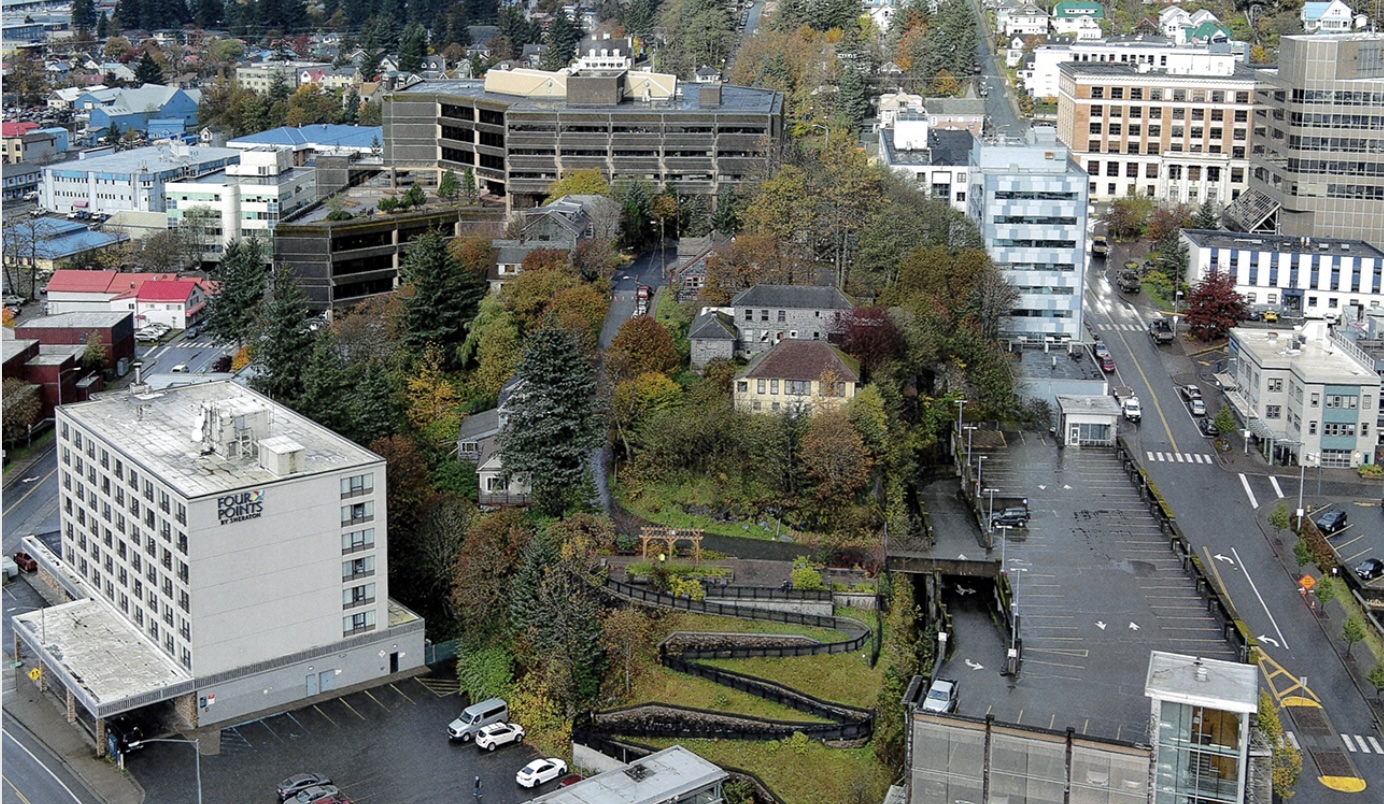
In a town as politically charged as Juneau, it’s prudent to pick and choose your battles. There are hills I’m willing to die on, but Telephone Hill isn’t one of them
That said, as the Juneau Assembly continued doubling down on its plan to re-develop the site, insisting that after demolition of existing homes, four new buildings could provide up to 155 housing units there, I began to believe that bullheadedness, not rationality, was driving the decision-making.
For years we’ve heard the complaints and experienced the frustration of downtown traffic clogging Egan Drive in the summertime. Cars and buses are often backed up to Gold Creek or even to the bridge. Adding 155 dwelling units and their corresponding vehicles will only aggravate the traffic situation downtown. Did the City’s consultants consider congestion? Not that I noticed: Telephone Hill Redevelopment – CBJ Updates.
The Telephone Hill hullabaloo has rekindled memories of an earlier land use controversy.
Juneau developed where it did because of the historic mine responsible for its 1880 founding. Wedged between the waterfront and two towering mountains, our downtown will always be challenged by its inconvenient geography.
Today, “housing” is the puzzle to be solved, but in the early 1980’s, parking was the problem. Parking for downtown businesses, the Capitol, city employees and residents was in such short supply that in December 1983, Mayor Fran Ulmer and her Assembly proposed building a parking garage on City property on the South Franklin St. waterfront.
Many residents were upset by the location choice and had I not been busy with babies, I might have engaged in the debate. Instead, I watched from afar, aghast that anyone would plunk a parking garage on prime waterfront property. Was a backwater bureaucrat to blame for this lame idea? Who would want a looming, multi-story, Soviet-style concrete bunker sheltering 280 cars on this beautiful site? Why not put it on the uphill side of the street or try tucking smaller structures into the hillside like they do in Europe?
It’s been forty years, so the facts are fuzzy now but many of us remember that Betty Breck (Belle Blue) sued the City to stop construction of the garage, alleging the City bypassed competitive bidding rules in awarding the $1.5 million construction contract. The Superior Court granted a preliminary injunction to halt construction but in 1985, the Supreme Court reversed the decision of the lower court.
Fran Ulmer left the Mayor’s office in October 1985 and was succeeded by Ernie Polley who was so annoyed with Belle Blue that he said he’d like to see her face on the side of a milk carton.
Local artist Bill Hudson of Folk Festival poster fame rose to the occasion and soon the Belle Blue on a milk carton print was the hottest piece of artwork in Juneau: “Belle Blue LAST SEEN: Fighting for the Supremacy of the Law, Trimming the Budget, Encouraging Sensible Development, Diversifying the Economy, and Promoting Citizen Participation in Government!”

In 1989, in an apparent effort to mitigate the mistake, the city re-located the downtown library to the top of the parking garage. Stunning large-scale murals adorn two sides of the structure. Still, as one approaches downtown Juneau, the visual impact of the concrete monolith persists as a monument to our city’s aesthetic choices. Will companion structures appear on Telephone Hill?
Next the City wants to build a waterfront museum on public land adjacent to the parking garage. I love museums, but shouldn’t a city museum be primarily accessible to Juneau residents? Will Juneau families be willing to negotiate traffic and parking to patronize this taxpayer-funded amenity? Perhaps in the off-season.
In the case of both Telephone Hill and a new museum, we’re told these plans have been in the works for years. Activity in the form of endless meetings and money spent does not guarantee a correct outcome.
Land use decisions carry generational consequences. The first question that should always be asked and thoughtfully answered is, “Is this the best and highest use of this piece of public property?”
Note to Assembly: It’s okay to change your mind. It’s why they put erasers on pencils.
This is not the hill you need to die on.
Paulette Simpson is a longtime Juneau resident.
Paulette Simpson: Of ships, senators, and good deeds that don’t go unpunished

5 thoughts on “Paulette Simpson: Telephone Hill is not the hill to die on”
Excellent arguement. Arguing using the Facts.
Unfortunately for you your target audience (The Juneau Assrmbly) you are trying to reach they put feeling over facts.
They are obsessed with doing away with traditional housing. Probably because traditional housing matches with traditional families. Whether the assembly and planning folks know it or not, they are making great progress towards destroying the American way.
Telephone Hill is prime real estate and I would say the rues of affordable housing is a shinny thing to distract citizens into acquiescence. Walking distance to the capitol, right in the hub of Juneau – those pushing for the removal of a few historic homes have big property tax dollars in their sights and it won’t be from ‘affordable housing’. Granted the area has been so hemmed in by state capitol and tourism development the HBU (highest and best use) is not longer single family dwelling, historic or not. Still it would be very nice if somehow the historic structures could somehow be incorporated into any development or even relocated.
Thumb pecking mistakes that slip by scrutiny drive me nuts. My first sentence ‘shiny’ not ‘shinny’. No shins involved.
1. There is no such thing as “affordable housing.” It’s an imaginary term; like affordable King Crab. Affordable housing is actually very expensive housing provided by taxpayers to those who could never otherwise afford to live in it. Anyone talking about “affordable housing” is talking about spending tax dollars on a specific group.
2. Telephone Hill is not prime real estate from an economic perspective. A thoughtful cost/benefit analysis will prove that. It can only be considered prime real estate as long as monetary feasibility is not a consideration. Only the government has the privilege of seeing investments from that point of view. I’ve seen it written in the media that the thought is being promoted to subsidize a private developer to the tune of $250k per housing unit developed on Telephone Hill. 155-units x $250k = $38M. It seems this idea could only exist if too much easy money is floating about in a government checking account.
3. As to housing, there are hundreds of locations other than Telephone Hill. The borough recently re-zoned a parcel near Costco to develop 140+ units. Voila, it happened with the stroke of a pen; no cost to taxpayers.
4. As to housing on Telephone Hill, what segment of the rental or condo markets is interested in buying without a place to park their car? I suggest a quite small segment.
5. As to the historic nature of the existing structures, it would be more feasible to restore them to rent or sell rather than demolish them. Remember, current hazmat regulations dictate every spoonful of demolition will need to be shipped to inland Washington state. Not feasible…. unless government just throws money at it. Who’s money?
6. I suggest selling Telephone Hill to the highest bidder restoring the existing structures for sale or rent.