
By SUZANNE DOWNING
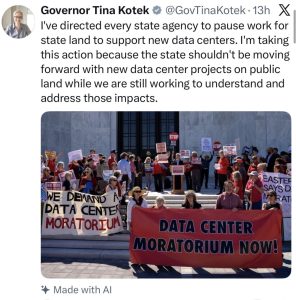
Sept. 12, 2026 — Oregon Gov. Tina Kotek announced a pause on using state-owned land for new data centers this week, posting the decision on X with a photograph of protesters demanding a moratorium.
Directly beneath the photograph was an awkward disclosure: “Made with AI.”
The label apparently applied to the protest image, not the text of Kotek’s announcement. Still, the irony is clear: Artificial intelligence requires enormous data centers to train and operate its models, and AI was used to help promote a government action restricting the infrastructure that makes the technology possible.
“I’ve directed every state agency to pause work for state land to support new data centers,” the Democratic governor wrote. “I’m taking this action because the state shouldn’t be moving forward with new data center projects on public land while we are still working to understand and address those impacts.”
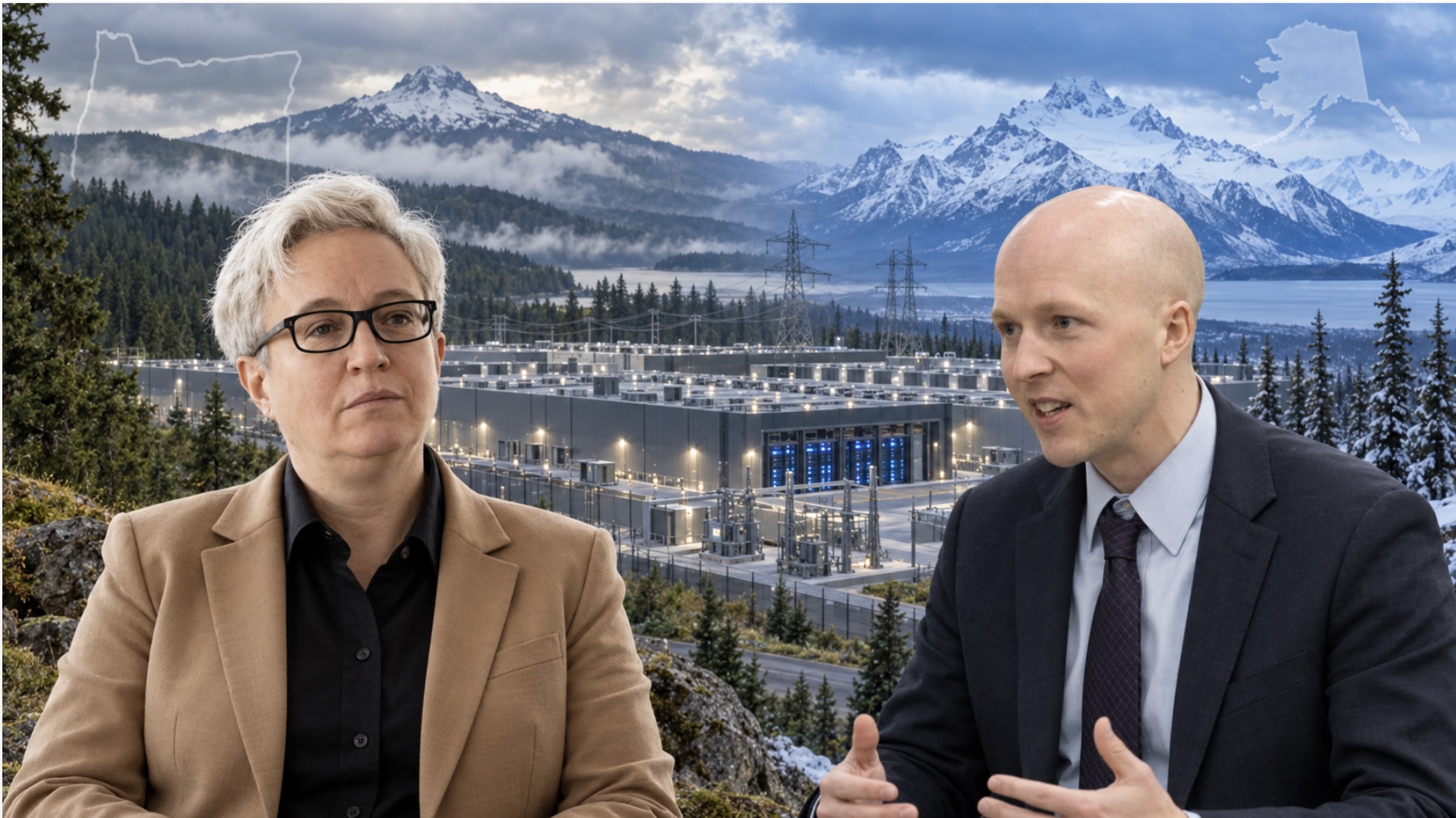
Alaska could get its own version of Kotek if Democrat Jonathan Kreiss-Tomkins is elected governor in November.
Kreiss-Tomkins is campaigning for a statewide freeze on data-center development while Alaska writes new regulations. If elected and able to carry out that proposal, he could follow Kotek’s example by using whatever executive authority is available to stop or delay data-center activity on state land, then asking the Legislature for broader powers.
There is an additional irony in Kreiss-Tomkins’ position. His campaign has received more than $500,000 from people connected to the artificial-intelligence industry, including $372,000 from six employees of Anthropic, one of the world’s leading AI companies. Yet he is now the only major Alaska gubernatorial candidate calling for a statewide moratorium on the physical infrastructure the AI industry requires.
Kotek does not have the power to enact an outright ban on data-center construction. It directs Oregon agencies to pause unapproved transactions involving state land, including sales, leases, easements, rights-of-way and permits, for new data centers through July 1, 2027.
The governor acknowledged that she lacks the legal authority to impose the broader statewide moratorium sought by some activists. Her directive instead reaches as far as her executive authority allows: transactions involving public land controlled by the state.
Kotek also terminated a pending sale of 32 acres of state property associated with a proposed $5 billion data-center development. Her office said the broader pause is intended to prevent data centers from shifting the costs of electricity, water and public infrastructure onto Oregon residents while state officials study the industry’s effects.
No other state has taken that same state-land-only approach. But Oregon is part of a rapidly growing government movement to slow, restrict or attach new conditions to data-center construction.
New York Democratic Gov. Kathy Hochul issued the nation’s first statewide permitting moratorium for hyperscale data centers in July. Her executive order pauses certain state environmental permits for proposed facilities requiring at least 50 megawatts of power while New York develops standards addressing electricity, water, noise and other effects.
In Texas, Republican Gov. Greg Abbott directed state regulators and the Electric Reliability Council of Texas to pause approvals for large data-center grid connections while they audit the projects seeking enormous amounts of electricity. The review is partly aimed at identifying speculative or duplicative applications that may never result in completed projects.
Pennsylvania Democratic Gov. Josh Shapiro stopped short of a moratorium but issued an executive order requiring large data-center developers to meet his Governor’s Responsible Infrastructure Development, or GRID, standards before state agencies review their permits. The requirements include commitments intended to prevent developers from shifting infrastructure and energy costs onto residential customers. Pennsylvania executive order
The larger movement is taking place mainly at the local level. Various trackers use different definitions and therefore produce substantially different totals, but all show the same trend: Temporary pauses, zoning restrictions and organized opposition to data centers have spread rapidly across the country.
The Moratorium Nation legal and academic inventory counts 533 local government instruments in 42 states, with 429 still in effect. About 93% of those actions target data centers. AI GridWatch, which uses a broader definition that includes community pushback, reports 853 actions in 49 states, with 691 still active. Electric Choice separately tracks hundreds of restrictions in more than 30 states.
Michigan, Ohio, Georgia and North Carolina are among the states with the greatest number of local actions. New Jersey is an outlier, with dozens of municipal restrictions concentrated within its Pinelands and affordable-housing regulatory framework.
The surge accelerated in 2026. Local governments commonly argue that their zoning codes were written before modern hyperscale facilities existed and often do not define “data center” as a separate land use. Moratoriums give officials time to write rules addressing electricity consumption, water use, noise, backup generators, fire protection, utility upgrades and effects on nearby property.
Anchorage chose a different route.
In March, the Anchorage Assembly adopted permanent zoning standards rather than temporarily stopping projects. AO 2026-27 defined data centers in municipal code, prohibited them in residential zones, and limited them to specified commercial and industrial districts as conditional uses.
The ordinance requires utility-capacity letters, noise studies, fire-protection information, enclosed generators, landscaping and 200-foot setbacks from residential property.
National moratorium trackers generally list Alaska as having no enacted moratorium. Anchorage moved directly to permanent rules before a hyperscale project had filed an application.
The Fairbanks North Star Borough Assembly took a more restrictive position in August when it adopted Resolution 2026-25 as part of its legislative priorities. The resolution asks state lawmakers and Alaska’s congressional delegation to impose a moratorium on permitting, leasing or constructing commercial data centers on state-owned or municipal land until standards are developed.
It is a request, not an enforceable moratorium. But it is the only item appearing on both state and federal portions of the borough’s 25-item priority list.
Wrangell rejected a proposed Greensparc lease at a port site in June, but that was a decision involving that single project rather than a community-wide freeze.
Alaska lawmakers also considered legislation aimed at preventing data-center costs from being shifted to ordinary utility customers. Senate Bill 250 passed the Senate but stalled in the House before adjournment. It would have required commission-approved utility contracts and financial protections for projects imposing major capital costs. Alaska still has no statewide moratorium.
Oregon’s AI-labeled announcement captured the central contradiction of the emerging movement in a single post: Government officials are increasingly using artificial intelligence even as they move to restrict the power plants, transmission lines, water systems and data centers needed to keep it running.
Alex Gimarc: Opponents of progress are looking for reasons to hate data centers
Alaska already has data centers, but will the Alaskan public turn against them?
As New York and Seattle slam the brakes on data centers, Alaska sees opportunity