


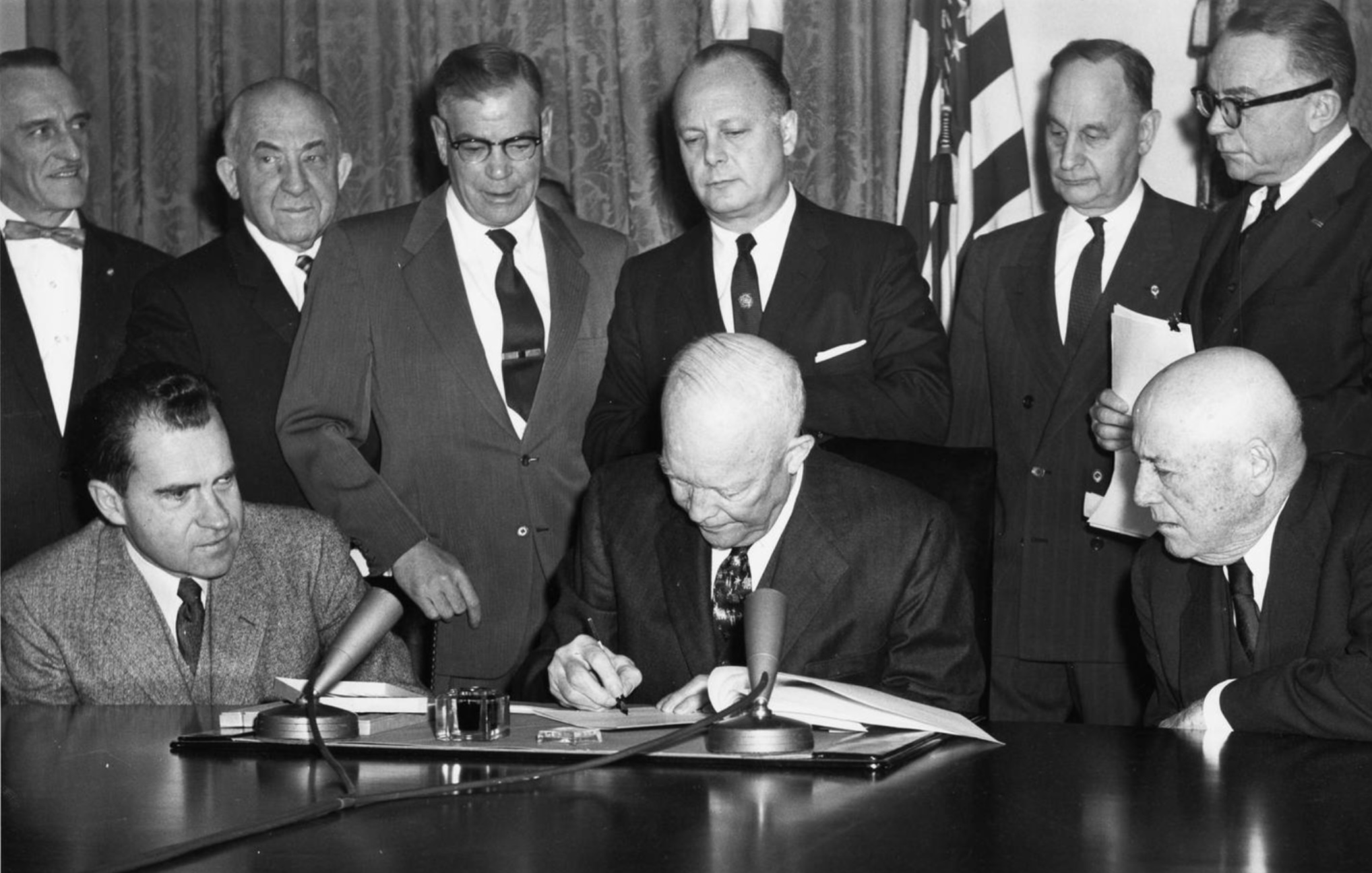
By SUZANNE DOWNING
July 7, 2026 – On this day in Alaska history, July 7, 1958, President Dwight D. Eisenhower signed the Alaska Statehood Act into law, setting the stage for Alaska to become America’s 49th state. It was the culmination of decades of effort by Alaskans who believed the vast northern territory deserved full representation and self-government after nearly half a century as a U.S. territory.
The legislation, HR 7999 (Public Law 85-508), had cleared the US House of Representatives on May 28, 1958, by a vote of 210-166 and passed the Senate on June 30 by a comfortable 64-20 margin. The measure had been introduced the previous year, but the push for statehood stretched back generations.
Among the leading champions of statehood were Alaska Delegate to Congress E. L. “Bob” Bartlett, Territorial Gov. Ernest Gruening, future Gov. Bill Egan, newspaper publisher Bob Atwood, and a young congressional aide named Ted Stevens, who would later become one of Alaska’s most influential political figures. Their campaign argued that Alaskans deserved voting representation in Congress and greater control over their own future.
Statehood was not automatic upon Eisenhower’s signature. The law required Alaskans themselves to approve its terms. In August 1958, voters overwhelmingly did just that, endorsing statehood and accepting the conditions of admission by roughly a six-to-one margin.
One of the most consequential provisions of the Statehood Act gave the new state the right to select approximately 103 million acres of federal land, part of a total entitlement of about 105 million acres, to help ensure Alaska’s long-term economic self-sufficiency. Those land selections would become the foundation of much of the state’s resource development, including timber, mining, oil, and other public lands.
Nearly six months after signing the legislation, Eisenhower signed the official proclamation admitting Alaska to the Union on Jan. 3, 1959. With that proclamation, the Last Frontier officially became the 49th state, ending 47 years as an organized U.S. territory.
Alaska’s admission also ushered in the brief era of the 49-star American flag. That version flew for just one year before Hawaii joined the Union as the 50th state in August 1959, prompting the creation of the familiar 50-star flag that remains in use today.
Looking back 68 years later, Eisenhower’s signature on July 7, 1958, remains one of the defining moments in Alaska history—transforming America’s largest territory into a full partner in the Union and laying the legal foundation for the state’s political and economic future.



6 thoughts on “On July 7, 1958 President Eisenhower signed the Alaska Statehood Act”
Suzanne, you forgot to mention Alaska’s first statehood governor:
Mike Stepovich.
Unfortunately, Stepovich was never State Governor. He was the last presidentially-appointed Territorial Governor, until the final months when some kind of switcheroo took place and a temp was put in. He lived to a ripe old age, ultimately becoming the last living former Territorial Governor out of all the States.
Stepovich was appointed as Governor, by Eisenhower, of the State of Alaska upon statehood. He lost in the first election for governor by Bill Eagan.
Not exactly “some kind of switcheroo”. Frank Heintzleman was Eisenhower’s first appointment at governor and he resigned. Waino Hendrickson, appointed as secretary of the territory by Eisenhower, became acting governor. Stepovich served as a senator in the 1957 session of the territorial legislature. If there was intention to appoint him governor when Heintzleman resigned, he would have had to give up his seat in the legislature. He took office after the legislature adjourned. The following year, he resigned as governor. The very first result on my NewsBank search revealed that he could not remain in office and be a candidate for state governor simultaneously, per the Hatch Act. Hendrickson once again became acting governor. As an aside, contemporary sources only refer to Hendrickson as secretary, not as acting governor. Sources only began referring to him as acting governor starting in the late 1970s. This is curious because Bill Egan was gravely ill with gall bladder problems when he took office as governor, leaving for Seattle almost immediately after being sworn in. During the several months Egan was in the hospital, Hugh Wade was acting governor. The same sources which mention Hendrickson’s tenure as acting governor typically fail to mention Wade’s tenure, even though it was as long or longer than Hendrickson’s second tenure in the position. If you dig, you’ll find that Egan’s inner circle did not think highly of Wade at all. I wonder if that had anything to do with it.
Thanks, Sean. Good, thorough background info on what got to be a surprisingly complicated sequence.
Our Alaska Statehood Act was not pursuant to our Constitution🇺🇸
Our Washington D.C. Delegates and our State of Alaska Governor and State Legislature are all Constitutionally ignorant and legitimize the FRAUD