Witnesses heard the Piper’s engine surge near the one-way airstrip before the aircraft struck a riverbank, killing a McCarthy pilot and two young passengers
By THE ALASKA STORY
Aug. 25, 2026 – A Piper airplane that crashed near McCarthy in July appears to have struck a berm during an attempted landing or go-around at a narrow, private airstrip surrounded by steep terrain, according to a newly released preliminary report from the National Transportation Safety Board.
Pilot Jason Lobo and passengers Anadyr Elliott, 23, and Elliott’s 19-year-old fiancée, “Jing” Dahlin Mungkieatsakul, were killed in the July 27 crash at the upper Dan Creek airstrip.
The three departed McCarthy Airport with passengers and supplies destined for the private airstrip, about 12 miles southeast of McCarthy. The flight was being conducted as a personal flight under federal aviation regulations.
The NTSB said the upper Dan Creek strip is uncharted and is generally considered a one-way airstrip because of the steeply rising terrain around it. Go-arounds are not recommended.
Multiple witnesses on the ground heard the Piper PA-22-150 approaching the southeast runway with what sounded like a normal landing power setting. They then heard the engine increase to a high-power setting, followed by a moment of silence and the sound of an impact.
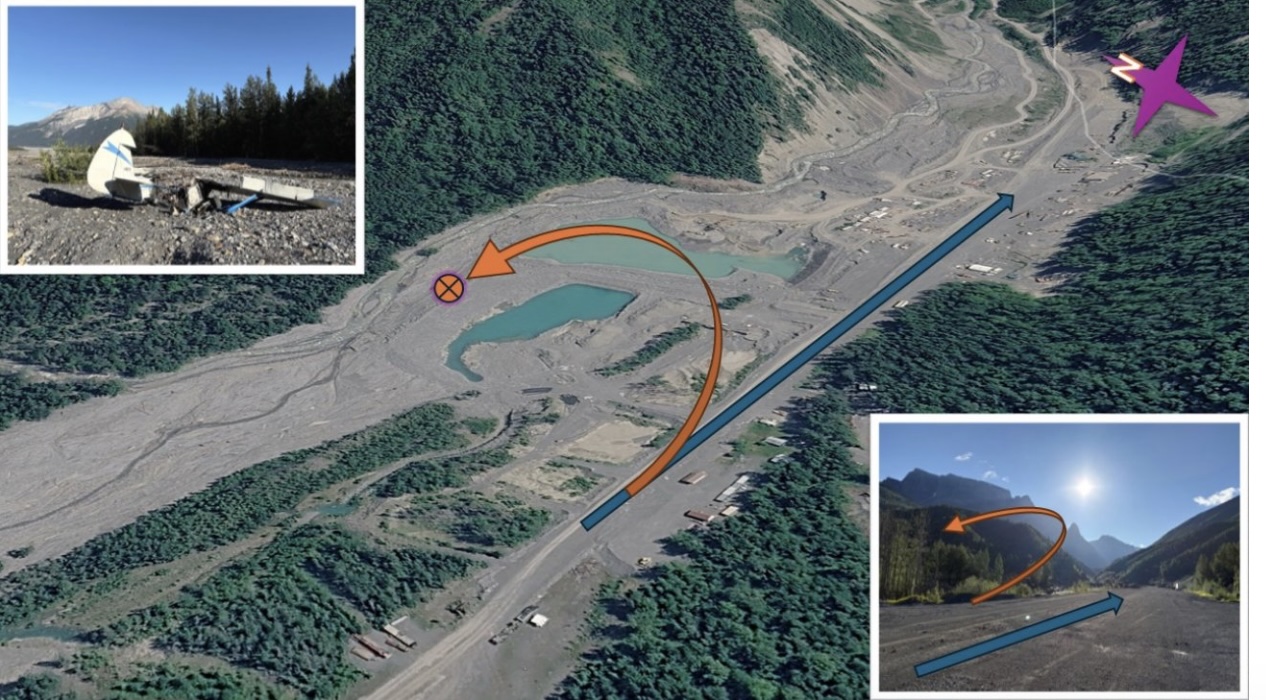
The airplane struck a berm on a rock-covered riverbank about 740 feet north of the airstrip. Investigators found the aircraft in a left-wing-low attitude, oriented toward the northwest.
The NTSB’s preliminary diagram shows the airplane approaching along the airstrip before turning left toward the riverbank where it crashed.
The impact bent the outer portion of the left wing downward and toward the rear. A post-crash fire consumed the fuselage, the inner portion of the left wing and parts of the right wing. Investigators said all four corners of the airplane were accounted for at the site.
The airplane, tail number N4535A, was listed by the NTSB as deregistered and was destroyed in the crash.
Investigators found no visible evidence of a problem with the flight-control system before impact. The fuel selector was set to the left tank, and 100-octane low-lead aviation fuel remained in that wing.
The throttle was found in the idle position and bent toward the pilot. Although witnesses reported hearing the engine briefly rise to high power, damage to the propeller indicated that it was turning at low power when the aircraft struck the berm. The blades showed damage to their leading-edge tips and chordwise witness marks.
Those findings do not by themselves establish what caused the crash or explain why the engine apparently returned to low power before impact.
The engine has been recovered and taken to a secure facility for a more detailed examination. The NTSB’s preliminary report documents the evidence collected so far but does not make a finding of probable cause. A final determination may take a year or longer.
The wreckage was discovered after Alaska State Troopers received a report of the crash at about 9:30 pm. Troopers reached the remote location aboard a state aircraft the following morning and found all three occupants dead.
The complete preliminary record is available through the NTSB investigation database.
Satellite messenger helps Alaska Air Guard rescue three after plane crash near Bettles
Eight killed in charter plane crash near remote western Alaska military radar site