


By SUZANNE DOWNING
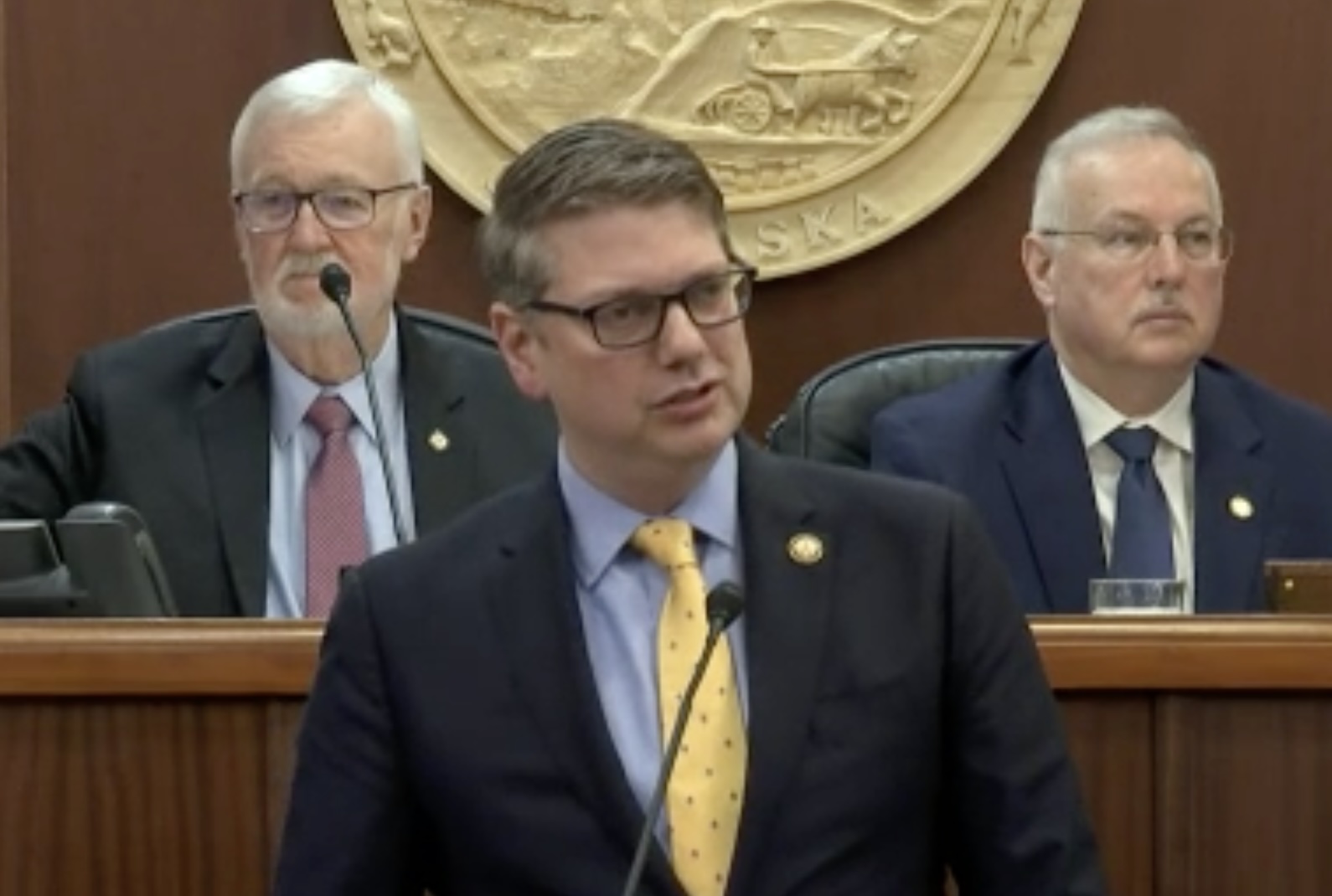
March 10, 2026 – Alaska Congressman Nick Begich III used his annual address to a joint session of the Alaska Legislature on Tuesday to deliver a message: The federal government, he said, is finally moving in Alaska’s direction, and now state lawmakers need to keep up.
Speaking to members of the House and Senate, Begich framed his first year in Congress as a record of legislative productivity and pointed out that Alaska is entering a rare window of opportunity for energy, resource development, infrastructure, and Arctic investment. He told lawmakers that “Alaskans expect results, not symbolic victories,” and said the “promise of Statehood,” including self-determination, resource development, and long-term prosperity, is now being delivered.
Begich’s speech was both a progress report and a challenge. His office has pushed bills through Congress at a record pace, highlighted measures involving Alaska Native settlement trusts, Native village lands, and Native veteran allotments, and he emphasized the durable wins written into law rather than temporary executive actions.
A major focus of the address was energy policy. Begich said Alaska has spent decades caught in a cycle of federal authorization and obstruction, particularly on Arctic National Wildlife Refuge, the National Petroleum Reserve-Alaska, and other resource-rich lands. He argued that congressional action over the past year has changed that by reopening acreage, restoring older management plans, and putting some of those changes into statute.
He pointed in particular to the upcoming federal lease sale in the NPRA as evidence that the new policy direction is already being implemented. In Begich’s telling, that shift means Alaska now has more certainty than it has had in years, which he said is essential to attracting the investment needed for jobs, infrastructure, and long-term population growth.
Begich turned his focus to the Alaska LNG project, describing it as the kind of generational decision that will define whether Alaska seizes or squanders the moment. He compared the opportunity to the boldness that built the trans-Alaska pipeline and warned lawmakers not to let process become paralysis. The federal path, he said, is “largely cleared,” but investors still need state-level certainty on taxes, royalties, and permitting.
“Scrutinize it carefully. Model it thoroughly. But do not become a roadblock,” he said.
Alaska LNG project making steady progress as key decisions take shape
That line captured the larger theme of the speech. Again and again, Begich argued that the Executive Branch has reduced barriers and that the next bottleneck is no longer federal resistance, but whether Alaska’s own political leaders will move quickly enough to match the moment.
He also called for state action on three fronts: fisheries accountability, workforce development, and Alaska LNG enabling legislation. On fisheries, he said the governor’s appointments to the North Pacific Fishery Management Council should better reflect the range of Alaska fishing interests. On workforce, he said Alaska needs more welders, pipefitters, equipment operators, and other skilled workers if it wants Alaskans — rather than Outside labor — to fill the jobs that come with major projects. And on LNG, he pressed lawmakers to provide the fiscal and regulatory clarity that project investors want to see.
Beyond development, Begich touched on a wide range of issues, including aviation safety, Coast Guard and Arctic defense investments, southern border security, fentanyl, and rural health care. He praised what he described as major federal investments in air traffic control modernization, missile defense, military readiness, and rural health access, while also arguing for lower taxes and more affordability for working families.
He also used part of the speech to highlight a new bill he introduced in Congress that would make the Alaska Permanent Fund dividend exempt from federal income tax. Begich said the PFD represents Alaska’s statehood compact and argued that Washington should not take a cut of money intended for Alaskans.
Begich’s remarks also included tributes and acknowledgments closer to home. Begich honored former legislator Craig Johnson, recognized the recent storm damage in Western Alaska, thanked members of Alaska’s congressional delegation, and congratulated several legislators on their new roles.
Still, the central political point of the address was unmistakable. Begich presented himself as a congressman delivering concrete federal victories and cast the Legislature as the body now being tested. “Alaska is unshackled,” he said near the end of the speech. “The obstacles are coming down. The permits are being approved. And we are ready to deliver.”
Whether lawmakers in Juneau agree with that framing, or with Begich’s heavy emphasis on oil, gas, mining, and large-scale development, remains to be seen. But his message to the Legislature was clear enough: Washington, for now, is opening doors for Alaska, and he expects the state to walk through them.
At the end of his remarks, most legislators stood to applause, with a handful just standing and one – Democrat Rep. Zack Fields – slouching in his chair, not participating in the applause. Others, such as Rep. Ashley Carrick, also remained seated, while others, like Rep. Sara Hannan, stood but kept her hands silent.
As the question-and-answer segment started, Senate President Gary Stevens first recognized Democrat Rep. Nellie Jimmie of Toksook Bay, who launched into a three-minute diatribe that she read aloud about the storm damage in Western Alaska, which “triggered the largest airlift in Alaskan history.” And then she continued to complain about the situation.





12 thoughts on “Nick Begich III tells Legislature the good news: Washington is getting out of the way of Alaska progress”
So damn proud of Nicholas, our fearless nephew. So damn proud!
I wish he’d run for governor, so I can vacation and live the rest of my life on the Begich Trust Fund. Then I can pal around on the beaches with Vern Murk and compare expense accounts.
Since pride is a sin I will not claim it. Rather, I am thankful for Nicholas. I am so thankful.
Mark, Tom. I may need a loan. Frankie is acting up again. And Princess is struggling at the polls. If RCV passes, I’m doomed in 2028. And too old to be stirring noodles in a food trailer.
There is Always been something that stood in the way of Alaska and Alaskans moving forward.
Don’t hold your breath about this body of legislators. They and their friends and supporters are government dependents. All of them. We have very government dependent state leaders. 90%of the legislature have never worked outside a job that wasn’t dependent on receiving government money to pay them. They don’t know any other kind of life outside of the government.
Tina your negativity and unfounded claims are tedious. In this comment, you castigate government employees without the restraint and accountability you should have as an Alaskan citizen. There are elected and appointed dooshbags to be sure, but when the power goes out and comes back on 20 minutes later, and you don’t get sick after eating a burger at the Spenard Buckaroo Club and after you’ve been T-boned by a drunk driver and suffered serious injuries but got instant EMS response , all this good stuff is because of paying taxes. It’s how responsible citizens coexist with each other.
Taxes keep the power on, cook food, and allow drunks to drive around recklessly t-boning other cars? Who knew, thanks for the civics lesson Evan!
Whoosh
Look at what Nick Begich 111 has done in just one year and compare it to what Mary Peltola did during her miserable 2 years. Does anybody out there think we want 6 years of her as a senator??? She’s a ding dong do nothing.
In my older age i kind of enjoy correcting Alaskans who are so quick to judge who they been brought to believe who is a government dependent as a person collecting welfare. Yes they are a government dependent. However the person who is the bigger government dependent is someone whose paychecks including benefits are coming through the government. They government dependent employee is a bigger welfare queen than the one collecting public assistance to which public assistance is chump change compared to what it costs on the taxpayer to pay a government dependent employee. They don’t know reminder to others i meet shuts them up about complaining about those receiving public assistance which is hardly anything compared to one being a public employee, a capital worker, non profit employee of a non profit dependent on multi million grants, education or health care worker.
There is a resource development window open to Alaskans that very possibly could close this November 3. The gas line and LNG export are essential to our economy. That project had better have 1,000 workers on the job this construction season (2,000 would be far better), and the Ambler Road had better have at least 500 or those developments will go seriously sideways if the election brings a change of party in Congress – at best postponed for years. The climate change crowd in Congress and in the AK Legislature, and within the laity encompassed by ISER, ADF&G, and uncounted NGO’s are quiet now but they haven’t gone anywhere.
Now we just need to get Juneau out of the way of Alaskan development. The worst obstacle isn’t on the Potomac anymore. It’s creatures like The Giessel, who clearly oppose even the idea of anyone but themselves prospering in any way