



By SUZANNE DOWNING
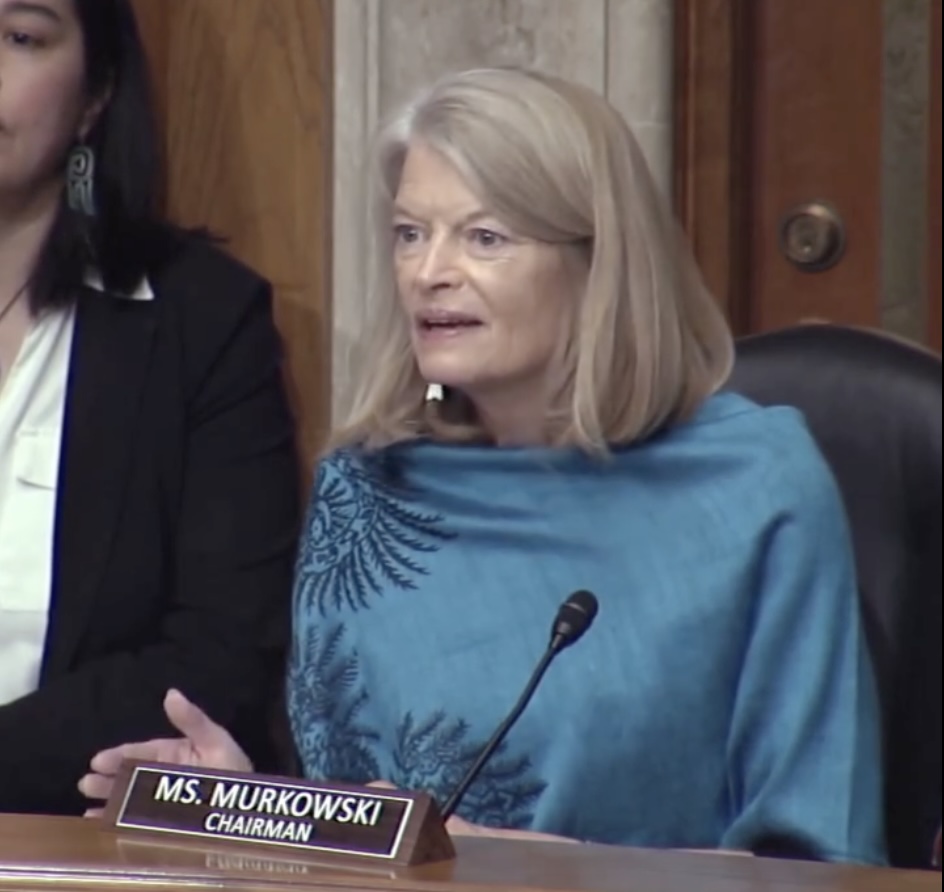
Feb. 16, 2026 – Sen. Lisa Murkowski has pushed back against characterizations that the Small Business Administration’s 8(a) Business Development Program is a Diversity, Equity, and Inclusion (DEI) initiative, saying the program instead fulfills a constitutional and federal trust responsibility to Native communities.
“As Chairman of the Senate Committee on Indian Affairs, I recently held a hearing on the SBA’s 8(a) Business Development Program — a program designed to help Native communities thrive,” Murkowski said in a statement. “This isn’t about DEI; it’s Congress fulfilling its constitutional duties and federal trust responsibility to Native peoples.”
The Alaska Republican, whose committee has jurisdiction over federal Indian policy, said Native-owned 8(a) participants reinvest their earnings in their communities, “practicing economic self-determination and building stronger futures for generations to come.” Murkowski described the program’s structure as intentionally transparent and community-accountable, asserting that design “was the right call — both for Native communities, and for their partners in the federal government.”
But Murkowski’s defense comes as the Trump Administration intensifies its review and overhaul of the 8(a) program, which critics have increasingly labeled as a form of race-based contracting akin to modern DEI initiatives.
The SBA’s 8(a) Business Development Program, established under the Small Business Act (Sections 7(j) and 8(a)), provides federal contracting assistance, development support, and training to small businesses owned and controlled by individuals who are “socially and economically disadvantaged.”
Official SBA descriptions do not classify 8(a) as a DEI program. Instead, the agency frames it as a statutory tool for business development and procurement assistance targeted at disadvantaged firms.
Certain groups, including Black Americans, Hispanic Americans, Native Americans, Asian Pacific Americans, and Subcontinent Asian Americans, have historically benefited from a rebuttable presumption of social disadvantage based on long-standing SBA regulations.
That structure has led some lawmakers like Murkowski to defend the Alaska Native-owned companies that have used 8(a) revenue to fund community services and infrastructure.
Others, such as Secretary of War Pete Hegseth describe 8(a) as having “morphed into swamp code words for DEI, race-based contracting.”
In January, the administration issued guidance aimed at making the program race-neutral, eliminating race-based presumptions of social disadvantage that were deemed unconstitutional by administration lawyers, and ending practices such as “social disadvantage narratives.” Officials have argued that federal contracting should be open to all races without preferential treatment and have linked reforms to broader efforts to end DEI policies across the federal government.
The administration’s reforms include auditing existing participants for compliance and potential fraud, suspending some contracts, and restructuring eligibility criteria to emphasize neutral measures of disadvantage.
Administration allies have characterized these changes as eliminating “wasteful DEI contracts” and ensuring fairness in federal procurement.
Murkowski’s championing of the program is on one side of a divide between lawmakers who view the program as essential to economic self-determination for Native communities and Americans who see any race-linked criteria as inconsistent with current policy priorities.




6 thoughts on “Murkowski defends SBA 8(a) program against DEI criticism as Trump Administration moves to reform”
Always-Wrong Sockeye Lisa, predictably taking the anti-justice, anti-common sense, anti-logical, anti-right, anti-freedom position yet again.
.
PS: Is that her death shroud she is wearing there, dare we hope? Her mummification process appears to be advancing well, in any event.
In 2024 Alaska Business Magazine 9 of the top 10 Alaskan businesses were Native Corporations with revenue from $775,000,000.00 up to $5,000,000,000.00 Lynden was the only corporation that wasn’t a Native corporation in the top 10. How are corporations with annual revenue greater than 3/4 of a BILLION dollars and up to 5 BILLION dollars involved in the Small Business Administration, let alone in their program for the “socially and economically disadvantaged”? It would take my small business thousands to tens of thousands of years to equal one years revenue of these small businesses that are apparently “socially and economically disadvantaged.”
Pandering to her pet Native voters again
Oh look! Ahtna will be getting free money:
https://thealaskastory.com/ahtna-subsidiaries-chosen-for-defense-contract-eligibility-for-golden-dome/
Lisa Murkowski is a dedicated Democrat…No ethics, no morals! A liar and traitor! Other than that, she’s ok.
Interesting articles in revolver and daily wire about 8a native program (including defense contracts) supported by the princess and who really benefits. Turns out a lot live in, operate out of Virginia.