
By KEVIN CLARKSON
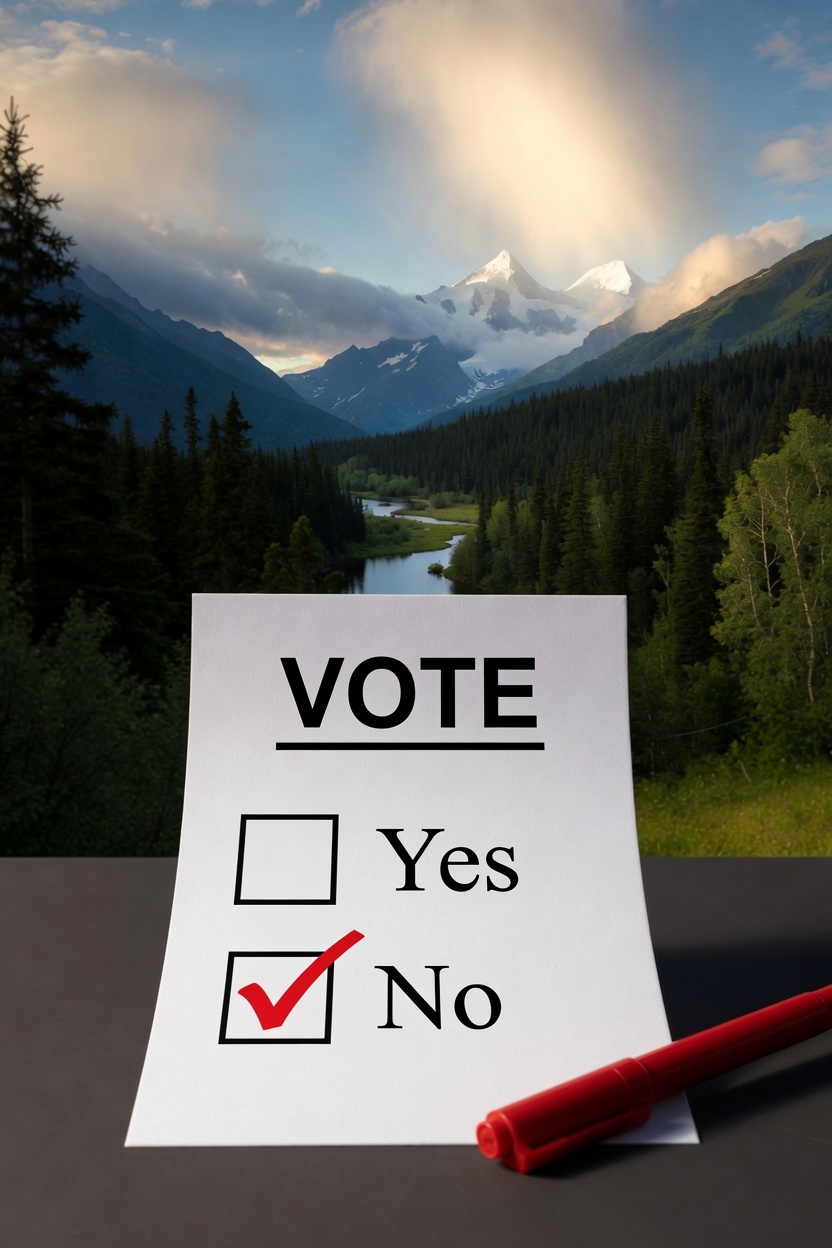
Aug. 4, 2026 – Ballot Measure 1 that will appear on Alaska’s upcoming ballot proposes campaign contribution limits that are most likely unconstitutional. Ballot Measure 1 seeks to reestablish campaign contribution limits in Alaska-limits on how much you can contribute to a candidate’s campaign.
Why is this an issue now? Well, because presently Alaska has no limit on how much a person can contribute to a candidate’s campaign. After the United States Supreme Court reversed aberrant Ninth Circuit precedent regarding campaign contribution limits in a case called Thompson v. Hebdon, the Ninth Circuit on remand in that same case struck down Alaska’s prior $500 per year contribution limit as unconstitutionally low.
I am intimately aware of that case and these issues because I was the attorney that filed and litigated the Thompson case through the district court and the first Ninth Circuit appeal before I became Alaska’s Attorney General.
Here’s the history. From statehood in 1959 to 1974, Alaska had no limits on campaign contributions. After 2010, due to a U.S. Supreme Court ruling in a case called Citizen’s United, people could give unlimited amounts to Independent Expenditure groups (IEs or think Political Action Committees (PACs) for simplification) and no limit could be placed on what IEs/PACs could spend in support of candidates.
From about 1996 to 2003, and then from 2006 to 2021, Alaska limited what people could give to candidates or groups of their choice to the basement level of $500 per year. Then from 2021 to present, because the U.S. Supreme Court reversed the lower court decisions that had upheld Alaska’s basement level contribution limits and then on remand the Ninth Circuit had struck down Alaska’s limits as unconstitutional, Alaska once again had no limits on what individuals could donate to the campaigns of the candidates of their choice. The lack of limits put individual Alaskans on par with what IEs and PACs could do.
What is the law on campaign contribution limits? Well, start with the importance of the right at stake. According to U.S. Supreme Court precedent, there is no right more basic in our democracy than the right to participate in electing political leaders.
The First Amendment safeguards an individual’s right to participate in public debate through political expression and political association. One way in which citizens can exercise those rights is to “contribute to a candidate’s campaign.” Thus, the right to make political contributions is protected by the First Amendment. When an individual contributes money to a candidate, he exercises both the right to political expression and the right to political association: “The contribution ‘serves as a general expression of support for the candidate and his views’ and ‘serves to affiliate a person with a candidate.’”
Because contributing to a campaign implicates First Amendment rights, the U.S. Supreme Court has limited what campaign contribution limits may seek to accomplish. Government may only restrict campaign contributions to prevent quid pro quo corruption or its appearance. The Latin phrase quid pro quo “captures the notion of a direct exchange of an official act for money.” The basest form of quid pro quocorruption is a bribe—a bribe requires an agreement to exercise specific formal governmental power, or to make an official decision regarding a specific matter then pending, in exchange for personal gain. Contribution limitations that pursue objectives other than preventing quid pro quo corruption or its appearance “impermissibly inject the Government ‘into the debate over who should govern.’”
The Supreme Court has plainly identified what sorts of things are illegitimate purposes for limiting campaign contributions. Things such as access, influence, and responsiveness from an elected official to a campaign contributor, are not corruption. Influence that a campaign contributor may have on a candidate, and favoritism that a candidate may show to his campaign’s supporters—whether voters or financial contributors—is not corruption.
“The fact that [contributor]s may have influence over or access to elected officials does not mean that these officials are corrupt.”
Government may not target the general gratitude a candidate feels toward those who support him, or the political access such support may afford. Government also may not seek to limit the appearance of mere influence over or access to elected officials. Further, government may not regulate contributions simply to reduce the amount of money in politics. Lower limits are not always better or constitutionally permissible.
According to the Supreme Court the hallmark of corruption is the financial quid pro quo: dollars for political favors. And to be “corrupt,” the political favor must encompass a specific “official act,” i.e., a formal exercise of governmental power or an official decision regarding a specific matter then pending in exchange for personal gain. It is not corrupt for a government official to be influenced by—listen and respond to—those who support him, even those who legally make maximum contributions to his or her campaign.
Moreover, “[s]pending large sums of money in connection with elections, but not in connection with an effort to control the exercise of an officeholder’s official duties, does not give rise to quid pro quo corruption.” And, the Court has held that “the possibility that an individual who spends large sums may garner ‘influence over or access to’ elected officials or political parties” is also not corruption that can justify a limit. In Justice Kennedy’s words:
“There is no basis, in law or in fact, to say favoritism or influence in general is the same as corrupt favoritism or influence in particular. . . . Favoritism and influence are not . . . avoidable in representative politics. It is in the nature of an elected representative to favor certain policies, and by necessary corollary, to favor the voters and contributors who support those policies.”
In a case called Randall v. Sorrell (decided in 2006), the U.S. Supreme Court held that there are certain “danger signs” that indicate a contribution limit is too low and thus unconstitutional. Those five danger signs are that the limit is:
1. Set per-election cycle rather than per election;
2. Lower than the limits the Supreme Court upheld in a case called Buckley v. Valeo;
3. Lower than comparable limits in other states and lowest or among the lowest in the Nation;
4. Below the lowest limit the Supreme Court has previously upheld; and
5. Are not adjusted for inflation.
How does Ballot Measure 1 measure up? Well, let’s start with its stated purposes which do not measure up to constitutional standards. The Measure states in its “Findings and Intent” that “political power and influence with public officials should not be allocated solely based on wealth.” The Measure’s focus on the “power” and “influence” that come from the ability to make greater contributions to candidates are not legitimate constitutional purposes for restricting campaign contributions.
The Measure’s statement that contribution limits are necessary to “secure equal rights for Alaskans” is also illegitimate. The US Supreme Court has specifically ruled that government may not try to “level the playing field” for candidates or contributors, or “level electoral opportunities,” or “equalize[e] the financial resources of candidates.” So, Ballot Measure 1 starts out on the wrong foot.
Then looking at the specific Randall warning signs, Ballot Measure 1 fails again.
Strike number one. The Ballot Measure 1 limit of $2,000 is a per cycle limit that the Supreme Court has previously frowned upon. In elections there is a primary and a general election and these two elections combined comprise the election cycle. A per election limit can be given for both the primary and the general elections. A per cycle limit is a cap on contributions for the entire cycle regardless of during which election period it is given (primary or general). Thus, the Ballot Measure 1 per cycle limit can be thought of as effectively representing an average of 1/2 the limit ($1,000) for the primary and 1/2 the limit ($1,000) for the general. In any event, the per cycle limit of Ballot Measure 1 triggers the first danger sign.
Strike number 2. The Ballot Measure 1 limit is effectively much lower than the limit the U.S. Supreme Court upheld in a case called Buckley v. Valeo (1976). The $1,000 limit that was approved in Buckley was a per election limit. The $1,000 amount that the Court found created no risk or appearance of corruption in 1976, when adjusted for inflation to 2026, is now equal to $5,869.10 per election, or $11,738.20 per cycle.
The $2,000 limit stated in Ballot Measure 1 might at first glance appear greater than the $1,000 limit approved by the Court in Buckley, but appearances are deceiving. The limit that Ballot Measure 1 proposes ($2,000 per cycle or an average of $1,000 per election) represents only 17% of the raw value of the per-election limit the Court approved in Buckley when adjusted for inflation. The math is simple: $1,000 in 1976 is equivalent to $5,869.10 in 2026 and $1,000 represents only 17% of $5,869.10. And the result is exactly the same when you compare the Buckley limit to Ballot Measure 1’s proposed limit on a per cycle basis: $2,000 represents only $17% of $11,738.20. Either way you look at it (per election or per cycle), Ballot Measure 1 is proposing a contribution limit that is effectively only $17% of the limit that the Court approved in Buckley.
And think of this comparison—the Ballot Measure 1 limit of $2,000 per cycle represents only 28% of the $7,000 per cycle limit for contributions to Alaska’s candidates for federal office. In 2026 there is a $3,500 per election contribution limit that applies to Alaska’s federal elections—U.S. Senate and House of Representatives. Federal elections in Alaska involve the exact same statewide voter base as Alaska’s state elections.
In 2026, the amount that an individual can contribute to a candidate for federal office (think Senator Dan Sullivan, Rep. Nick Begich, or Mary Peltola) is $3,500 per election. Because the primary and general elections count as separate elections, individuals may give $7,000 per federal candidate per cycle in Alaska.
And the Ballot Measure 1 limit, that could potentially be given only for any one election in the election cycle (primary or general), represents only 57% of the federal per election limit. Because statewide elections in Alaska, whether the election is for federal or state office, are effectively the same from a campaign finance standpoint (candidates have to campaign from Barrow/Utqiaġvik in the north to Ketchikan in the south), there is no possible justification for such a comparatively smaller state contribution limit.
The fact that Ballot Measure 1 would allow a contributor to give $4,000 per cycle to a combined gubernatorial campaign ($2,000 each for a combined campaign of two candidates, one running for governor and one running for lieutenant governor) does not appreciably change the comparisons. The limit that Ballot Measure 1 proposes in the case of a combined Gov./Lt. Gov campaign ($4,000 per cycle or an average of $2,000 per election) still represents only 17% of the raw value of the per-election limit the Court approved in Buckley when adjusted for inflation even if that limit were doubled for a combined campaign. Doubling the Buckley limit in 1976 to $2,000 per election for a combined campaign (thus $4,000 per cycle) results in an effective 2026 per election limit of $11,738.21 or $23,476.41 per cycle. A $4,000 contribution to a combined campaign in 2026 would still represent only 17% of the effective value of permissible contribution back in 1976.
Strike number 3. Ballot Measure 1 proposes a limit that would be one of the six lowest in the nation for statewide races. Only five states—Colorado, Delaware, Massachusetts, Montana, and Rhode Island—have contribution limits for statewide offices that are equal to or lower than Ballot Measure 1’s proposed limit. See the chart provided by Ballotpedia at this link.
Strike number 4. Ballot Measure 1’s limit of $2,000 per cycle (an average of $1,000 per election) is below the lowest statewide limit the Supreme Court has previously upheld. The lowest limit the Court has ever upheld is the $1,075 per-election limit that the Court upheld in a case called Nixon v. Shrink Missouri Gov’t PAC in 2000. The Nixon $1,075 limit was a per election limit and thus a $2,150 per cycle limit. Ballot Measure 1’s proposed limit has a value of only $1,031 when adjusted back to the value of dollars in 2000.
In fact, the Ballot Measure 1 proposed limit is dangerously comparable to the per-cycle limits the Court struck down in Randall. Vermont’s limits in 2006 were $400 per cycle statewide. Ballot Measure 1’s proposed limit for 2026 would represent only $603.68 per election and $1,207.36 per cycle when adjusted back to 2006 dollars. Alaska’s statewide population is only slightly greater than Vermont’s.
Strike number 5. Ballot Measure 1 proposes to adjust the contribution limit for inflation only once every 10 years (once a decade) and for the first time not until 2031 (that would be 5 years after adoption if Ballot Measure 1 passes). By comparison federal election contribution limits are adjusted for inflation every 2 years. Waiting a decade to adjust the contribution limit for inflation will cause the value of contributions to shrink in effective value to candidates and campaigns for 9 years before an adjustment is made.
Inflation is real and it would have a significant impact on the value of contributions long before a decade has passed. For example, to equal the effective value that a $2,000 contribution you made ten years ago to a candidate in 2016, you would have to donate that same candidate $2,782.85 in 2026.
Ballot Measure 1 proposes a law that is likely destined for the dustbin of unconstitutionality.
Am I saying that this is certain? No, just that it is likely. Voters should take that into consideration when deciding how to vote on the proposition.
Kevin Clarkson writes under the pseudonym K.C. Gilbert at Substack at this link.

10 thoughts on “Kevin Clarkson: Ballot Measure 1 in the Alaska primary election is likely unconstitutional”
Exactly. Thank you for writing this. My only question is, why did Dahlstrom allow it on the ballot?
Exactly! Why is this ballot measure on the Primary ticket? Hasn’t the Primary election always been to select candidates to go on to the General Election? This ballot measure on the Primary ticket is unprecedented. It’s like someone has something up their sleeve that they want to play as soon as the Primary election is over.
It was allowed on the ballot because … unfortunately … the Alaska Supreme Court has ruled that likely unconstitutionality is not a valid reason to keep a proposition off the ballot. Unless the measure is “clearly unconstitutional” a standard that requires virtual certainty of unconstitutionality (like proposing a measure for Alaska to secede from the Union). Dahlstrom had no choice.
Interesting article, quip pro quo is certainly an important part of unlimited contributions.
It’ll likely narrowly pass just as ballot measure two. Attorneys can at least get a head start preparing the lawsuit to eventually end up at the US Supreme Court once again
Alaskans are still not yet smart enough to know any better
How narrowly this article defines quid pro quo as related to unlimited contributions. It’s a perverse definition by the SCOTUS to rule that unlimited contributions are protected by the 1st amendment unless there is such an explicit quid pro quo corruption. They are looking the other way on how this type of corruption has always worked in politics.
Completely agree it is unconstitutional. Also agree that the Alaska Supreme Court will uphold it, punting the argument into federal court where it will lose.
You guys do know that democrat unions aren’t the only entities that can set up election PACs, right? What makes you think that conservatives can’t play too?
Final note: You are aware that Elon Musk has more $$$ than Soros and will be participating in this election cycle in support of Republicans. Cheers –
Lawsuit coming if it passes. You hear that Republicans? No sitting on your butts. DO IT.
Did the Lt Governor run this ballot measure through the Department of Law? What was their response/input? Or were the SCOTUS’ decisions merely disregarded by the liberal lawyers? Suzanne, get a copy of the memos between the Lt Gov and the Department of Law.
Why would the left/democrats push this initiative? A distraction from the real threat to democrat power of the repeal of ranked choice voting in November? Force the right to spend time/energy/money trying to defend against yet another left wing initiative from Kendall & crowd? This is Rep Schragge’s bill, the democrat who fakes being independent (along with other democrat legislators over the last few years). D’s are desperate to slap restrictions on citizen donations because that is where right of center candidates get most of their funding from. The D’s get a great deal of their money through/from unions, PAC’s and IE’s (although the IE’s are hidden since they do their work without “overt” coordination with the campaigns they are supporting or opposing). Those groups aren’t affected by this initiative, they still get all the money advantage just like certain groups still get all the dark money they want after the installation of ranked choice voting in 2020. Because the lie was the RCV initiative would remove dark money except…it doesn’t. From my view, this isn’t about preventing money influencing politics at all, it’s about creating an uneven advantageous playing field for one side of the political aisle.
Another interesting side note from this article. Mr Clarkson discusses the quid pro quo and what can be illegal. I did a quick AI search and its a felony in Alaska statutes and obviously federal law. It reminds me of a previous hot topic in Alaska of this so called binding caucus the Alaska legislature uses, which I would think falls squarely into that bucket of promising things of value (power, money, votes, positions/chairmanships, etc). How has this not become a criminal matter? Why hasn’t the department of law taken up the task of cleaning up that level of corruption in the legislature? Why haven’t the feds looked into the corrupt practices of the AK legislature forcing elected officials to promise their votes in advance for things of value like chairmanships, control over money, etc.?