By SUZANNE DOWNING
One of the astronauts set to circle the Moon on NASA’s historic Artemis II mission in early 2026 once lived and worked in Utqiagvik. It was from Alaska’s north coast that she submitted the application that ultimately launched her spaceflight career.
Christina Koch, a mission specialist on Artemis II, was a field engineer in 2012 at NOAA’s Atmospheric Baseline Observatory outside Utqiaġvik. The remote facility, located about five miles northeast of town near the Arctic Ocean, is one of the world’s most remote sites for long-term monitoring of atmospheric gases, aerosols, and climate data.
Koch’s job in Barrow involved maintaining and operating sensitive scientific instruments in extreme cold, long periods of isolation, and harsh weather, conditions that mirror many of the physical and psychological challenges of spaceflight. While stationed on Alaska’s North Slope, she submitted her application to NASA’s astronaut corps online.
She has since joked that she never expected to hear back from more than 500 miles north of the Arctic Circle. Yet, the following year, in 2013, Koch was selected as part of NASA’s Astronaut Group 21.
That decision set in motion a career that would make spaceflight history. Koch later served as a flight engineer aboard the International Space Station during Expeditions 59, 60, and 61, spending a record-setting 328 consecutive days in space. That was the longest single continuous spaceflight by a woman at the time.
NASA has consistently cited Koch’s Arctic and Antarctic fieldwork as foundational preparation for her success in space. Before Alaska, she spent years working in Antarctica and Greenland, including a winter-over season at the Amundsen–Scott South Pole Station, where temperatures plunged to minus 111 degrees Fahrenheit and crews endured months without sunlight, resupply, or outside contact.
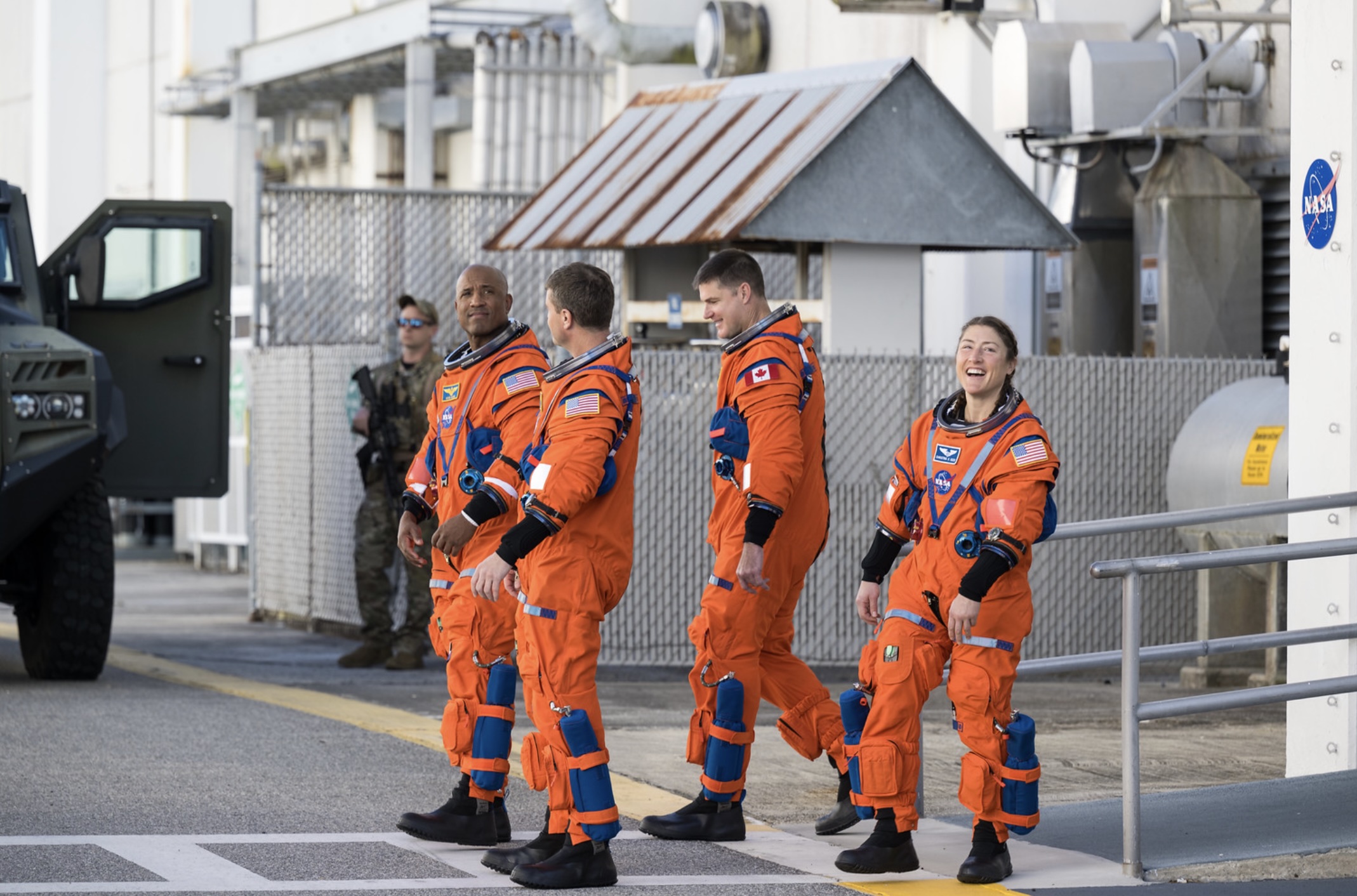
Now, Koch is part of the four-person crew selected to fly Artemis II, NASA’s first crewed mission of the Artemis program and the first human flight beyond low Earth orbit since Apollo. The mission will send astronauts on a multi-day journey around the Moon aboard NASA’s Orion spacecraft, testing systems needed for future lunar landings and, eventually, crewed missions to Mars.
The Artemis II crew includes NASA astronauts Reid Wiseman, the mission commander; Victor Glover, the pilot; Koch, as mission specialist; and Canadian Space Agency astronaut Jeremy Hansen, also a mission specialist. On Dec. 20, the crew took part in a full countdown demonstration test at NASA’s Kennedy Space Center in Florida, rehearsing launch-day procedures inside the Vehicle Assembly Building while final preparations continue on the Space Launch System rocket and Orion spacecraft.
The first crewed flight to the Moon, the Artemis II mission is currently targeting a launch window of between February and April 2026.
If the mission proceeds as planned in 2026, Koch will become the first woman to travel beyond low Earth orbit, a milestone that traces back, in part, to a decision she made nearly 15 years earlier in Alaska’s northernmost community.
Born in Michigan in 1979, and raised in North Carolina, Koch earned degrees in electrical engineering and physics before building a career in space science instrumentation, field engineering, and extreme-environment research. She lives with her husband in Texas now, but her biography is a reminder that even from Utqiaġvik it is possible to set a course for the Moon.